Renner Susanne S, Schaefer Hanno, Kocyan Alexander
Department of Biology, University of Munich, Munich, Germany.
BMC Evol Biol. 2007 Apr 10;7:58. doi: 10.1186/1471-2148-7-58.
Melon, Cucumis melo, and cucumber, C. sativus, are among the most widely cultivated crops worldwide. Cucumis, as traditionally conceived, is geographically centered in Africa, with C. sativus and C. hystrix thought to be the only Cucumis species in Asia. This taxonomy forms the basis for all ongoing Cucumis breeding and genomics efforts. We tested relationships among Cucumis and related genera based on DNA sequences from chloroplast gene, intron, and spacer regions (rbcL, matK, rpl20-rps12, trnL, and trnL-F), adding nuclear internal transcribed spacer sequences to resolve relationships within Cucumis.
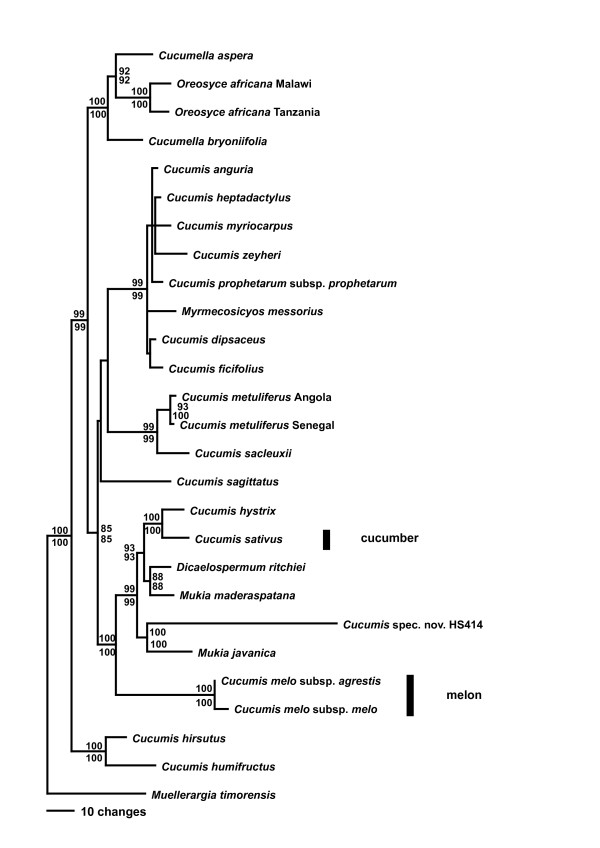
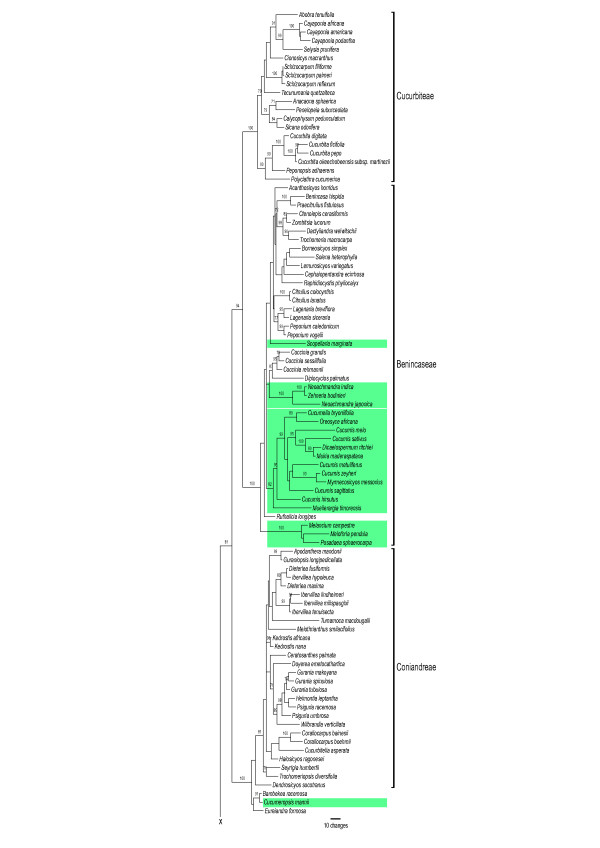
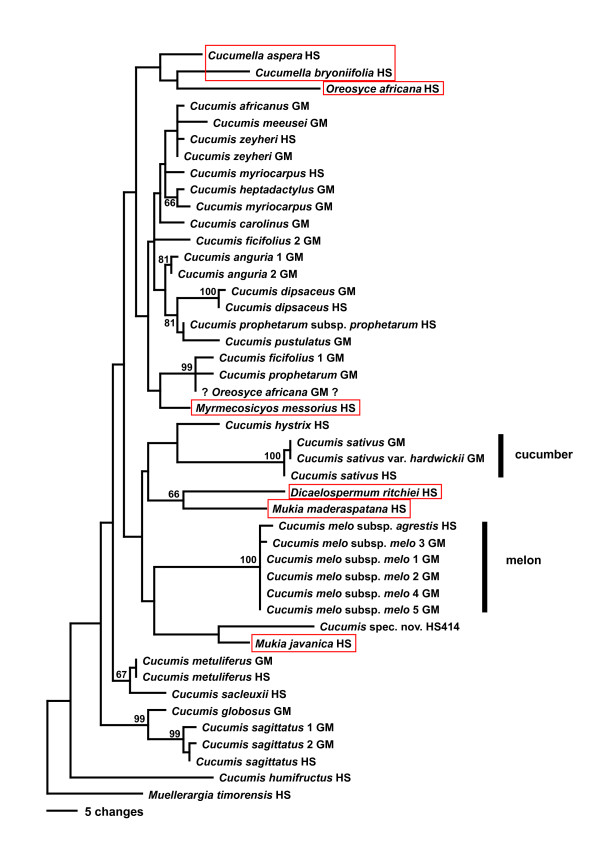
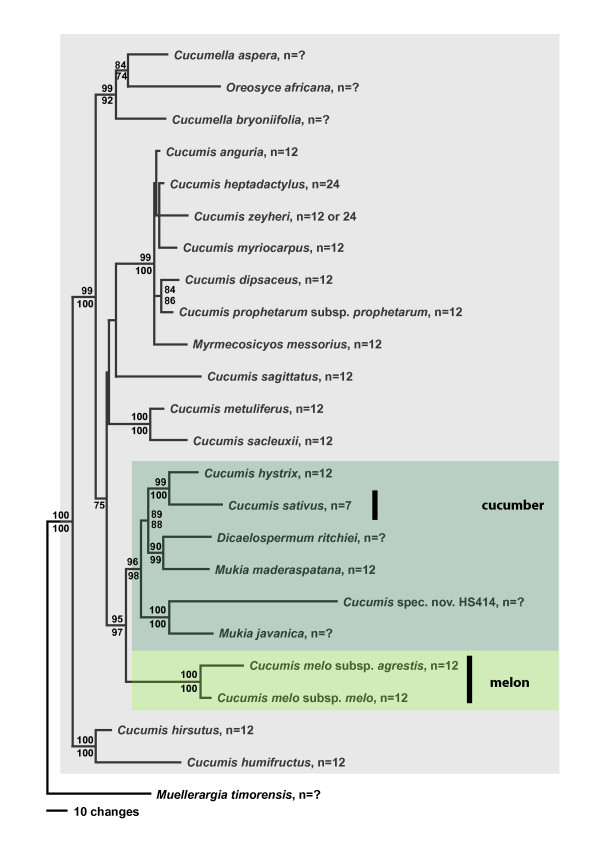
Analyses of combined chloroplast sequences (4,375 aligned nucleotides) for 123 of the 130 genera of Cucurbitaceae indicate that the genera Cucumella, Dicaelospermum, Mukia, Myrmecosicyos, and Oreosyce are embedded within Cucumis. Phylogenetic trees from nuclear sequences for these taxa are congruent, and the combined data yield a well-supported phylogeny. The nesting of the five genera in Cucumis greatly changes the natural geographic range of the genus, extending it throughout the Malesian region and into Australia. The closest relative of Cucumis is Muellerargia, with one species in Australia and Indonesia, the other in Madagascar. Cucumber and its sister species, C. hystrix, are nested among Australian, Malaysian, and Western Indian species placed in Mukia or Dicaelospermum and in one case not yet formally described. Cucumis melo is sister to this Australian/Asian clade, rather than being close to African species as previously thought. Molecular clocks indicate that the deepest divergences in Cucumis, including the split between C. melo and its Australian/Asian sister clade, go back to the mid-Eocene.
Based on congruent nuclear and chloroplast phylogenies we conclude that Cucumis comprises an old Australian/Asian component that was heretofore unsuspected. Cucumis sativus evolved within this Australian/Asian clade and is phylogenetically far more distant from C. melo than implied by the current morphological classification.
甜瓜(Cucumis melo)和黄瓜(C. sativus)是全球种植最广泛的作物之一。传统上认为,黄瓜属在地理上以非洲为中心,而黄瓜(C. sativus)和糙果黄瓜(C. hystrix)被认为是亚洲仅有的黄瓜属物种。这一分类法构成了所有正在进行的黄瓜属育种和基因组学研究的基础。我们基于叶绿体基因、内含子和间隔区(rbcL、matK、rpl20 - rps12、trnL和trnL - F)的DNA序列测试了黄瓜属及相关属之间的关系,并添加了核内转录间隔区序列以解析黄瓜属内的关系。
对葫芦科130个属中的123个属的叶绿体序列组合(4375个比对核苷酸)分析表明,Cucumella、Dicaelospermum、Mukia、Myrmecosicyos和Oreosyce属嵌套在黄瓜属内。这些类群的核序列系统发育树是一致的,并且组合数据产生了一个得到充分支持的系统发育关系。这五个属在黄瓜属中的嵌套极大地改变了该属的自然地理范围,将其扩展到整个马来群岛地区并延伸至澳大利亚。黄瓜属最亲近的亲属是Muellerargia,其中一个物种分布在澳大利亚和印度尼西亚,另一个在马达加斯加。黄瓜及其姊妹种糙果黄瓜嵌套在置于Mukia或Dicaelospermum属的澳大利亚、马来西亚和西印度物种之中,还有一个尚未正式描述。甜瓜是这个澳大利亚/亚洲分支的姊妹种,而不是像之前认为的那样与非洲物种关系密切。分子钟表明,黄瓜属中最古老的分歧,包括甜瓜与其澳大利亚/亚洲姊妹分支之间的分化,可以追溯到始新世中期。
基于一致的核和叶绿体系统发育关系,我们得出结论,黄瓜属包含一个此前未被怀疑的古老的澳大利亚/亚洲成分。黄瓜在这个澳大利亚/亚洲分支内进化,并且在系统发育上与甜瓜的距离比当前形态分类所暗示的要远得多。