Tatem Andrew J, Hay Simon I
Spatial Ecology and Epidemiology Group, Tinbergen Building, Department of Zoology, University of Oxford, South Parks Road, Oxford OX1 3PS, UK.
Proc Biol Sci. 2007 Jun 22;274(1617):1489-96. doi: 10.1098/rspb.2007.0148.
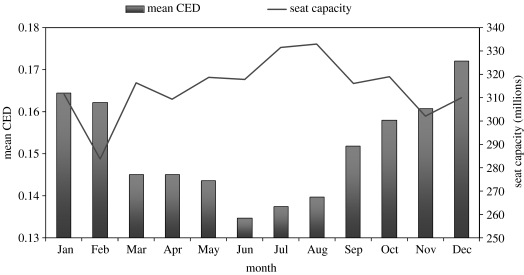
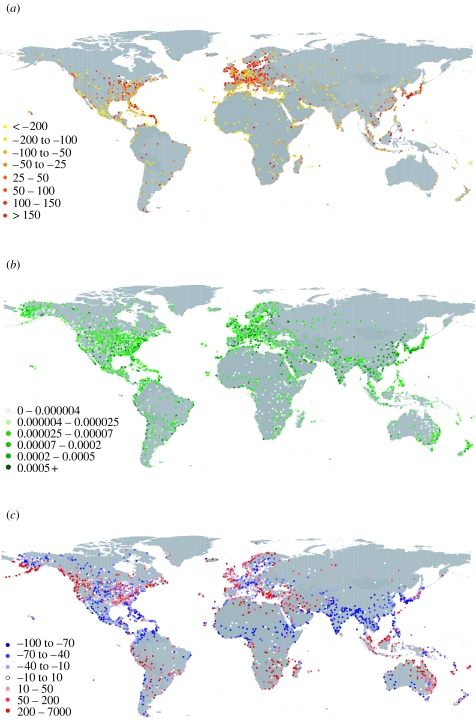
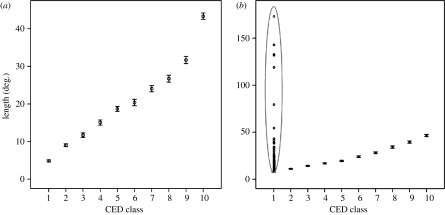
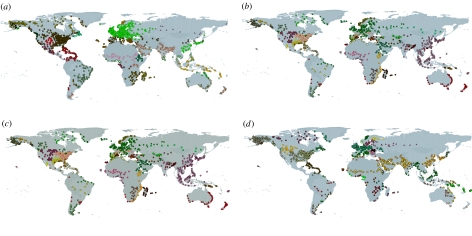
Recent increases in the rates of biological invasion and spread of infectious diseases have been linked to the continued expansion of the worldwide airline transportation network (WAN). Here, the global structure of the WAN is analysed in terms of climatic similarity to illuminate the risk of deliberate or accidental movements of climatically sensitive organisms around the world. From over 44,000 flight routes, we show, for each month of an average year, (i) those scheduled routes that link the most spatially distant but climatically similar airports, (ii) the climatically best-connected airports, and (iii) clusters of airports with similar climatic features. The way in which traffic volumes alter these findings is also examined. Climatic similarity across the WAN is skewed (most geographically close airports are climatically similar) but heavy-tailed (there are considerable numbers of geographically distant but climatically similar airports), with climate similarity highest in the June-August period, matching the annual peak in air traffic. Climatically matched, geographically distant airports form subnetworks within the WAN that change throughout the year. Further, the incorporation of passenger and freight traffic data highlight at greater risk of invasion those airports that are climatically well connected by numerous high capacity routes.
近期生物入侵和传染病传播速度的增加与全球航空运输网络(WAN)的持续扩张有关。在此,从气候相似性的角度分析了WAN的全球结构,以阐明对气候敏感的生物在全球范围内有意或无意移动的风险。从超过44000条航线中,我们展示了平均一年中每个月的情况:(i)连接空间距离最远但气候相似的机场的定期航线;(ii)气候连接性最佳的机场;(iii)具有相似气候特征的机场集群。还研究了交通流量如何改变这些结果。WAN上的气候相似性呈偏态分布(大多数地理位置相近的机场气候相似)但具有重尾特征(存在相当数量地理位置遥远但气候相似的机场),气候相似性在6月至8月期间最高,与航空交通的年度峰值相匹配。气候匹配、地理位置遥远的机场在WAN内形成子网,且全年都会变化。此外,纳入客运和货运交通数据凸显了那些通过众多高容量航线实现良好气候连接的机场面临更大的入侵风险。