Chen Ting, Muratore Tara L, Schaner-Tooley Christine E, Shabanowitz Jeffrey, Hunt Donald F, Macara Ian G
Department of Microbiology, Center for Cell Signaling, University of Virginia School of Medicine University of Virginia, Charlottesville, VA 22908-0577, USA.
Nat Cell Biol. 2007 May;9(5):596-603. doi: 10.1038/ncb1572. Epub 2007 Apr 15.
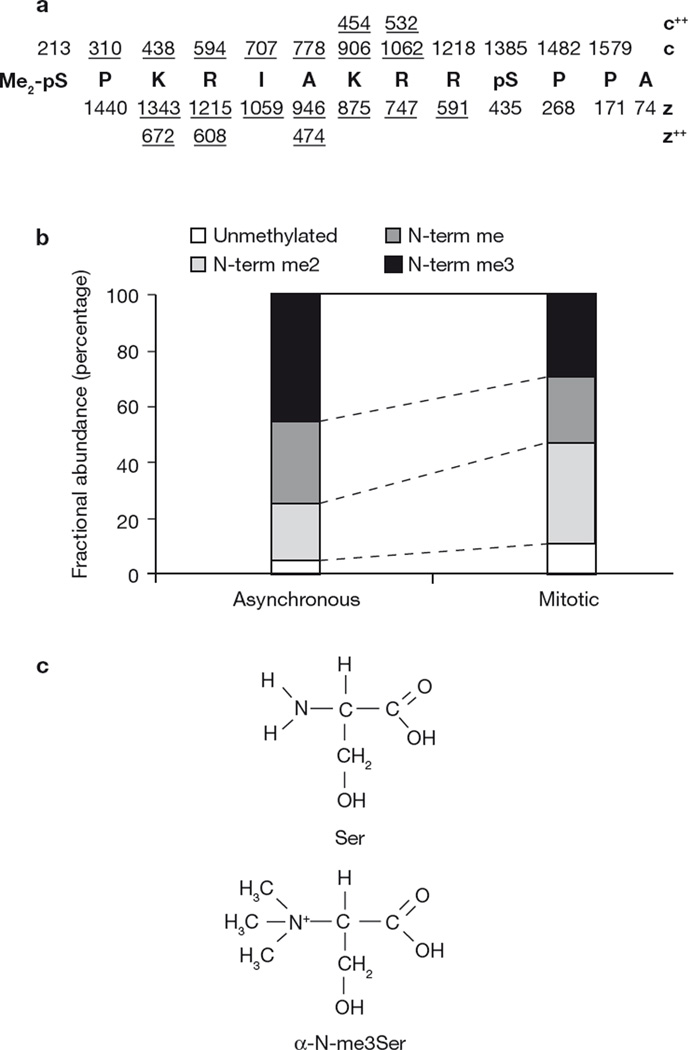
Regulator of chromatin condensation 1 (RCC1) is the only known guanine nucleotide-exchange factor for the Ran GTPase and has pivotal roles in nucleo-cytoplasmic transport, mitosis, and nuclear-envelope assembly. RCC1 associates dynamically with chromatin through binding to histones H2A and/or H2B in a Ran-regulated manner. Here, we report that, unexpectedly, the amino-terminal serine or proline residue of RCC1 is uniquely methylated on its alpha-amino group. Methylation requires removal of the initiating methionine, and the presence of proline and lysine at positions 3 and 4, respectively. Methylation-defective mutants of RCC1 bind less effectively than wild-type protein to chromatin during mitosis, which causes spindle-pole defects. We propose a bimodal attachment mechanism for RCC1 in which the tail promotes stable RCC1 association with chromatin through DNA binding in an alpha-N-methylation-dependent manner. These data provide the first known function for N-terminal protein methylation.
染色质凝聚调节因子1(RCC1)是已知的唯一一种Ran GTP酶的鸟嘌呤核苷酸交换因子,在核质运输、有丝分裂和核膜组装中起关键作用。RCC1通过以Ran调节的方式与组蛋白H2A和/或H2B结合而动态地与染色质结合。在此,我们意外地报道,RCC1的氨基末端丝氨酸或脯氨酸残基在其α-氨基上被独特地甲基化。甲基化需要去除起始甲硫氨酸,并且分别在第3和第4位存在脯氨酸和赖氨酸。RCC1的甲基化缺陷突变体在有丝分裂期间与染色质结合的效率低于野生型蛋白,这会导致纺锤极缺陷。我们提出了一种RCC1的双峰附着机制,其中尾部通过以α-N-甲基化依赖的方式与DNA结合来促进RCC1与染色质的稳定结合。这些数据提供了N末端蛋白质甲基化的首个已知功能。