Komakula Sushma, Khatri Sumita, Mermis Joel, Savill Samira, Haque Shireen, Rojas Mauricio, Brown LouAnn, Teague Gerald W, Holguin Fernando
Department of Medicine, Emory University, Atlanta, USA.
Respir Res. 2007 Apr 16;8(1):32. doi: 10.1186/1465-9921-8-32.
Recently, it has been shown that increasing body mass index (BMI) in asthma is associated with reduced exhaled NO. Our objective in this study was to determine if the BMI-related changes in exhaled NO differ across asthmatics and controls, and to determine if these changes are related to increased airway oxidative stress and systemic levels of leptin and adiponectin.
Observational study of the association of BMI, leptin, and adiponectin with exhaled nitric oxide (NO) and exhaled 8-isoprostanes in 67 non-smoking patients with moderate to severe persistent asthma during baseline conditions and 47 controls. Measurements included plasma levels of leptin, adiponectin, exhaled breath condensates for 8-isoprostanes, exhaled NO, pulmonary function tests, and questionnaires regarding asthma severity and control.
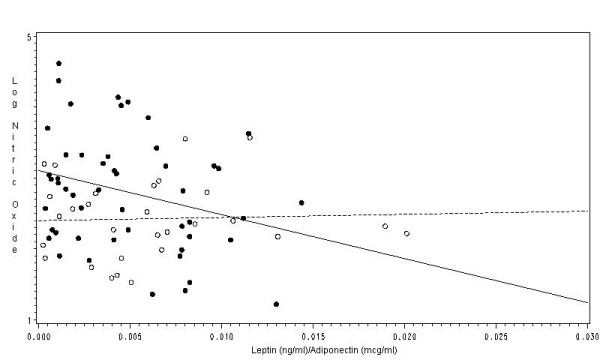
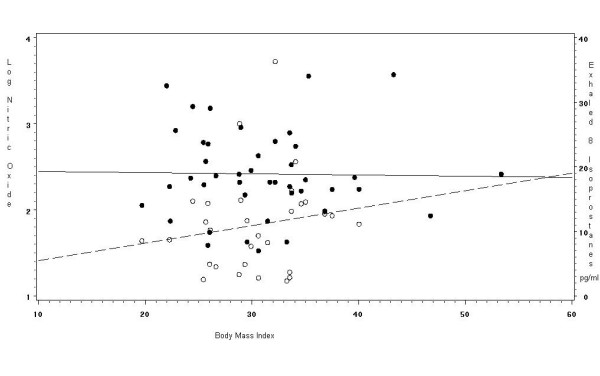
In asthmatics, BMI and the ratio of leptin to adiponectin were respectively associated with reduced levels of exhaled NO (beta = -0.04 [95% C.I. -0.07, -0.1], p < 0.003) and (beta = -0.0018 [95% C.I. -0.003, -0.00034], p = 0.01) after adjusting for confounders. Also, BMI was associated with increased levels of exhaled 8-isoprostanes (beta = 0.30 [95% C.I. 0.003, 0.6], p = 0.03) after adjusting for confounders. In contrast, we did not observe these associations in the control group of healthy non-asthmatics with a similar weight distribution.
In adults with stable moderate to severe persistent asthma, but not in controls, BMI and the plasma ratio of leptin/adiponectin is associated with reduced exhaled NO. Also, BMI is associated with increased exhaled 8-isoprostanes. These results suggest that BMI in asthmatics may increase airway oxidative stress and could explain the BMI-related reductions in exhaled NO.
最近的研究表明,哮喘患者体重指数(BMI)的增加与呼出一氧化氮(NO)水平降低有关。本研究的目的是确定哮喘患者和对照组中与BMI相关的呼出NO变化是否存在差异,并确定这些变化是否与气道氧化应激增加以及瘦素和脂联素的全身水平有关。
对67例中度至重度持续性哮喘非吸烟患者和47例对照者在基线条件下进行观察性研究,分析BMI、瘦素和脂联素与呼出一氧化氮(NO)和呼出8-异前列腺素之间的关系。测量指标包括血浆瘦素、脂联素水平,呼出气体冷凝物中的8-异前列腺素、呼出NO、肺功能测试,以及关于哮喘严重程度和控制情况的问卷。
在哮喘患者中,调整混杂因素后,BMI和瘦素与脂联素的比值分别与呼出NO水平降低相关(β=-0.04 [95%置信区间 -0.07, -0.1],p<0.003)和(β=-0.0018 [95%置信区间 -0.003, -0.00034],p = 0.01)。此外,调整混杂因素后,BMI与呼出8-异前列腺素水平升高相关(β=0.30 [95%置信区间 0.003, 0.6],p = 0.03)。相比之下,在体重分布相似的健康非哮喘对照组中,我们未观察到这些关联。
在稳定的中度至重度持续性哮喘成人患者中,而非对照组中,BMI和血浆瘦素/脂联素比值与呼出NO降低相关。此外,BMI与呼出8-异前列腺素增加相关。这些结果表明,哮喘患者的BMI可能会增加气道氧化应激,并可解释与BMI相关的呼出NO降低现象。