Bansal Anjali, Sankararamakrishnan Ramasubbu
Department of Biological Sciences and Bioengineering, Indian Institute of Technology, Kanpur, India.
BMC Struct Biol. 2007 Apr 19;7:27. doi: 10.1186/1472-6807-7-27.
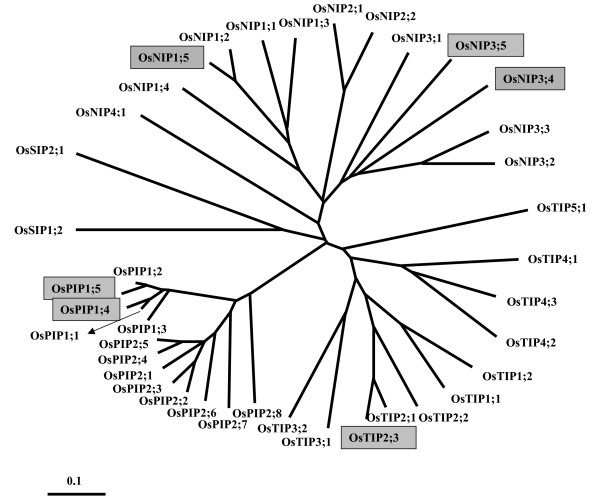
The major intrinsic proteins (MIPs) facilitate the transport of water and neutral solutes across the lipid bilayers. Plant MIPs are believed to be important in cell division and expansion and in water transport properties in response to environmental conditions. More than 30 MIP sequences have been identified in Arabidopsis thaliana, maize and rice. Plasma membrane intrinsic proteins (PIPs), tonoplast intrinsic proteins (TIPs), Nod26-like intrinsic protein (NIPs) and small and basic intrinsic proteins (SIPs) are subfamilies of plant MIPs. Despite sequence diversity, all the experimentally determined structures belonging to the MIP superfamily have the same "hour-glass" fold.
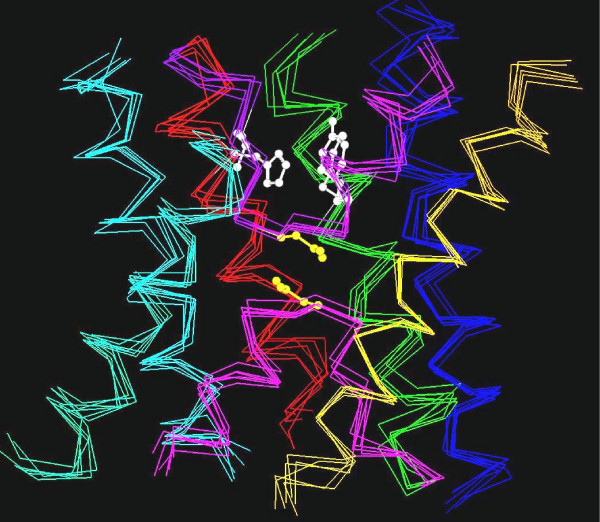
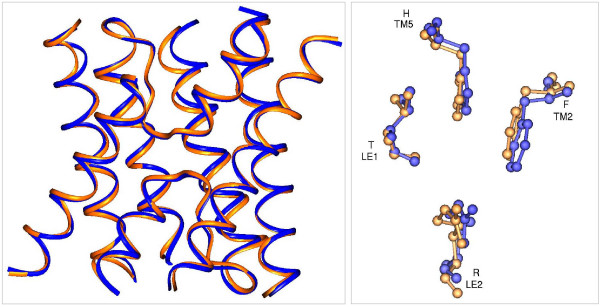
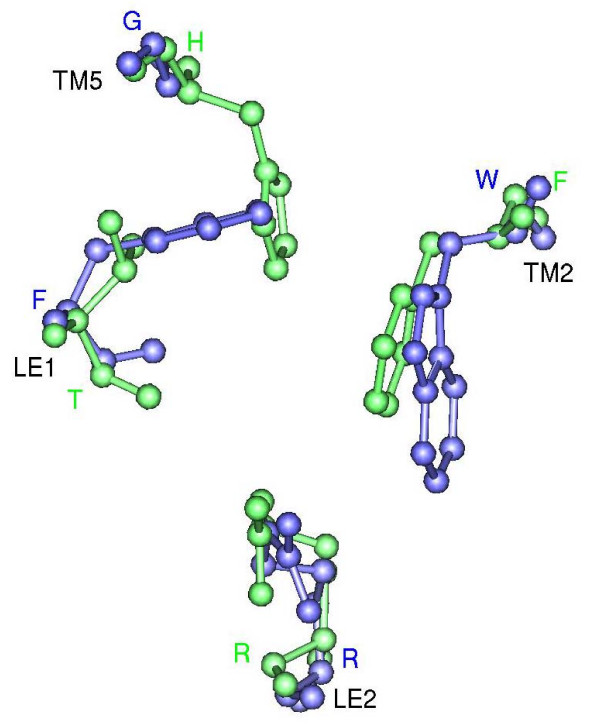
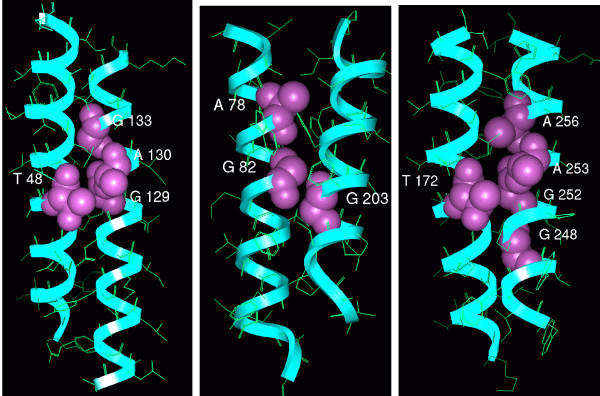
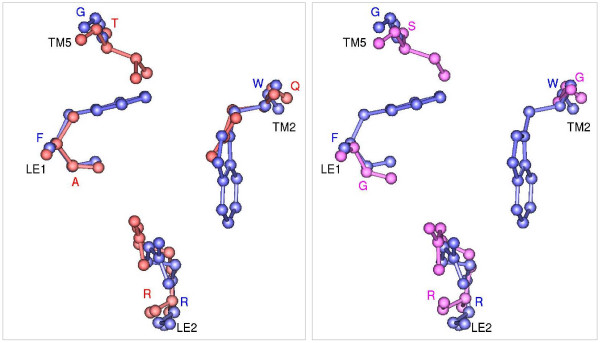
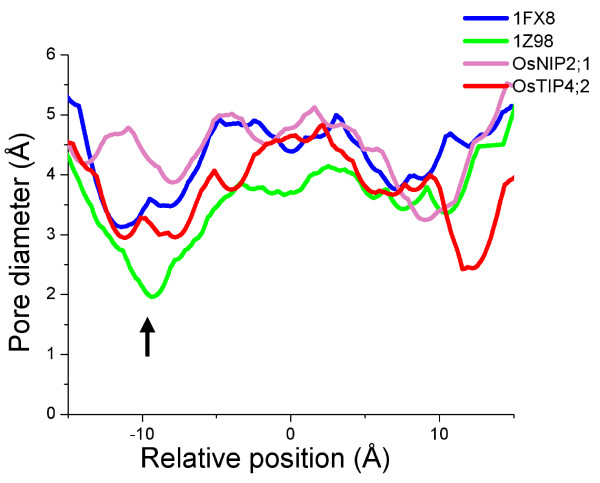
We have structurally characterized 39 rice and 31 maize MIPs and compared them with that of Arabidopsis. Homology models of 105 MIPs from all three plant species were built. Structure-based sequence alignments were generated and the residues in the helix-helix interfaces were analyzed. Small residues (Gly/Ala/Ser/Thr) are found to be highly conserved as a group in the helix-helix interface of MIP structures. Individual families sometimes prefer one or another of the residues from this group. The narrow aromatic/arginine (ar/R) selectivity filter in MIPs has been shown to provide an important constriction for solute permeability. Ar/R regions were analyzed and compared between the three plant species. Seventeen TIP, NIP and SIP members from rice and maize have ar/R signatures that are not found in Arabidopsis. A subgroup of rice and maize NIPs has small residues in three of the four positions in the ar/R tetrad, resulting in a wider constriction. These MIP members could transport larger solute molecules.
Small residues are group-conserved in the helix-helix interface of MIP structures and they seem to be important for close helix-helix interactions. Such conservation might help to preserve the hour-glass fold in MIP structures. Analysis and comparison of ar/R selectivity filters suggest that rice and maize MIPs could transport more diverse solutes than Arabidopsis MIPs. Thus the MIP members show conservation in helix-helix interfaces and diversity in aromatic/arginine selectivity filters. The former is related to structural stability and the later can be linked to functional diversity.
主要内在蛋白(MIPs)促进水和中性溶质跨脂质双层的运输。植物MIPs被认为在细胞分裂和扩展以及响应环境条件的水运输特性中起重要作用。在拟南芥、玉米和水稻中已鉴定出30多个MIP序列。质膜内在蛋白(PIPs)、液泡膜内在蛋白(TIPs)、Nod26样内在蛋白(NIPs)以及小的碱性内在蛋白(SIPs)是植物MIPs的亚家族。尽管存在序列多样性,但所有通过实验确定的属于MIP超家族的结构都具有相同的“沙漏”折叠。
我们对39个水稻和31个玉米MIPs进行了结构表征,并将它们与拟南芥的MIPs进行了比较。构建了来自所有三种植物的105个MIPs的同源模型。生成了基于结构的序列比对,并分析了螺旋-螺旋界面中的残基。发现小残基(甘氨酸/丙氨酸/丝氨酸/苏氨酸)在MIP结构的螺旋-螺旋界面中作为一组高度保守。个别家族有时更喜欢该组中的一种或另一种残基。MIPs中狭窄的芳香族/精氨酸(ar/R)选择性过滤器已被证明对溶质通透性提供重要的限制。对三个植物物种的ar/R区域进行了分析和比较。来自水稻和玉米的17个TIP、NIP和SIP成员具有拟南芥中未发现的ar/R特征。水稻和玉米NIPs的一个亚组在ar/R四联体的四个位置中的三个位置具有小残基,导致更宽的限制。这些MIP成员可以运输更大的溶质分子。
小残基在MIP结构的螺旋-螺旋界面中是成组保守的,它们似乎对紧密的螺旋-螺旋相互作用很重要。这种保守性可能有助于保持MIP结构中的沙漏折叠。对ar/R选择性过滤器的分析和比较表明,水稻和玉米MIPs比拟南芥MIPs能够运输更多种类的溶质。因此,MIP成员在螺旋-螺旋界面中表现出保守性,而在芳香族/精氨酸选择性过滤器中表现出多样性。前者与结构稳定性有关,后者可以与功能多样性联系起来。