Department of Biological Sciences and Bioengineering, Indian Institute of Technology Kanpur, Kanpur 208016, India.
BMC Plant Biol. 2009 Nov 20;9:134. doi: 10.1186/1471-2229-9-134.
Members of major intrinsic proteins (MIPs) include water-conducting aquaporins and glycerol-transporting aquaglyceroporins. MIPs play important role in plant-water relations. The model plants Arabidopsis thaliana, rice and maize contain more than 30 MIPs and based on phylogenetic analysis they can be divided into at least four subfamilies. Populus trichocarpa is a model tree species and provides an opportunity to investigate several tree-specific traits. In this study, we have investigated Populus MIPs (PtMIPs) and compared them with their counterparts in Arabidopsis, rice and maize.
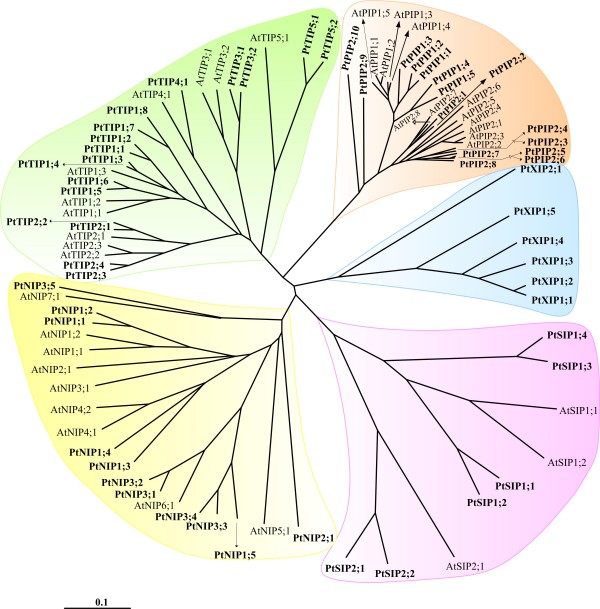
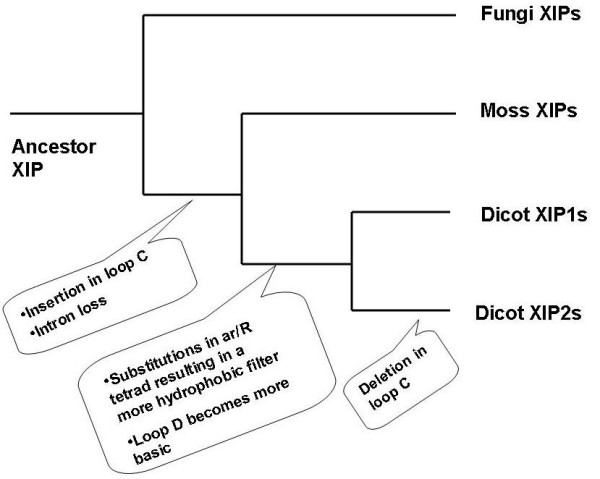
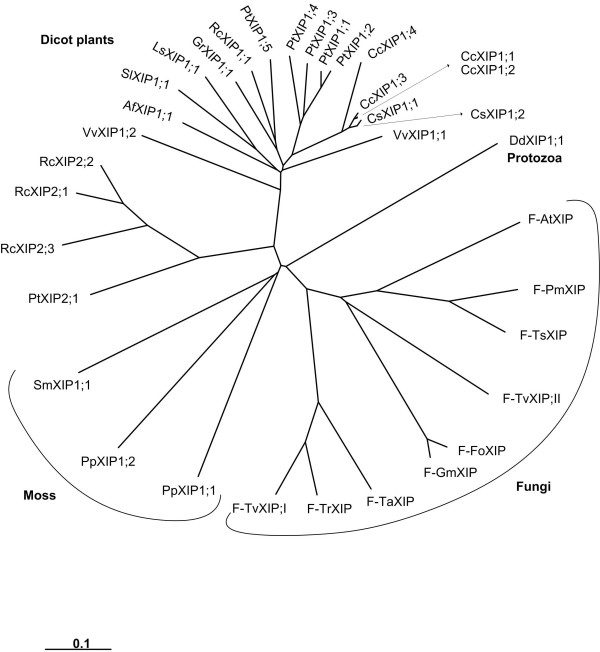
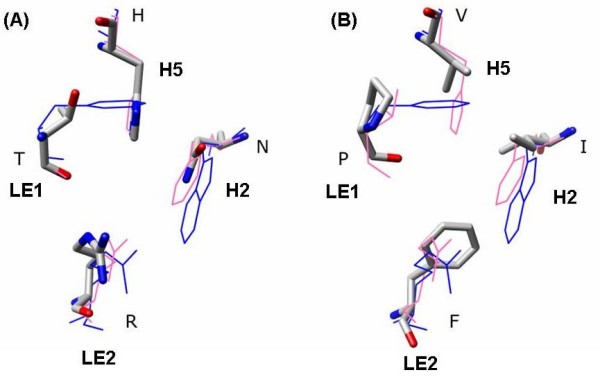
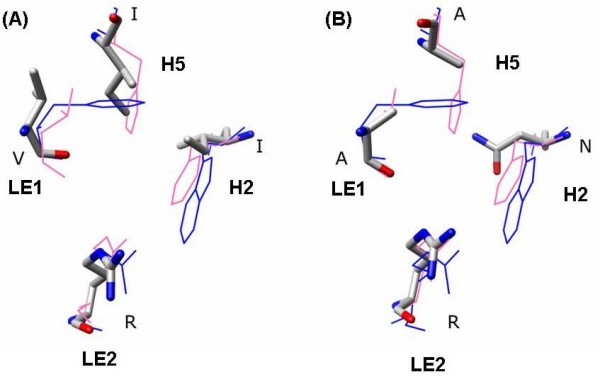
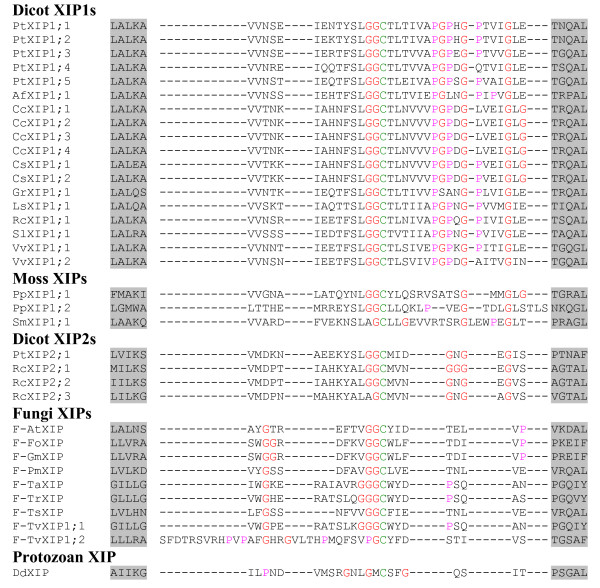
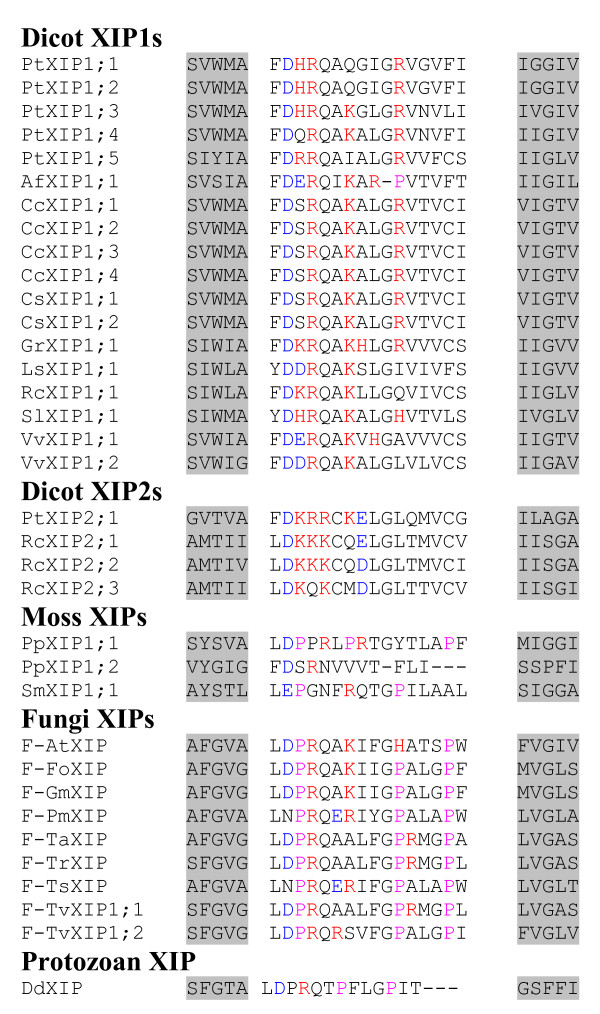
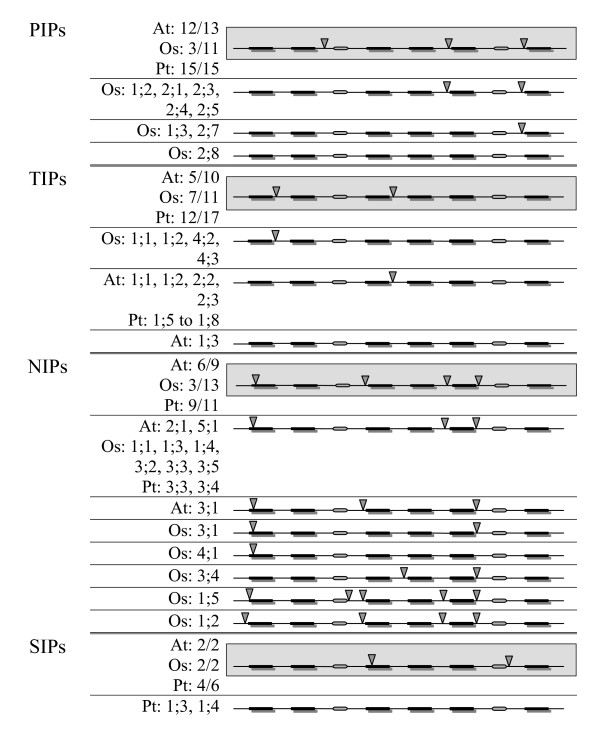
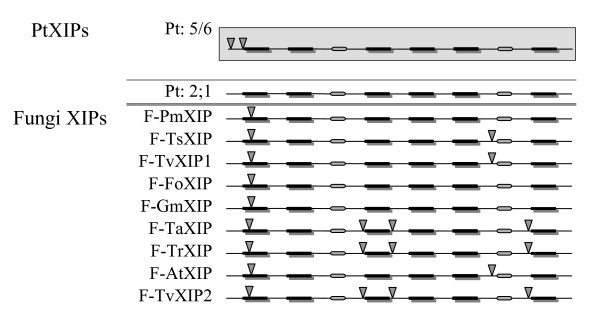
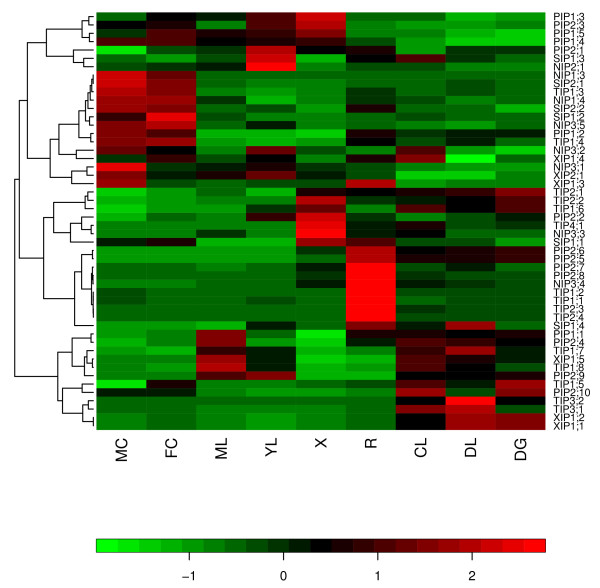
Fifty five full-length MIPs have been identified in Populus genome. Phylogenetic analysis reveals that Populus has a fifth uncharacterized subfamily (XIPs). Three-dimensional models of all 55 PtMIPs were constructed using homology modeling technique. Aromatic/arginine (ar/R) selectivity filters, characteristics of loops responsible for solute selectivity (loop C) and gating (loop D) and group conservation of small and weakly polar interfacial residues have been analyzed. Majority of the non-XIP PtMIPs are similar to those in Arabidopsis, rice and maize. Additional XIPs were identified from database search and 35 XIP sequences from dicots, fungi, moss and protozoa were analyzed. Ar/R selectivity filters of dicots XIPs are more hydrophobic compared to fungi and moss XIPs and hence they are likely to transport hydrophobic solutes. Loop C is longer in one of the subgroups of dicot XIPs and most probably has a significant role in solute selectivity. Loop D in dicot XIPs has higher number of basic residues. Intron loss is observed on two occasions: once between two subfamilies of eudicots and monocot and in the second instance, when dicot and moss XIPs diverged from fungi. Expression analysis of Populus MIPs indicates that Populus XIPs don't show any tissue-specific transcript abundance.
Due to whole genome duplication, Populus has the largest number of MIPs identified in any single species. Non-XIP MIPs are similar in all four plant species considered in this study. Small and weakly polar residues at the helix-helix interface are group conserved presumably to maintain the hourglass fold of MIP channels. Substitutions in ar/R selectivity filter, insertion/deletion in loop C, increasing basic nature of loop D and loss of introns are some of the events occurred during the evolution of dicot XIPs.
主要内在蛋白(MIPs)成员包括导水 aquaporins 和甘油转运 aquaglyceroporins。MIPs 在植物水分关系中发挥重要作用。模式植物拟南芥、水稻和玉米包含 30 多种 MIPs,根据系统发育分析,它们可分为至少四个亚家族。杨树是一种模式树种,为研究几个树种特有的性状提供了机会。在这项研究中,我们研究了杨树 MIPs(PtMIPs),并将其与拟南芥、水稻和玉米中的对应物进行了比较。
在杨树基因组中鉴定出 55 个全长 MIP。系统发育分析表明,杨树有一个未表征的第五个亚家族(XIPs)。使用同源建模技术构建了所有 55 个 PtMIPs 的三维模型。分析了芳香族/精氨酸(ar/R)选择性过滤器、负责溶质选择性的环 C 和门控环 D 的特征以及小而弱极性界面残基的组保守性。大多数非 XIP PtMIPs 与拟南芥、水稻和玉米中的相似。从数据库搜索中鉴定出额外的 XIPs,并分析了来自双子叶植物、真菌、苔藓和原生动物的 35 个 XIP 序列。与真菌和苔藓 XIPs 相比,双子叶植物 XIPs 的 ar/R 选择性过滤器更疏水,因此它们可能运输疏水性溶质。在双子叶植物 XIPs 的一个亚组中,环 C 更长,可能在溶质选择性方面具有重要作用。双子叶植物 XIPs 的环 D 中有更多的碱性残基。在两个场合观察到内含子丢失:一次是在真双子叶植物和单子叶植物的两个亚家族之间,另一次是在双子叶植物和苔藓植物的 XIPs 与真菌分化时。杨树 MIPs 的表达分析表明,杨树 XIPs 在任何单一物种中都没有表现出任何组织特异性的转录丰度。
由于全基因组复制,杨树是在任何单一物种中鉴定出的 MIPs 数量最多的物种。在本研究中考虑的四个植物物种中,非 XIP MIPs 相似。小而弱极性的残基在螺旋-螺旋界面上被组保守,大概是为了维持 MIP 通道的沙漏折叠。ar/R 选择性过滤器中的取代、环 C 中的插入/缺失、环 D 碱性的增加以及内含子的丢失是双子叶植物 XIPs 进化过程中发生的一些事件。