Fajardo-Gutiérrez Arturo, Juárez-Ocaña Servando, González-Miranda Guadalupe, Palma-Padilla Virginia, Carreón-Cruz Rogelio, Ortega-Alvárez Manuel Carlos, Mejía-Arangure Juan Manuel
Registro de Cáncer en Niños, Unidad de Investigación Médica en Epidemiología Clínica, Hospital de Pediatría, Centro Médico Nacional Siglo XXI, Ciudad de México, Mexico.
BMC Cancer. 2007 Apr 19;7:68. doi: 10.1186/1471-2407-7-68.
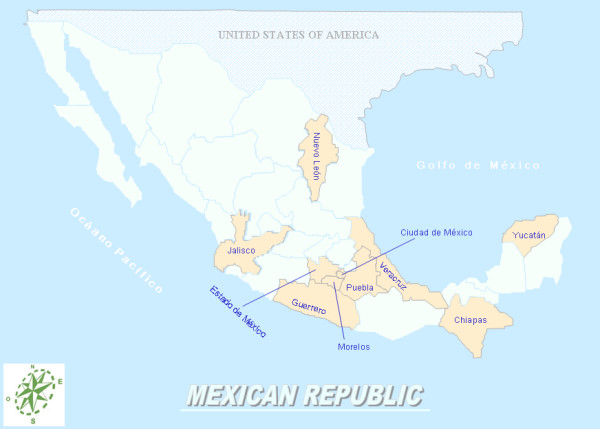
In 1996, Mexico started to register cases of childhood cancer. Here, we describe the incidence of cancer in children, residing in ten Mexican jurisdictions, who were treated by the Instituto Mexicano del Seguro Social (IMSS).
New cases of childhood cancer, which were registered prospectively in nine principal Medical Centers of IMSS during the periods 1998-2000 (five jurisdictions) and 1996-2002 (five jurisdictions), were analyzed. Personnel were specifically trained to register, capture, and encode information. For each of these jurisdictions, the frequency, average annual age-standardized incidence (AAS) and average annual incidence per period by sex and, age, were calculated (rates per 1,000,000 children/years).
In total 2,615 new cases of cancer were registered, with the male/female ratio generally >1, but in some tumors there were more cases in females (retinoblastoma, germ cells tumors). The principal groups of neoplasms in seven jurisdictions were leukemias, central nervous system tumors (CNS tumors), and lymphomas, and the combined frequency for these three groups was 62.6 to 77.2%. Most frequently found (five jurisdictions) was the North American-European pattern (leukemias-CNS tumors-lymphomas). Eight jurisdictions had AAS within the range reported in the world literature. The highest incidence was found for children underless than five year of age. In eight jurisdictions, leukemia had high incidence (>50). The AAS of lymphomas was between 1.9 to 28.6. Chiapas and Guerrero had the highest AAS of CNS tumors (31.9 and 30.3, respectively). The frequency and incidence of neuroblastoma was low. Chiapas had the highest incidence of retinoblastoma (21.8). Germ-cell tumors had high incidence.
The North American-European pattern of cancers was the principal one found; the overall incidence was within the range reported worldwide. In general but particularly in two jurisdictions (Yucatán and Chiapas), it will be necessary to carry out studies concerning the causes of cancer in children. Due to the little that is known about the incidence of cancer in Mexican children, it will be necessary to develop a national program to establish a cancer registry for the whole of the country.
1996年,墨西哥开始登记儿童癌症病例。在此,我们描述了居住在墨西哥十个辖区、由墨西哥社会保障局(IMSS)治疗的儿童癌症发病率。
分析了1998 - 2000年期间(五个辖区)和1996 - 2002年期间(五个辖区)在IMSS的九个主要医疗中心前瞻性登记的儿童癌症新病例。工作人员经过专门培训以登记、获取和编码信息。针对每个辖区,计算了按性别和年龄划分的频率、年均年龄标准化发病率(AAS)以及每个时期的年均发病率(每100万儿童/年的发病率)。
共登记了2615例癌症新病例,男女比例总体>1,但在某些肿瘤中女性病例更多(视网膜母细胞瘤、生殖细胞肿瘤)。七个辖区的主要肿瘤类型为白血病、中枢神经系统肿瘤(CNS肿瘤)和淋巴瘤,这三组的综合频率为62.6%至77.2%。最常见的模式(五个辖区)是北美 - 欧洲模式(白血病 - CNS肿瘤 - 淋巴瘤)。八个辖区的AAS在世界文献报道的范围内。五岁以下儿童的发病率最高。在八个辖区,白血病发病率较高(>50)。淋巴瘤的AAS在1.9至28.6之间。恰帕斯州和格雷罗州的CNS肿瘤AAS最高(分别为31.9和30.3)。神经母细胞瘤的频率和发病率较低。恰帕斯州的视网膜母细胞瘤发病率最高(21.8)。生殖细胞肿瘤发病率较高。
发现北美 - 欧洲癌症模式是主要模式;总体发病率在全球报道的范围内。一般而言,尤其是在两个辖区(尤卡坦州和恰帕斯州),有必要开展关于儿童癌症病因的研究。由于对墨西哥儿童癌症发病率了解甚少,有必要制定一项国家计划,为整个国家建立癌症登记处。