Fernandes Jolene S, Sternberg Paul W
Division of Biology, California Institute of Technology, Pasadena, California, United States of America.
PLoS Genet. 2007 Apr 27;3(4):e69. doi: 10.1371/journal.pgen.0030069. Epub 2007 Mar 19.
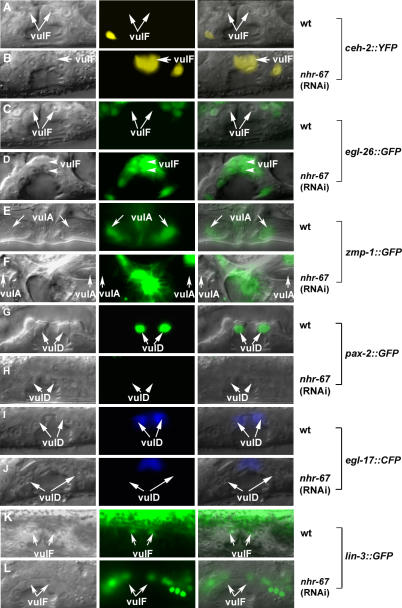
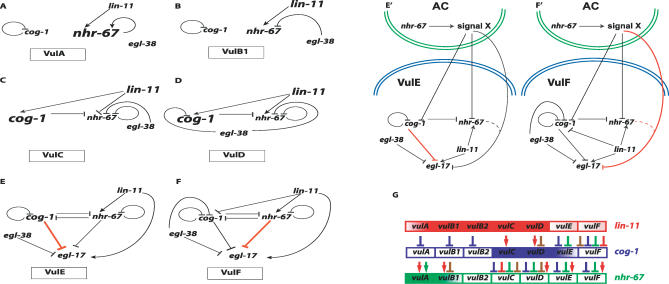
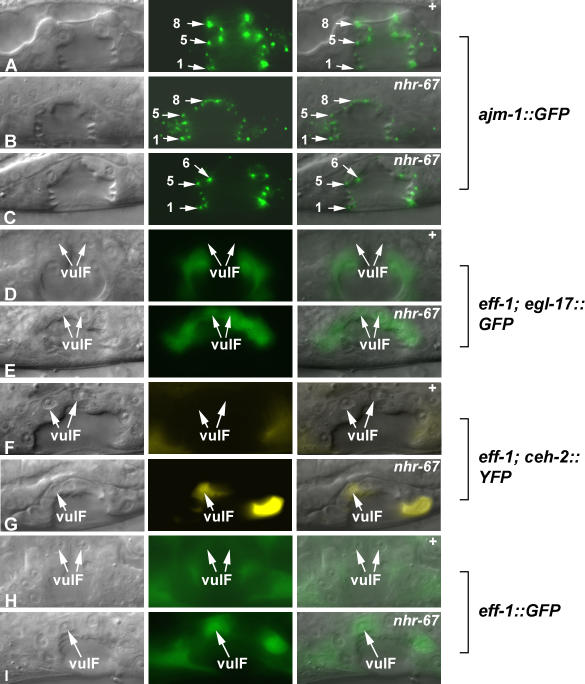
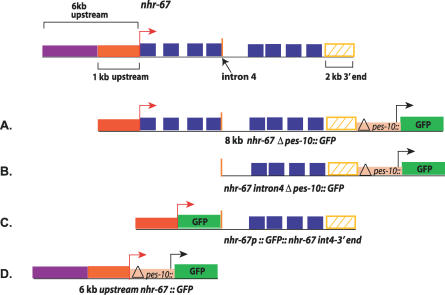
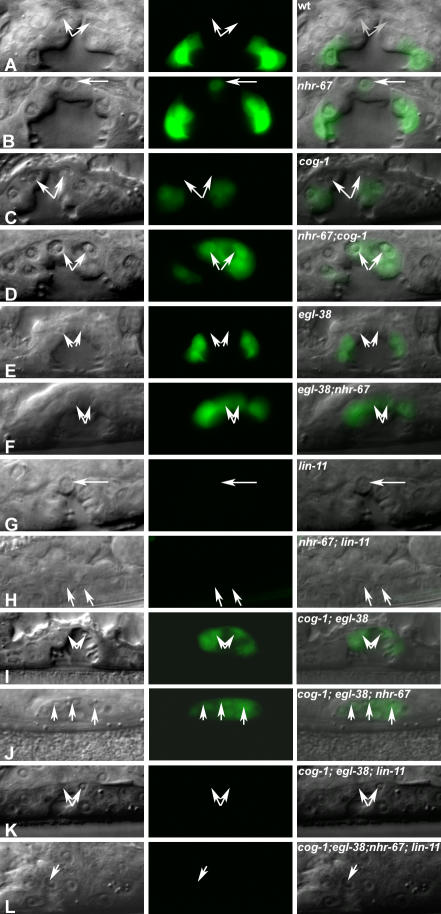
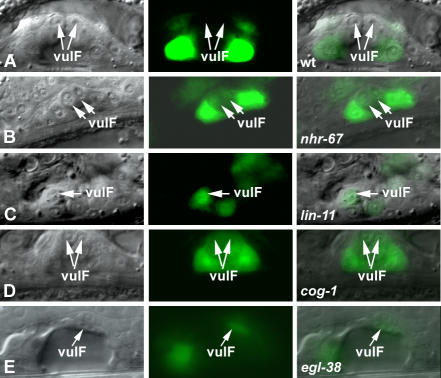
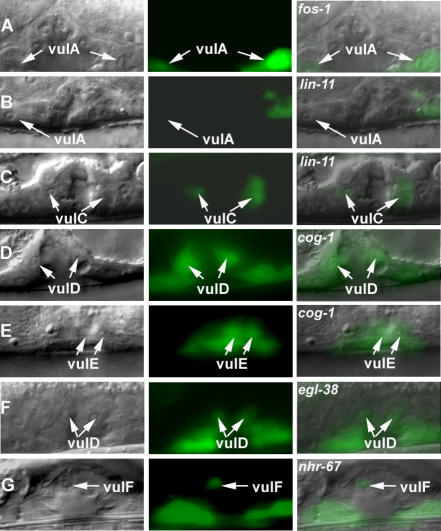
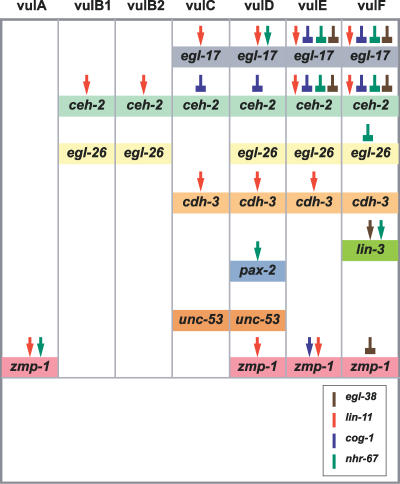
Regulation of spatio-temporal gene expression in diverse cell and tissue types is a critical aspect of development. Progression through Caenorhabditis elegans vulval development leads to the generation of seven distinct vulval cell types (vulA, vulB1, vulB2, vulC, vulD, vulE, and vulF), each with its own unique gene expression profile. The mechanisms that establish the precise spatial patterning of these mature cell types are largely unknown. Dissection of the gene regulatory networks involved in vulval patterning and differentiation would help us understand how cells generate a spatially defined pattern of cell fates during organogenesis. We disrupted the activity of 508 transcription factors via RNAi and assayed the expression of ceh-2, a marker for vulB fate during the L4 stage. From this screen, we identified the tailless ortholog nhr-67 as a novel regulator of gene expression in multiple vulval cell types. We find that one way in which nhr-67 maintains cell identity is by restricting inappropriate cell fusion events in specific vulval cells, namely vulE and vulF. nhr-67 exhibits a dynamic expression pattern in the vulval cells and interacts with three other transcriptional regulators cog-1 (Nkx6.1/6.2), lin-11 (LIM), and egl-38 (Pax2/5/8) to generate the composite expression patterns of their downstream targets. We provide evidence that egl-38 regulates gene expression in vulB1, vulC, vulD, vulE, as well as vulF cells. We demonstrate that the pairwise interactions between these regulatory genes are complex and vary among the seven cell types. We also discovered a striking regulatory circuit that affects a subset of the vulval lineages: cog-1 and nhr-67 inhibit both one another and themselves. We postulate that the differential levels and combinatorial patterns of lin-11, cog-1, and nhr-67 expression are a part of a regulatory code for the mature vulval cell types.
不同细胞和组织类型中时空基因表达的调控是发育的一个关键方面。秀丽隐杆线虫外阴发育过程会产生七种不同的外阴细胞类型(vulA、vulB1、vulB2、vulC、vulD、vulE和vulF),每种细胞类型都有其独特的基因表达谱。建立这些成熟细胞类型精确空间模式的机制在很大程度上尚不清楚。剖析参与外阴模式形成和分化的基因调控网络将有助于我们理解细胞在器官发生过程中如何产生空间定义的细胞命运模式。我们通过RNA干扰破坏了508个转录因子的活性,并检测了ceh-2的表达,ceh-2是L4阶段vulB命运的标志物。通过这个筛选,我们确定了无尾直系同源基因nhr-67是多种外阴细胞类型中基因表达的新型调节因子。我们发现nhr-67维持细胞身份的一种方式是通过限制特定外阴细胞(即vulE和vulF)中不适当的细胞融合事件。nhr-67在外阴细胞中表现出动态表达模式,并与其他三个转录调节因子cog-1(Nkx6.1/6.2)、lin-11(LIM)和egl-38(Pax2/5/8)相互作用,以产生其下游靶标的复合表达模式。我们提供证据表明egl-38调节vulB1、vulC、vulD、vulE以及vulF细胞中的基因表达。我们证明这些调节基因之间的成对相互作用是复杂的,并且在七种细胞类型中有所不同。我们还发现了一个影响一部分外阴谱系的显著调节回路:cog-1和nhr-67相互抑制且自我抑制。我们推测lin-11、cog-1和nhr-67表达的差异水平和组合模式是成熟外阴细胞类型调控密码的一部分。