Okada M, Okabe A, Uchihori Y, Kitamura H, Sekine E, Ebisawa S, Suzuki M, Okayasu R
Molecular Probe Group, National Institute of Radiological Sciences, 4-9-1 Anagawa, Inage-ku, Chiba-shi 263-8555, Japan.
Br J Cancer. 2007 Jun 4;96(11):1707-10. doi: 10.1038/sj.bjc.6603775. Epub 2007 May 8.
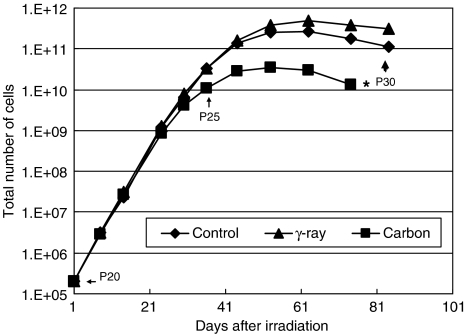
To investigate the long-term biological effect of extreme low dose ionising radiation, we irradiated normal human fibroblasts (HFLIII) with carbon ions (290 MeV u(-1), 70 keV microm(-1)) and gamma-rays at 1 mGy (total dose) once at a low dose rate (1 mGy 6-8 h(-1)), and observed the cell growth kinetics up to 5 months by continuous culturing. The growth of carbon-irradiated cells started to slow down considerably sooner than that of non-irradiated cells before reaching senescence. In contrast, cells irradiated with gamma-rays under similar conditions did not show significant deviation from the non-irradiated cells. A DNA double strand break (DSB) marker, gamma-H2AX foci, and a DSB repair marker, phosphorylated DNA-PKcs foci, increased in number when non-irradiated cells reached several passages before senescence. A single low dose/low dose rate carbon ion exposure further raised the numbers of these markers. Furthermore, the numbers of foci for these two markers were significantly reduced after the cells became fully senescent. Our results indicate that high linear energy transfer (LET) radiation (carbon ions) causes different effects than low LET radiation (gamma-rays) even at very low doses and that a single low dose of heavy ion irradiation can affect the stability of the genome many generations after irradiation.
为了研究极低剂量电离辐射的长期生物学效应,我们用碳离子(290 MeV u(-1),70 keV μm(-1))和γ射线以低剂量率(1 mGy 6 - 8 h(-1))对正常人成纤维细胞(HFLIII)进行1 mGy(总剂量)的单次照射,并通过连续培养观察长达5个月的细胞生长动力学。在达到衰老之前,碳离子照射的细胞生长比未照射的细胞明显更早开始显著减缓。相比之下,在类似条件下用γ射线照射的细胞与未照射的细胞相比没有显示出明显差异。当未照射的细胞在衰老前达到几个传代时,DNA双链断裂(DSB)标记物γ-H2AX焦点和DSB修复标记物磷酸化DNA-PKcs焦点的数量增加。单次低剂量/低剂量率碳离子照射进一步增加了这些标记物的数量。此外,在细胞完全衰老后,这两种标记物的焦点数量显著减少。我们的结果表明,即使在非常低的剂量下,高传能线密度(LET)辐射(碳离子)与低LET辐射(γ射线)也会产生不同的效应,并且单次低剂量重离子照射可在照射后许多代影响基因组的稳定性。