Hardin Michael G, Schroth Elizabeth, Pine Daniel S, Ernst Monique
Emotional Development and Affective Neuroscience Branch, Mood and Anxiety Disorders Program, National Institute of Mental Health, NIH/DHHS, Bethesda, MD 20892, USA.
J Child Psychol Psychiatry. 2007 May;48(5):446-54. doi: 10.1111/j.1469-7610.2006.01722.x.
Developmental changes in cognitive and affective processes contribute to adolescent risk-taking behavior, emotional intensification, and psychopathology. The current study examined adolescent development of cognitive control processes and their modulation by incentive, in health and psychopathology. Predictions include 1) better cognitive control in adults than adolescents, and in healthy adolescents than anxious and depressed adolescents, and 2) a stronger influence of incentives in adolescents than adults, and in healthy adolescents than their depressed and anxious counterparts.
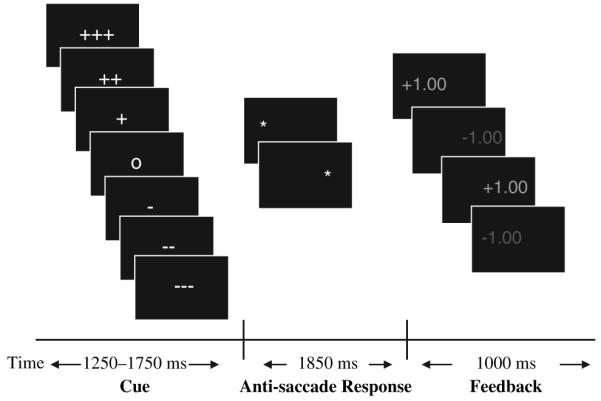
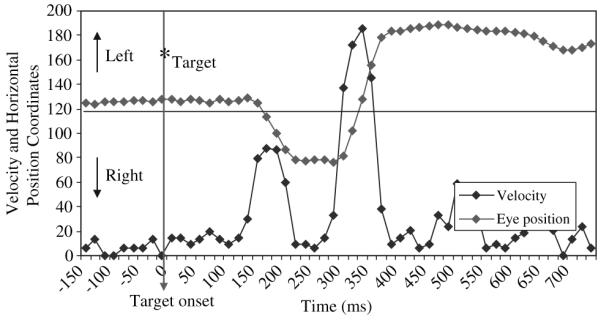
Antisaccadic eye movement parameters, which provide a measure of cognitive control, were collected during a reward antisaccade task that included parameterized incentive levels. Participants were 20 healthy adults, 30 healthy adolescents, 16 adolescents with an anxiety disorder, and 11 adolescents with major depression. Performance accuracy and saccade latency were analyzed to test both developmental and psychopathology hypotheses.
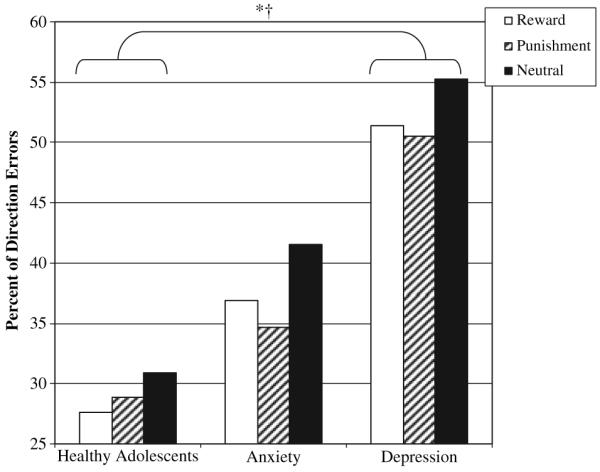
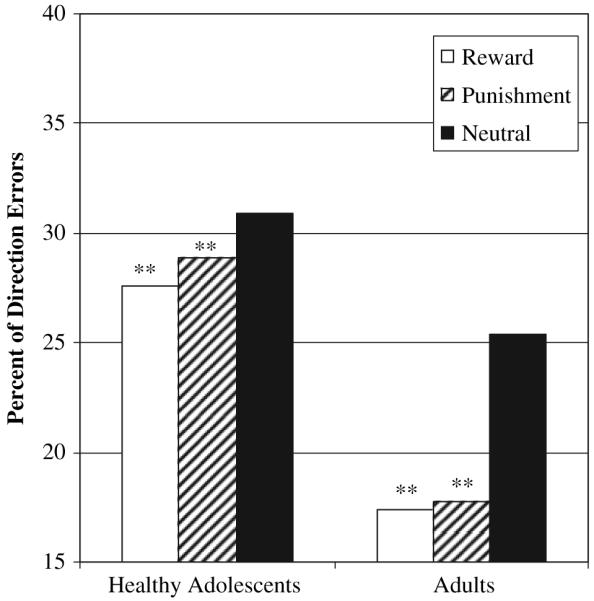
Development and psychopathology group differences in cognitive control were found. Specifically, adults performed better than healthy adolescents, and healthy adolescents than anxious and depressed adolescents. Incentive improved accuracy for all groups; however, incremental increases were not sufficiently large to further modulate performance. Incentives also affected saccade latencies, pushing healthy adolescent latencies to adult levels, while being less effective in adolescents with depression or anxiety. This latter effect was partially mediated by anxiety symptom severity.
Current findings evidence the modulation of cognitive control processes by incentives. While seen in both healthy adults and healthy adolescents, this modulatory effect was stronger in youth. While anxious and depressed adolescents exhibited improved cognitive control under incentives, this effect was smaller than that in healthy adolescents. These findings suggest differential incentive and/or cognitive control processing in anxiety and depression, and across development. Differences could result from disorder specific, or combined developmental and pathological mechanisms.
认知和情感过程的发展变化导致青少年出现冒险行为、情绪强化和精神病理学问题。本研究考察了认知控制过程在健康和精神病理学背景下的青少年发展情况及其受动机的调节作用。预测结果包括:1)成年人比青少年具有更好的认知控制能力,健康青少年比焦虑和抑郁青少年具有更好的认知控制能力;2)动机对青少年的影响比对成年人更强,对健康青少年的影响比对抑郁和焦虑青少年更强。
在一项奖励性反扫视任务中收集反扫视眼动参数,该参数可衡量认知控制能力,任务中包含参数化的动机水平。参与者包括20名健康成年人、30名健康青少年、16名患有焦虑症的青少年和11名患有重度抑郁症的青少年。分析表现准确性和扫视潜伏期,以检验发展和精神病理学假设。
发现了认知控制方面的发展和精神病理学组间差异。具体而言,成年人的表现优于健康青少年,健康青少年优于焦虑和抑郁青少年。动机提高了所有组的准确性;然而,增量不足以进一步调节表现。动机也影响扫视潜伏期,使健康青少年的潜伏期达到成年人水平,而对抑郁或焦虑青少年的效果较小。后一种效应部分由焦虑症状严重程度介导。
当前研究结果证明了动机对认知控制过程的调节作用。虽然在健康成年人和健康青少年中均有发现,但这种调节作用在青少年中更强。虽然焦虑和抑郁青少年在动机作用下认知控制有所改善,但这种效果小于健康青少年。这些发现表明在焦虑和抑郁以及整个发展过程中,动机和/或认知控制加工存在差异。差异可能源于特定疾病,或发展和病理机制的综合作用。