Sharma Adrian K, Walsh David A, Bapteste Eric, Rodriguez-Valera Francisco, Ford Doolittle W, Papke R Thane
Department of Biochemistry and Molecular Biology, Dalhousie University, Halifax, Nova Scotia, Canada.
BMC Evol Biol. 2007 May 18;7:79. doi: 10.1186/1471-2148-7-79.
The type 1 (microbial) rhodopsins are a diverse group of photochemically reactive proteins that display a broad yet patchy distribution among the three domains of life. Recent work indicates that this pattern is likely the result of lateral gene transfer (LGT) of rhodopsin genes between major lineages, and even across domain boundaries. Within the lineage in which the microbial rhodopsins were initially discovered, the haloarchaea, a similar patchy distribution is observed. In this initial study, we assess the roles of LGT and gene loss in the evolution of haloarchaeal rhodopsin ion pump genes, using phylogenetics and comparative genomics approaches.
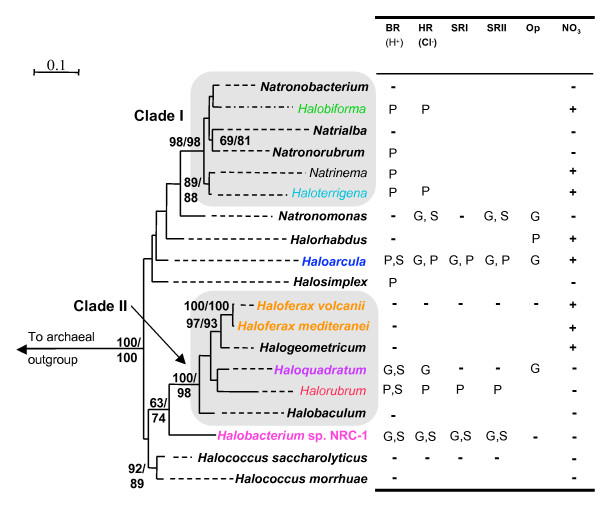
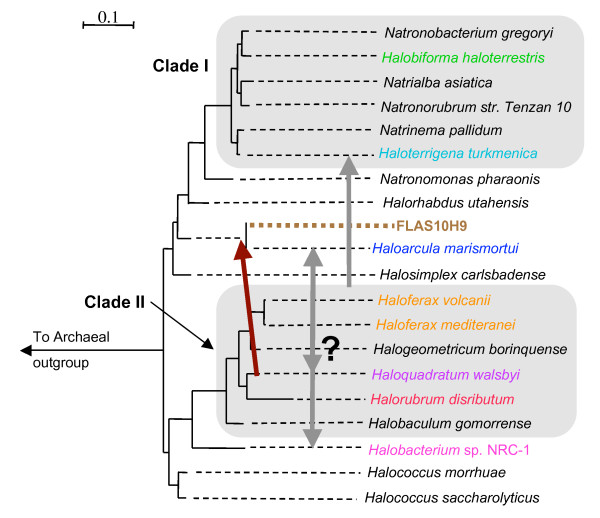
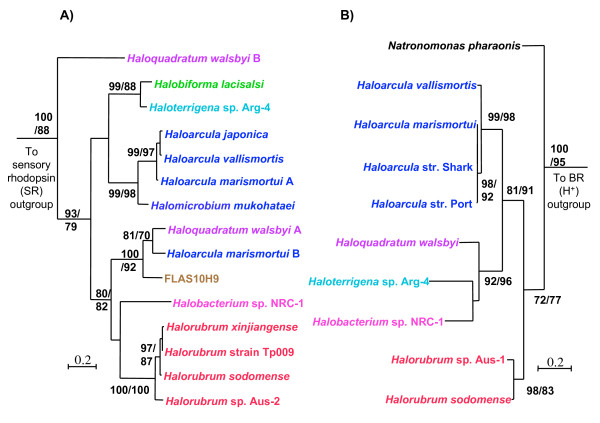
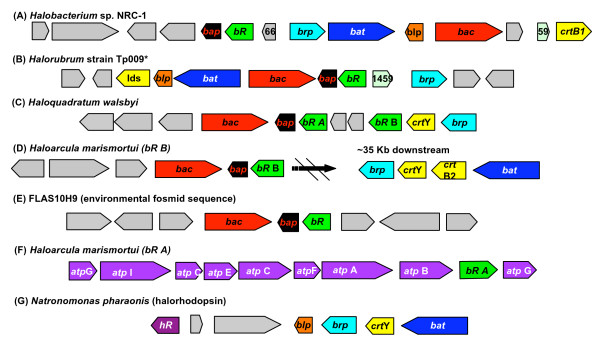
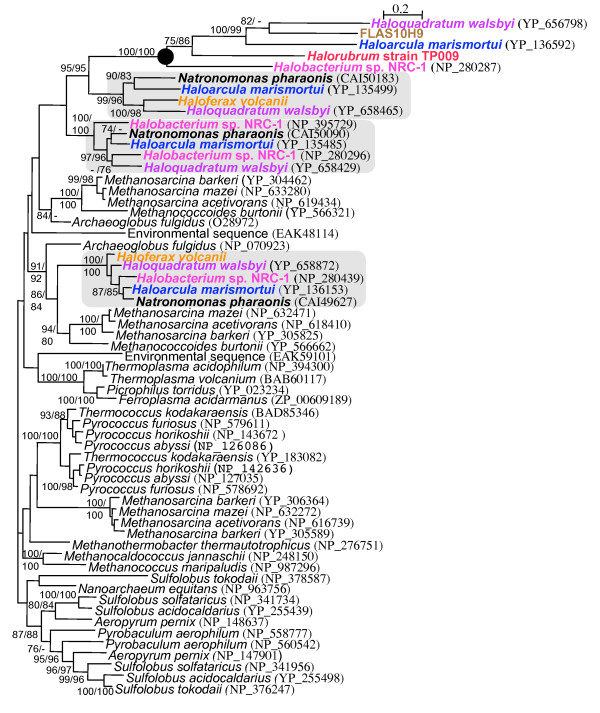
Mapping presence/absence of rhodopsins onto the phylogeny of the RNA polymerase B' subunit (RpoB') of the haloarchaea supports previous notions that rhodopsins are patchily distributed. The phylogeny for the bacteriorhodopsin (BR) protein revealed two discrepancies in comparison to the RpoB' marker, while the halorhodopsin (HR) tree showed incongruence to both markers. Comparative analyses of bacteriorhodopsin-linked regions of five haloarchaeal genomes supported relationships observed in the BR tree, and also identified two open reading frames (ORFs) that were more frequently linked to the bacteriorhodopsin gene than those genes previously shown to be important to the function and expression of BR.
The evidence presented here reveals a complex evolutionary history for the haloarchaeal rhodopsins, with both LGT and gene loss contributing to the patchy distribution of rhodopsins within this group. Similarities between the BR and RpoB' phylogenies provide supportive evidence for the presence of bacteriorhodopsin in the last common ancestor of haloarchaea. Furthermore, two loci that we have designated bacterio-opsin associated chaperone (bac) and bacterio-opsin associated protein (bap) are inferred to have important roles in BR biogenesis based on frequent linkage and co-transfer with bacteriorhodopsin genes.
1型(微生物)视紫红质是一类光化学反应性蛋白质,在生命的三个域中分布广泛但并不连续。最近的研究表明,这种分布模式可能是视紫红质基因在主要谱系之间,甚至跨域边界进行横向基因转移(LGT)的结果。在最初发现微生物视紫红质的谱系中,即嗜盐古菌中,也观察到了类似的不连续分布。在这项初步研究中,我们使用系统发育学和比较基因组学方法,评估LGT和基因丢失在嗜盐古菌视紫红质离子泵基因进化中的作用。
将视紫红质的有无情况映射到嗜盐古菌RNA聚合酶B'亚基(RpoB')的系统发育树上,支持了之前视紫红质分布不连续的观点。细菌视紫红质(BR)蛋白的系统发育显示,与RpoB'标记相比有两个差异,而嗜盐视紫红质(HR)树与这两个标记均不一致。对五个嗜盐古菌基因组中与细菌视紫红质相关区域的比较分析支持了BR树中观察到的关系,并且还鉴定出两个开放阅读框(ORF),它们与细菌视紫红质基因的联系比之前显示对BR功能和表达重要的那些基因更为频繁。
此处提供的证据揭示了嗜盐古菌视紫红质复杂的进化历史,LGT和基因丢失都导致了该类群中视紫红质的不连续分布。BR和RpoB'系统发育之间的相似性为嗜盐古菌的最后共同祖先中存在细菌视紫红质提供了支持性证据。此外,基于与细菌视紫红质基因的频繁连锁和共转移,我们推断两个位点,即细菌视蛋白相关伴侣蛋白(bac)和细菌视蛋白相关蛋白(bap),在BR生物合成中具有重要作用。