Jin Yiping, Shen Linling, Chong Eva-Marie, Hamrah Pedram, Zhang Qiang, Chen Lu, Dana M Reza
Schepens Eye Research Institute and the Massachusetts Eye & Ear Infirmary, Department of Ophthalmology, Harvard Medical School, Boston, MA 02114, USA.
Mol Vis. 2007 Apr 27;13:626-34.
Trafficking of corneal antigen-presenting cells (APC) to draining lymph nodes (LN) is critical in triggering immune responses. However, very little is known about the molecular regulation of this pathway. We investigated the expression and function of the chemokine receptor CCR7 in mediating corneal APC migration in inflammation.
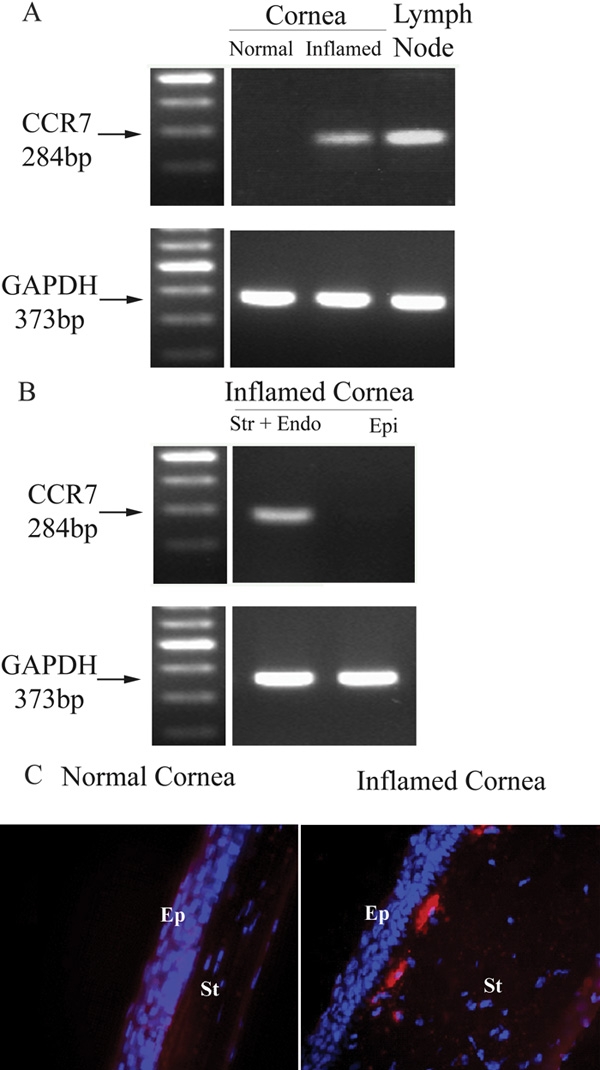
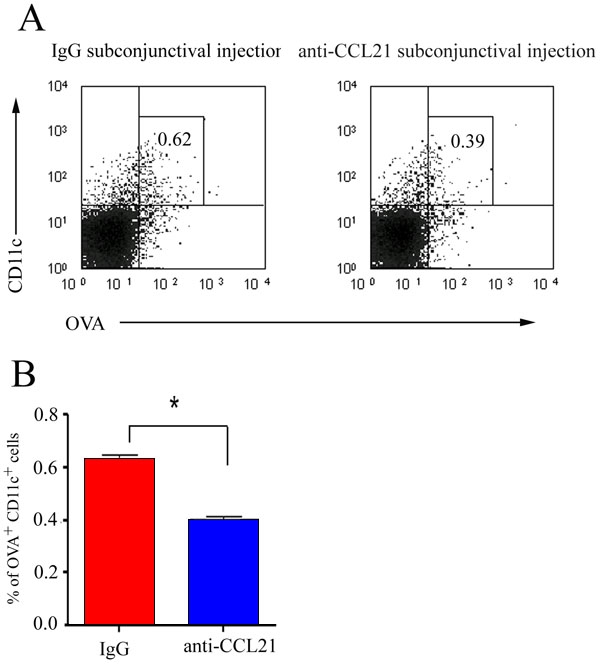
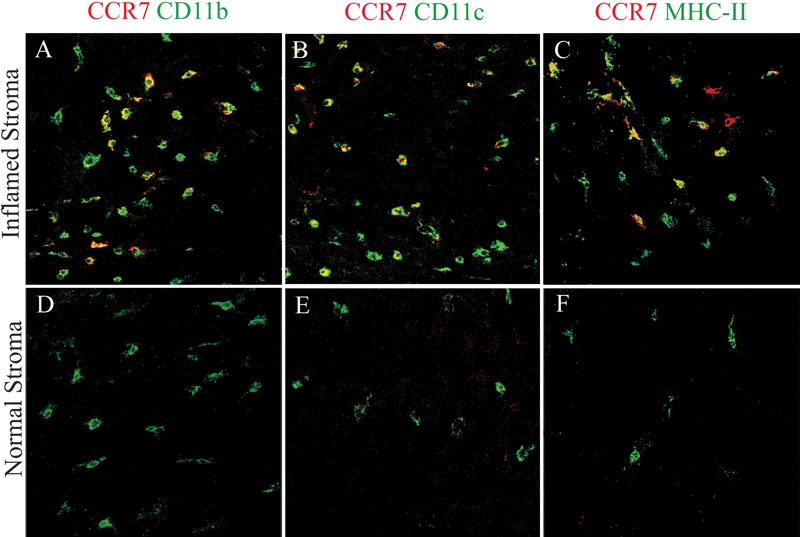
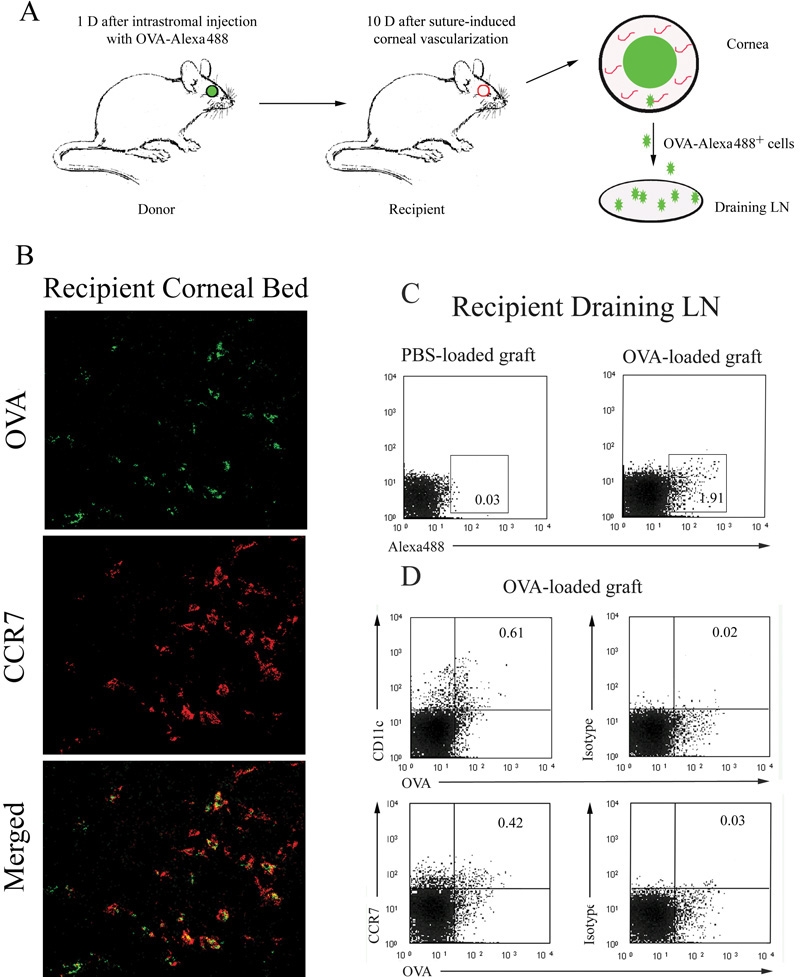
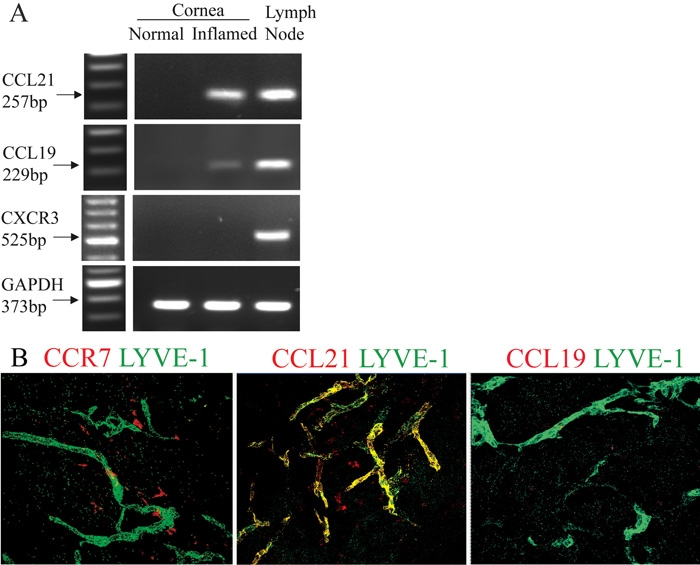
Expression of CCR7 and its ligands, CCL21 and CCL19, in the normal and inflamed corneas was analyzed by RT-PCR and immunofluorescence staining. The phenotype of CCR7-expressing cells was identified by double-staining with different cell surface markers. To trace the trafficking of APC to draining LN, we injected corneal grafts with Alexa488-conjugated ovalbumin (OVA) and transplanted to syngeneic recipients. CCR7 expression on the Alexa488-conjugated OVA+ cells in the ipsilateral draining LN was analyzed by flow cytometry. To determine the functional role of CCR7, we injected anti-CCL21 neutralizing antibody subconjunctivally after corneal transplantation and analyzed changes in numbers of OVA+ cells in the draining LN. Each experiment was repeated at least three times.
Both CCR7 and its ligand CCL21 were significantly upregulated in inflamed corneas as measured by RT-PCR and immunofluorescence staining. CCR7+ cells were detected especially in the corneal periphery near LYVE-1+ lymphatic vessels. CCR7+ cells were universally CD11b+CD11c+, and a majority were major histocompatibility complex class II positive, suggesting a monocytic dendritic cell lineage and a relative state of maturation. Forty-eight h after syngeneic transplantation with OVA-loaded grafts, CCR7 expression was detected on the OVA+ cells in both the host corneal beds and the draining LN. Local administration of anti-CCL21 led to a significant suppression in the flow of OVA+CD11c+ cells to the draining LN.
These data suggest that in inflammation, APC expressing CCR7 on their cell surface interact with CCL21 to facilitate their migration from the cornea to draining LN via afferent lymphatics.
角膜抗原呈递细胞(APC)向引流淋巴结(LN)的转运在触发免疫反应中至关重要。然而,对于该途径的分子调控知之甚少。我们研究了趋化因子受体CCR7在介导炎症中角膜APC迁移的表达及功能。
通过逆转录聚合酶链反应(RT-PCR)和免疫荧光染色分析正常和炎症角膜中CCR7及其配体CCL21和CCL19的表达。用不同细胞表面标志物双重染色鉴定表达CCR7的细胞表型。为追踪APC向引流LN的转运,我们将Alexa488偶联的卵清蛋白(OVA)注入角膜移植物并移植到同基因受体。通过流式细胞术分析同侧引流LN中Alexa488偶联的OVA+细胞上的CCR7表达。为确定CCR7的功能作用,我们在角膜移植后结膜下注射抗CCL21中和抗体,并分析引流LN中OVA+细胞数量的变化。每个实验至少重复三次。
通过RT-PCR和免疫荧光染色测量,CCR7及其配体CCL21在炎症角膜中均显著上调。特别是在LYVE-1+淋巴管附近的角膜周边检测到CCR7+细胞。CCR7+细胞普遍为CD11b+CD11c+,且大多数主要组织相容性复合体II类阳性,提示单核细胞树突状细胞谱系和相对成熟状态。用负载OVA的移植物进行同基因移植48小时后,在宿主角膜床和引流LN的OVA+细胞上均检测到CCR7表达。局部给予抗CCL21导致OVA+CD11c+细胞向引流LN的流动显著抑制。
这些数据表明,在炎症中,细胞表面表达CCR7的APC与CCL21相互作用,以促进其通过输入淋巴管从角膜迁移至引流LN。