Rivero-Müller Adolfo, Lajić Svetlana, Huhtaniemi Ilpo
Department of Physiology, University of Turku, Kiinamyllynkatu 10, Turku 20520, Finland.
Nucleic Acids Res. 2007;35(10):e78. doi: 10.1093/nar/gkm250. Epub 2007 May 21.
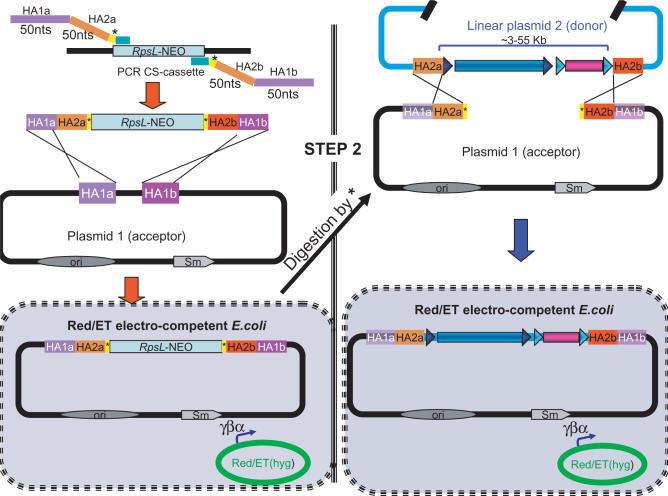
Functional genomics require manipulation and modification of large fragments of the genome. Such manipulation has only recently become more efficient due to the discovery of different techniques based on homologous recombination. However, certain limitations of these strategies still exist since insertion of homology arms (HAs) is often based on amplification of DNA sequences with PCR. Large quantities of PCR products longer than 4-5 kb can be difficult to obtain and the risk of mutations or mismatches increases with the size of the template that is being amplified. This can be overcome by adding HAs by conventional cloning techniques, but with large fragments such as entire genes the procedure becomes time-consuming and tedious. Second, homologous recombination techniques often require addition of antibiotic selection genes, which may not be desired in the final construct. Here, we report a method to overcome the size and selection marker limitations by a two- or three-step procedure. The method can insert any fragment into small or large episomes, without the need of an antibiotic selection gene. We have humanized the mouse luteinizing hormone receptor gene (Lhcgr) by inserting a approximately 55 kb fragment from a BAC clone containing the human Lhcgr gene into a 170 kb BAC clone comprising the entire mouse orthologue. The methodology is based on the rationale to introduce a counter-selection cassette flanked by unique restriction sites and HAs for the insert, into the vector that is modified. Upon enzymatic digestion, in vitro or in Escherichia coli, double-strand breaks are generated leading to recombination between the vector and the insert. The procedure described here is thus an additional powerful tool for manipulating large and complex genomic fragments.
功能基因组学需要对基因组的大片段进行操作和修饰。由于基于同源重组的不同技术的发现,这种操作直到最近才变得更加高效。然而,这些策略仍然存在某些局限性,因为同源臂(HAs)的插入通常基于通过聚合酶链反应(PCR)扩增DNA序列。难以获得大量长度超过4-5 kb的PCR产物,并且随着被扩增模板大小的增加,突变或错配的风险也会增加。这可以通过传统克隆技术添加HAs来克服,但对于诸如完整基因这样的大片段,该过程变得耗时且繁琐。其次,同源重组技术通常需要添加抗生素选择基因,而这在最终构建体中可能是不需要的。在此,我们报道一种通过两步或三步程序克服大小和选择标记限制的方法。该方法可以将任何片段插入小的或大的附加体中,而无需抗生素选择基因。我们通过将来自包含人促黄体生成素受体基因(Lhcgr)的BAC克隆的约55 kb片段插入包含整个小鼠同源物的170 kb BAC克隆中,实现了小鼠促黄体生成素受体基因(Lhcgr)的人源化。该方法基于以下原理:将一个由独特的限制性酶切位点和插入片段的HAs侧翼的反选择盒引入到被修饰的载体中。在体外或在大肠杆菌中进行酶切时,会产生双链断裂,导致载体与插入片段之间发生重组。因此,这里描述的程序是用于操作大的和复杂的基因组片段的又一强大工具。