Shi Chengyu, Papanikolaou Nikos, Yan Yulong, Weng Xuejun, Jiang Hongyu
Cancer Therapy and Research Center and UTHSCSA, San Antonio, Texas 78229, USA.
J Appl Clin Med Phys. 2006 May 25;7(2):1-8. doi: 10.1120/jacmp.v7i2.2230.
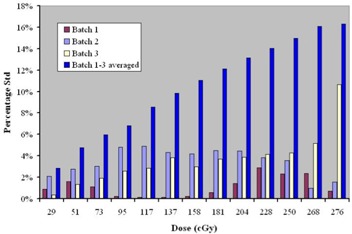
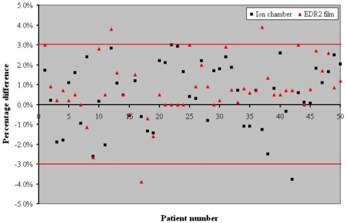
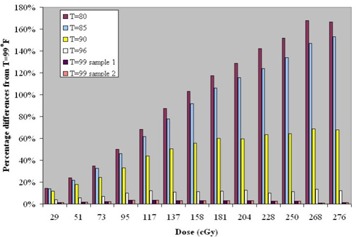
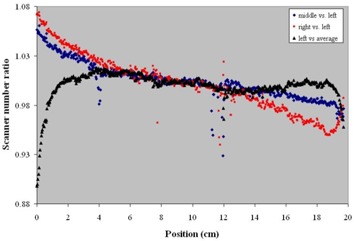
In our institution, patient specific quality assurance (QA) for intensity modulated radiation therapy (IMRT) is usually performed by measuring the dose to a point using an ion chamber and by measuring the dose to a plane using film. In order to perform absolute dose comparison measurements using film, an accurate calibration curve should be used. In this paper, we investigated the film response curve uncertainty factors including film batch differences, film processor temperature effect, film digitization, and treatment unit. In addition, we reviewed fifty patient-specific IMRT QA procedures performed in our institution in order to quantify the sources of error in film based dosimetry. Our study showed that the EDR2 film dosimetry can be done with less than 3% uncertainty. The EDR2 film response was not affected by the choice of treatment unit provided the nominal energy was the same. This investigation of the different sources of uncertainties in the film calibration procedure can provide a better understanding of the film based dosimetry and improve quality control for IMRT QA.
在我们机构,调强放射治疗(IMRT)的患者特异性质量保证(QA)通常通过使用电离室测量点剂量以及使用胶片测量平面剂量来进行。为了使用胶片进行绝对剂量比较测量,应使用准确的校准曲线。在本文中,我们研究了胶片响应曲线的不确定因素,包括胶片批次差异、胶片处理器温度效应、胶片数字化和治疗单元。此外,我们回顾了在我们机构进行的五十例患者特异性IMRT QA程序,以便量化基于胶片的剂量测定中的误差来源。我们的研究表明,EDR2胶片剂量测定的不确定度可控制在3%以内。只要标称能量相同,EDR2胶片响应不受治疗单元选择的影响。对胶片校准程序中不同不确定度来源的这项研究可以更好地理解基于胶片的剂量测定,并改善IMRT QA的质量控制。