Yohannes Indra, Prasetio Heru, Kallis Karoline, Bert Christoph
University Hospital Erlangen.
J Appl Clin Med Phys. 2016 Jul 8;17(4):106-113. doi: 10.1120/jacmp.v17i4.6194.
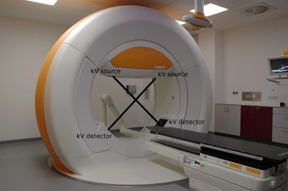
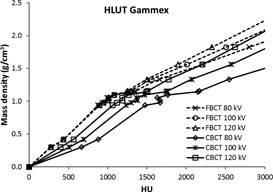
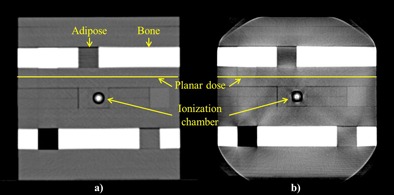
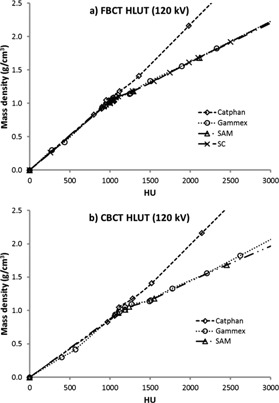
We report an investigation on the accuracy of dose calculation based on the cone-beam computed tomography (CBCT) images of the nonbowtie filter kV imaging system of the Vero linear accelerator. Different sets of materials and tube voltages were employed to generate the Hounsfield unit lookup tables (HLUTs) for both CBCT and fan-beam CT (FBCT) systems. The HLUTs were then implemented for the dose calculation in a treatment planning system (TPS). Dosimetric evaluation was carried out on an in-house-developed cube phantom that consists of water-equivalent slabs and inhomogeneity inserts. Two independent dosimeters positioned in the cube phantom were used in this study for point-dose and two-dimensional (2D) dose distribution measurements. The differences of HLUTs from various materials and tube voltages in both CT systems resulted in differences in dose calculation accuracy. We found that the higher the tube voltage used to obtain CT images, the better the point-dose calculation and the gamma passing rate of the 2D dose distribution agree to the values determined in the TPS. Moreover, the insert materials that are not tissue-equivalent led to higher dose-calculation inaccuracy. There were negligible differences in dosimetric evaluation between the CBCT- and FBCT-based treatment planning if the HLUTs were generated using the tissue-equivalent materials. In this study, the CBCT images of the Vero system from a complex inhomogeneity phantom can be applied for the TPS dose calculation if the system is calibrated using tissue-equivalent materials scanned at high tube voltage (i.e., 120 kV).
我们报告了一项关于基于Vero直线加速器的非蝴蝶结滤过千伏成像系统的锥束计算机断层扫描(CBCT)图像进行剂量计算准确性的研究。采用不同的材料组和管电压来生成CBCT和扇形束CT(FBCT)系统的亨氏单位查找表(HLUT)。然后将这些HLUT应用于治疗计划系统(TPS)中的剂量计算。在一个由水等效平板和不均匀性插入物组成的内部开发的立方体模体上进行剂量学评估。本研究中使用放置在立方体模体中的两个独立剂量计进行点剂量和二维(2D)剂量分布测量。两个CT系统中不同材料和管电压的HLUT差异导致剂量计算准确性的差异。我们发现,用于获取CT图像的管电压越高,点剂量计算以及2D剂量分布的伽马通过率与TPS中确定的值就越吻合。此外,非组织等效的插入材料会导致更高的剂量计算不准确性。如果使用组织等效材料生成HLUT,则基于CBCT和FBCT的治疗计划在剂量学评估方面的差异可以忽略不计。在本研究中,如果使用在高管电压(即120 kV)下扫描的组织等效材料对Vero系统进行校准,那么来自复杂不均匀性模体的Vero系统的CBCT图像可用于TPS剂量计算。