Grajales Alejandro, Aguilar Catalina, Sánchez Juan A
Departamento de Ciencias Biológicas-Facultad de Ciencias, Laboratorio Biología Molecular Marina (BIOMMAR), Universidad de Los Andes, Bogotá, Colombia.
BMC Evol Biol. 2007 Jun 11;7:90. doi: 10.1186/1471-2148-7-90.
Most phylogenetic studies using current methods have focused on primary DNA sequence information. However, RNA secondary structures are particularly useful in systematics because they include characteristics, not found in the primary sequence, that give "morphological" information. Despite the number of recent molecular studies on octocorals, there is no consensus opinion about a region that carries enough phylogenetic resolution to solve intrageneric or close species relationships. Moreover, intrageneric morphological information by itself does not always produce accurate phylogenies; intra-species comparisons can reveal greater differences than intra-generic ones. The search for new phylogenetic approaches, such as by RNA secondary structure analysis, is therefore a priority in octocoral research.
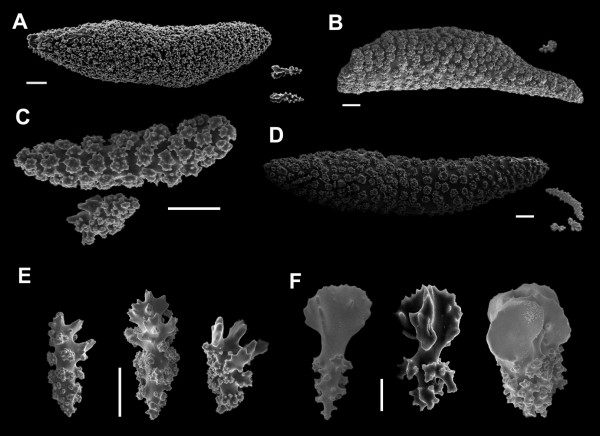
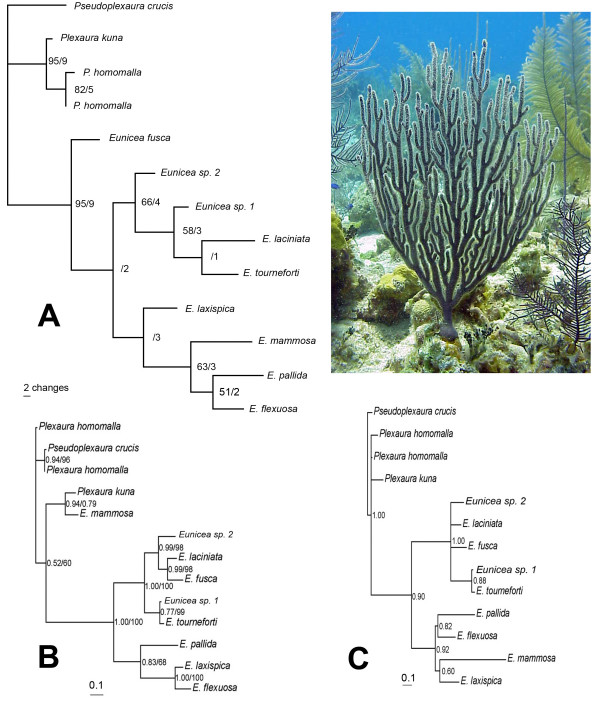
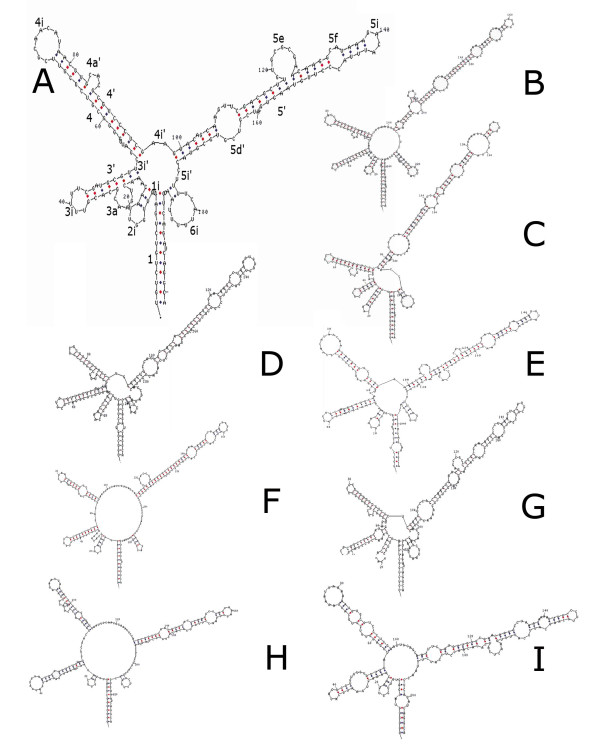
Initially, twelve predicted RNA secondary structures were reconstructed to provide the basic information for phylogenetic analyses; they accorded with the 6 helicoidal ring model, also present in other groups of corals and eukaryotes. We obtained three similar topologies for nine species of the Caribbean gorgonian genus Eunicea (candelabrum corals) with two sister taxa as outgroups (genera Plexaura and Pseudoplexaura) on the basis of molecular morphometrics of ITS2 RNA secondary structures only, traditional primary sequence analyses and maximum likelihood, and a Bayesian analysis of the combined data. The latter approach allowed us to include both primary sequence and RNA molecular morphometrics; each data partition was allowed to have a different evolution rate. In addition, each helix was partitioned as if it had evolved at a distinct rate. Plexaura flexuosa was found to group within Eunicea; this was best supported by both the molecular morphometrics and combined analyses. We suggest Eunicea flexuosa (Lamouroux, 1821) comb. nov., and we present a new species description including Scanning Electron Microscopy (SEM) images of morphological characteristics (sclerites). Eunicea flexuosa, E. pallida, E. laxispica and E. mammosa formed a separate clade in the molecular phylogenies, and were reciprocally monophyletic with respect to other Eunicea (Euniceopsis subgenus, e.g. E. tourneforti and E. laciniata) in the molecular morphometrics tree, with the exception of E. fusca. Moreover, we suggest a new diagnostic character for Eunicea, also present in E. flexuosa: middle layer sclerites > 1 mm in length.
ITS2 was a reliable sequence for intrageneric studies in gorgonian octocorals because of the amount of phylogenetic signal, and was corroborated against morphological characters separating Eunicea from Plexaura. The ITS2 RNA secondary structure approach to phylogeny presented here did not rely on alignment methods such as INDELS, but provided clearly homologous characters for partition analysis and RNA molecular morphometrics. These approaches support the divergence of Eunicea flexuosa comb. nov. from the outgroup Plexaura, although it has been considered part of this outgroup for nearly two centuries because of morphological resemblance.
目前大多数系统发育研究都聚焦于初级DNA序列信息。然而,RNA二级结构在系统学中特别有用,因为它们包含初级序列中不存在的特征,这些特征能提供“形态学”信息。尽管最近对八放珊瑚进行了大量分子研究,但对于一个具有足够系统发育分辨率以解决属内或近缘物种关系的区域,尚无共识。此外,属内形态学信息本身并不总能产生准确的系统发育树;种内比较可能揭示出比属内更大的差异。因此,寻找新的系统发育方法,如通过RNA二级结构分析,是八放珊瑚研究的当务之急。
最初,重建了12个预测的RNA二级结构,为系统发育分析提供基本信息;它们符合6螺旋环模型,该模型也存在于其他珊瑚类群和真核生物中。仅基于ITS2 RNA二级结构的分子形态计量学、传统的初级序列分析和最大似然法,以及对合并数据的贝叶斯分析,我们获得了加勒比海柳珊瑚属Eunicea(烛台珊瑚)9个物种的三种相似拓扑结构,以两个姐妹分类单元作为外类群(Plexaura属和Pseudoplexaura属)。后一种方法使我们能够纳入初级序列和RNA分子形态计量学;每个数据分区可以有不同的进化速率。此外,每个螺旋都被划分,就好像它以不同的速率进化一样。发现弯曲柔枝柳珊瑚(Plexaura flexuosa)归入Eunicea属;这在分子形态计量学和合并分析中都得到了最好的支持。我们建议将弯曲柔枝柳珊瑚(Eunicea flexuosa (Lamouroux, 1821) comb. nov.)重新组合,并给出一个新物种描述,包括形态特征(骨针)的扫描电子显微镜(SEM)图像。弯曲柔枝柳珊瑚、苍白柔枝柳珊瑚(E. pallida)、疏松柔枝柳珊瑚(E. laxispica)和乳房柔枝柳珊瑚(E. mammosa)在分子系统发育树中形成一个单独的分支,并且在分子形态计量学树中相对于其他Eunicea(Euniceopsis亚属,如托氏柔枝柳珊瑚(E. tourneforti)和条带柔枝柳珊瑚(E. laciniata))是相互单系的,但棕柔枝柳珊瑚(E. fusca)除外。此外,我们提出了一个Eunicea属的新诊断特征,弯曲柔枝柳珊瑚中也存在:中层骨针长度>1毫米。
由于系统发育信号的数量,ITS2是柳珊瑚八放珊瑚属内研究的可靠序列,并且与将Eunicea与Plexaura区分开的形态特征相佐证。本文提出的基于ITS2 RNA二级结构的系统发育方法不依赖于如插入缺失(INDELS)这样的数据比对方法,而是为分区分析和RNA分子形态计量学提供了明显同源的特征。这些方法支持了弯曲柔枝柳珊瑚(Eunicea flexuosa comb. nov.)与外类群Plexaura的分化,尽管由于形态相似,它在近两个世纪里一直被认为是这个外类群的一部分。