Lewis Claire E, Hughes Russell
Tumour Targeting Group, Academic Unit of Pathology, Section of Infection, Inflammation and Immunity, The Sir Henry Wellcome Laboratories for Medical Research, University of Sheffield Medical School, UK.
Breast Cancer Res. 2007;9(3):209. doi: 10.1186/bcr1679.
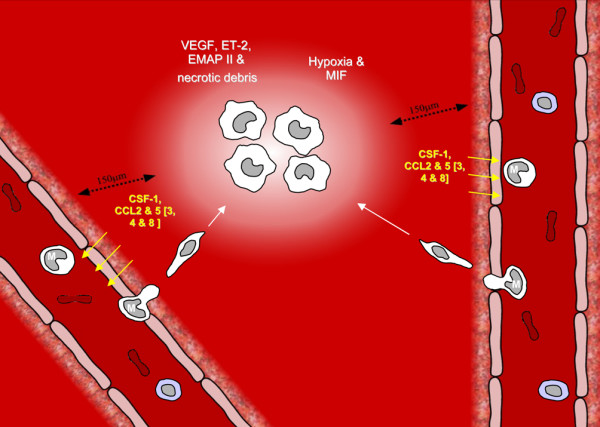
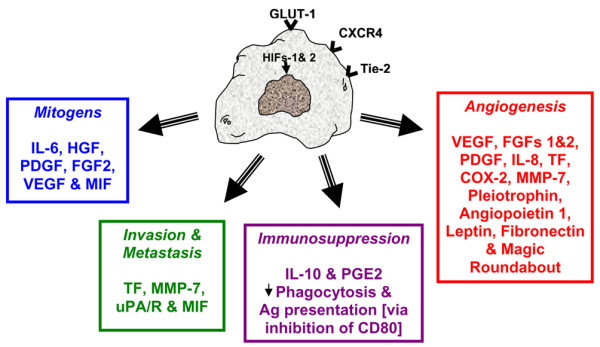
Considerable evidence has now accumulated for tumour-associated macrophages stimulating key aspects of tumour progression, including the proliferation, survival and metastasis of tumour cells, tumour angiogenesis and suppression of the anti-tumour functions of other immune effectors at the tumour site. Tumour micro-environmental factors such as hypoxia have profound, direct effects on these cells, stimulating many of their pro-tumour functions. Hypoxia also does so indirectly by stimulating the release of the cytokine angiopoietin-2 from tumour cells and tumour blood vessels. This in turn then recruits Tie-2-expressing monocytes into tumours from the bloodstream and inhibits their production of anti-apoptotic and anti-angiogenic cytokines.
目前已有大量证据表明,肿瘤相关巨噬细胞可刺激肿瘤进展的关键环节,包括肿瘤细胞的增殖、存活和转移、肿瘤血管生成以及抑制肿瘤部位其他免疫效应细胞的抗肿瘤功能。诸如缺氧等肿瘤微环境因素对这些细胞具有深远的直接影响,刺激它们的许多促肿瘤功能。缺氧还通过刺激肿瘤细胞和肿瘤血管释放细胞因子血管生成素-2而间接发挥作用。这反过来又会从血液中招募表达Tie-2的单核细胞进入肿瘤,并抑制它们产生抗凋亡和抗血管生成细胞因子。