Anney Richard J L, Lotfi-Miri Mehrnoush, Olsson Craig A, Reid Sophie C, Hemphill Sheryl A, Patton George C
Neuropsychiatric Genetics Research Group, Department of Psychiatry, Trinity College Dublin, Dublin, Ireland.
BMC Genet. 2007 Jul 3;8:46. doi: 10.1186/1471-2156-8-46.
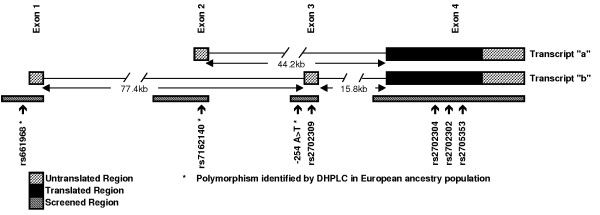
The mesolimbic structures of the brain are important in the anticipation and perception of reward. Moreover, many drugs of addiction elicit their response in these structures. The M5 muscarinic receptor (M5R) is expressed in dopamine-containing neurones of the substantia nigra pars compacta and ventral tegmental area, and regulates the release of mesolimbic dopamine. Mice lacking M5R show a substantial reduction in both reward and withdrawal responses to morphine and cocaine. The CHRM5, the gene that codes for the M5R, is a strong biological candidate for a role in human addiction. We screened the coding and core promoter sequences of CHRM5 using denaturing high performance liquid chromatography to identify common polymorphisms. Additional polymorphisms within the coding and core promoter regions that were identified through dbSNP were validated in the test population. We investigated whether these polymorphisms influence substance dependence and dose in a cohort of 1947 young Australians.
Analysis was performed on 815 participants of European ancestry who were interviewed at wave 8 of the cohort study and provided DNA. We observed a 26.8% increase in cigarette consumption in carriers of the rs7162140 T-allele, equating to 20.1 cigarettes per week (p=0.01). Carriers of the rs7162140 T-allele were also found to have nearly a 3-fold increased risk of developing cannabis dependence (OR=2.9 (95%CI 1.1-7.4); p=0.03).
Our data suggest that variation within the CHRM5 locus may play an important role in tobacco and cannabis but not alcohol addiction in European ancestry populations. This is the first study to show an association between CHRM5 and substance use in humans. These data support the further investigation of this gene as a risk factor in substance use and dependence.
大脑的中脑边缘结构在奖励的预期和感知中起着重要作用。此外,许多成瘾药物在这些结构中引发反应。M5毒蕈碱受体(M5R)在黑质致密部和腹侧被盖区含多巴胺的神经元中表达,并调节中脑边缘多巴胺的释放。缺乏M5R的小鼠对吗啡和可卡因的奖励及戒断反应大幅降低。编码M5R的基因CHRM5是人类成瘾中发挥作用的有力生物学候选基因。我们使用变性高效液相色谱法筛选CHRM5的编码和核心启动子序列,以鉴定常见多态性。通过dbSNP鉴定出的编码和核心启动子区域内的其他多态性在测试人群中得到验证。我们在1947名澳大利亚年轻人群体中调查了这些多态性是否影响物质依赖和剂量。
对队列研究第8波接受访谈并提供DNA的815名欧洲血统参与者进行了分析。我们观察到rs7162140 T等位基因携带者的香烟消费量增加了26.8%,相当于每周20.1支香烟(p = 0.01)。还发现rs7162140 T等位基因携带者患大麻依赖的风险增加了近3倍(OR = 2.9(95%CI 1.1 - 7.4);p = 0.03)。
我们的数据表明,CHRM5基因座内的变异可能在欧洲血统人群的烟草和大麻成瘾中起重要作用,但在酒精成瘾中不起作用。这是第一项显示CHRM5与人类物质使用之间存在关联的研究。这些数据支持进一步研究该基因作为物质使用和依赖的风险因素。