School of Psychological Science, University of Bristol, Bristol, UK.
MRC Integrative Epidemiology Unit, University of Bristol, Bristol, UK.
Addiction. 2022 Mar;117(3):741-750. doi: 10.1111/add.15673. Epub 2021 Sep 29.
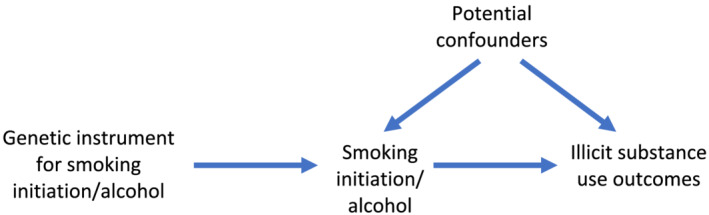
Initial use of drugs such as tobacco and alcohol may lead to subsequent more problematic drug use-the 'gateway' hypothesis. However, observed associations may be due to a shared underlying risk factor, such as trait impulsivity. We used bidirectional Mendelian randomization (MR) to test the gateway hypothesis.
Our main method was inverse-variance weighted (IVW) MR, with other methods included as sensitivity analyses (where consistent results across methods would raise confidence in our primary results). MR is a genetic instrumental variable approach used to support stronger causal inference in observational studies.
Genome-wide association summary data among European ancestry individuals for smoking initiation, alcoholic drinks per week, cannabis use and dependence, cocaine and opioid dependence (n = 1749-1 232 091).
Genetic variants for exposure.
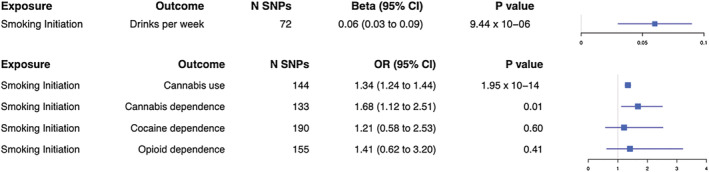
We found evidence of causal effects from smoking initiation to increased drinks per week [(IVW): β = 0.06; 95% confidence interval (CI) = 0.03-0.09; P = 9.44 × 10 ], cannabis use [IVW: odds ratio (OR) = 1.34; 95% CI = 1.24-1.44; P = 1.95 × 10 ] and cannabis dependence (IVW: OR = 1.68; 95% CI = 1.12-2.51; P = 0.01). We also found evidence of an effect of cannabis use on the increased likelihood of smoking initiation (IVW: OR = 1.39; 95% CI = 1.08-1.80; P = 0.01). We did not find evidence of an effect of drinks per week on other substance use outcomes, except weak evidence of an effect on cannabis use (IVW: OR = 0.55; 95% CI = 0.16-1.93; P-value = 0.35). We found weak evidence of an effect of opioid dependence on increased drinks per week (IVW: β = 0.002; 95% CI = 0.0005-0.003; P = 8.61 × 10 ).
Bidirectional Mendelian randomization testing of the gateway hypothesis reveals that smoking initiation may lead to increased alcohol consumption, cannabis use and cannabis dependence. Cannabis use may also lead to smoking initiation and opioid dependence to alcohol consumption. However, given that tobacco and alcohol use typically begin before other drug use, these results may reflect a shared risk factor or a bidirectional effect for cannabis use and opioid dependence.
最初使用烟草和酒精等药物可能会导致随后更成问题的药物使用——“门户”假说。然而,观察到的关联可能是由于共同的潜在风险因素,例如特质冲动性。我们使用双向孟德尔随机化 (MR) 来检验门户假说。
我们的主要方法是逆方差加权 (IVW) MR,其他方法包括作为敏感性分析(如果方法之间的结果一致,则会提高对我们主要结果的信心)。MR 是一种基于遗传的工具变量方法,用于在观察性研究中支持更强的因果推断。
欧洲血统个体中关于吸烟起始、每周饮酒量、大麻使用和依赖、可卡因和阿片类药物依赖的全基因组关联汇总数据(n=1749-1232091)。
暴露的遗传变异。
我们发现吸烟起始与每周饮酒量增加之间存在因果关系的证据[IVW:β=0.06;95%置信区间(CI)=0.03-0.09;P=9.44×10⁻⁸]、大麻使用[IVW:比值比(OR)=1.34;95%CI=1.24-1.44;P=1.95×10⁻¹⁰]和大麻依赖[IVW:OR=1.68;95%CI=1.12-2.51;P=0.01]。我们还发现大麻使用对增加吸烟起始可能性的影响的证据[IVW:OR=1.39;95%CI=1.08-1.80;P=0.01]。我们没有发现每周饮酒量对其他物质使用结果的影响的证据,除了对大麻使用的微弱影响[IVW:OR=0.55;95%CI=0.16-1.93;P 值=0.35]。我们发现阿片类药物依赖对每周饮酒量增加的影响的微弱证据[IVW:β=0.002;95%CI=0.0005-0.003;P=8.61×10⁻⁸]。
双向孟德尔随机化检验门户假说表明,吸烟起始可能导致饮酒量增加、大麻使用和大麻依赖。大麻使用也可能导致吸烟起始和阿片类药物依赖导致饮酒。然而,鉴于烟草和酒精的使用通常在其他药物使用之前开始,这些结果可能反映了共同的风险因素或大麻使用和阿片类药物依赖的双向影响。