Reeve Janice L V, Szegezdi Eva, Logue Susan E, Ní Chonghaile Tríona, O'Brien Timothy, Ritter Thomas, Samali Afshin
Department of Biochemistry, National Centre for Biomedical Engineering Science, National University of Ireland, Galway, Ireland.
J Cell Mol Med. 2007 May-Jun;11(3):509-20. doi: 10.1111/j.1582-4934.2007.00042.x.
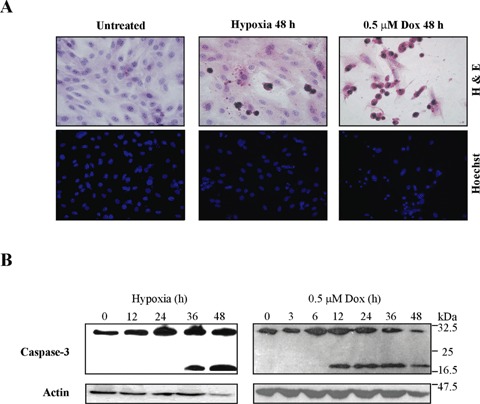
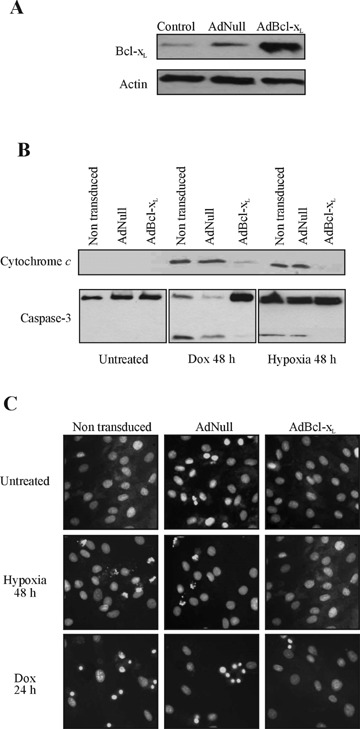
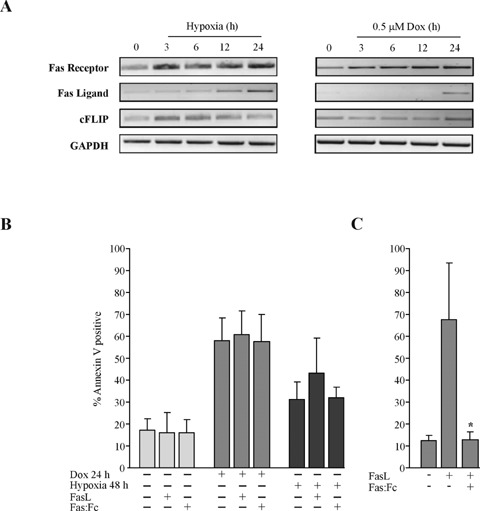
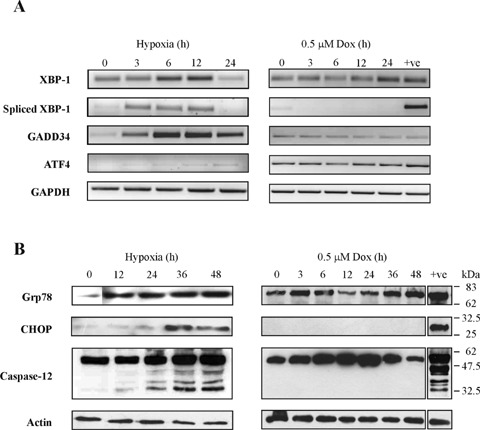
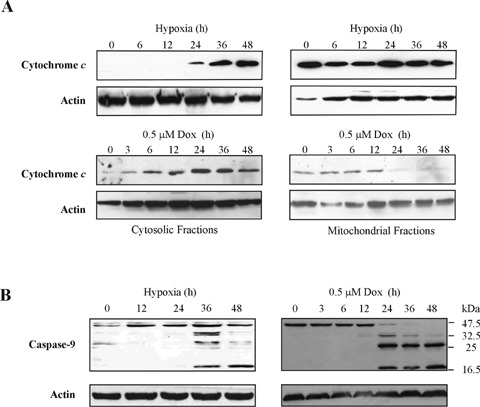
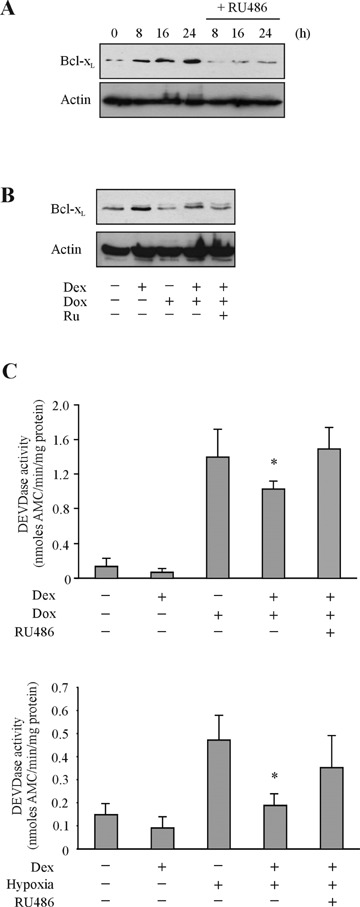
Hypoxia and doxorubicin can cause cardiotoxicity and loss of myocardial function. These effects are due, in part, to an induction of apoptosis. Herein we identify the apoptotic pathways activated in H9c2 cells in response to hypoxia (O(2)/N(2)/CO(2), 0.5:94.5:5) and doxorubicin (0.5 muM). Although the apoptosis induced was accompanied by induction of Fas and Fas ligand, the death receptor pathway was not critical for caspase activation by either stimulus. Hypoxia induced the expression of endoplasmic reticulum (ER) stress mediators and processed ER-resident pro-caspase-12 whereas doxorubicin did not induce an ER stress response. Most importantly, both stimuli converged on mitochondria to promote apoptosis. Accumulation of cytochrome c in the cytosol coincided with the processing of pro-caspase-9 and -3. Increasing the expression of the anti-apoptotic protein Bcl-x(L), either by dexamethasone or adenovirus-mediated transduction, protected H9c2 cells from doxorubicin- and hypoxia-induced apoptosis. Bcl-x(L) attenuated mitochondrial cytochrome crelease and reduced downstream pro-caspase processing and apoptosis. These data demonstrate that two distinct cardiomyocyte-damaging stimuli converge on mitochondria thus presenting this organelle as a potentially important therapeutic target for anti-apoptotic strategies for cardiovascular diseases.
缺氧和阿霉素可导致心脏毒性和心肌功能丧失。这些影响部分归因于细胞凋亡的诱导。在此,我们确定了H9c2细胞在缺氧(氧气/氮气/二氧化碳,0.5:94.5:5)和阿霉素(0.5μM)刺激下激活的凋亡途径。虽然诱导的细胞凋亡伴随着Fas和Fas配体的诱导,但死亡受体途径对这两种刺激激活半胱天冬酶并不关键。缺氧诱导内质网(ER)应激介质的表达并加工内质网驻留的前半胱天冬酶-12,而阿霉素未诱导ER应激反应。最重要的是,两种刺激均作用于线粒体以促进细胞凋亡。细胞色素c在细胞质中的积累与前半胱天冬酶-9和-3的加工同时发生。通过地塞米松或腺病毒介导的转导增加抗凋亡蛋白Bcl-x(L)的表达,可保护H9c2细胞免受阿霉素和缺氧诱导的细胞凋亡。Bcl-x(L)减弱线粒体细胞色素c的释放,并减少下游前半胱天冬酶的加工和细胞凋亡。这些数据表明,两种不同的心肌细胞损伤刺激均作用于线粒体,从而使该细胞器成为心血管疾病抗凋亡策略的潜在重要治疗靶点。