Hickish T F, Purvies H, Mansi J, Soukop M, Cunningham D
Section of Medicine, Royal Marsden Hospital, Sutton, Surrey, UK.
Br J Cancer. 1991 Dec;64(6):1161-3. doi: 10.1038/bjc.1991.482.
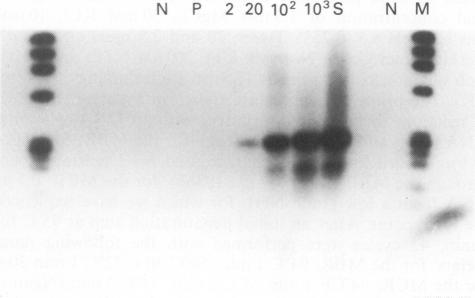
Molecular monitoring by the polymerase chain reaction was used to detect and follow minimal disease in working formulation category B and C on non-Hodgkin's lymphoma. Rearrangement of the bcl-2 gene served as the target for gene amplification. Thirty patients were studied. Bone marrow histology was compared to PCR analysis of bone marrow aspirate and blood. PCR upstaged disease status in approximately 50% of patients. Results are shown from a patient whose disease was followed with PCR during chemotherapy from initial remission to relapse. We conclude that PCR of bone marrow and blood can be used to upstage disease status in low grade lymphoma and PCR of blood may be used to monitor response to treatment with obvious patient benefit. The general approach of molecular monitoring provides a means for appraising therapies in the setting of subclinical disease.
采用聚合酶链反应进行分子监测,以检测和追踪B类和C类工作制剂中非霍奇金淋巴瘤的微小病变。bcl-2基因重排作为基因扩增的靶点。对30例患者进行了研究。将骨髓组织学与骨髓穿刺液和血液的PCR分析进行了比较。PCR使约50%的患者疾病分期上升。结果显示的是一名患者在化疗期间从初始缓解到复发过程中通过PCR追踪疾病的情况。我们得出结论,骨髓和血液的PCR可用于提高低度淋巴瘤的疾病分期,血液的PCR可用于监测治疗反应,对患者有明显益处。分子监测的一般方法为在亚临床疾病情况下评估治疗提供了一种手段。