Jansen Aaltje P D, van Hout Hein P J, van Marwijk Harm W J, Nijpels Giel, Gundy Chad, Vernooij-Dassen Myrra J F J, de Vet Henrica C W, Schellevis François G, Stalman Wim A B
EMGO Institute, VU University medical center, Amsterdam, The Netherlands.
Clin Pract Epidemiol Ment Health. 2007 Jul 23;3:11. doi: 10.1186/1745-0179-3-11.
The Sense of Competence Questionnaire (SCQ) was originally developed for informal caregivers of patients with diagnosed dementia. In order to study the validity and usefulness of the SCQ when applied to informal caregivers of older adults with dementia symptoms (i.e. cognitive impairment, pre-diagnostic dementia or dementia in its early stages), we investigated the construct validity, feasibility, subscales, homogeneity, and floor and ceiling effects in this new target population.
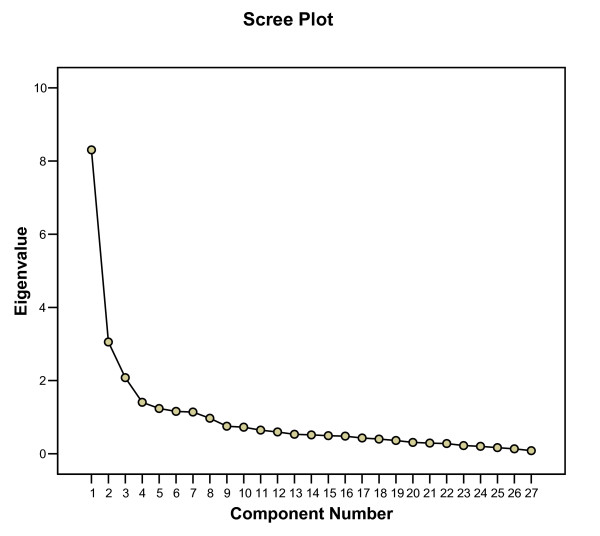
A psychometric evaluation was performed among 99 informal caregivers. To investigate construct validity, hypotheses were tested, concerning the association between sense of competence and burden, mental quality of life, depressive symptoms, and mastery. To investigate feasibility, response rate and the proportion of missing data were explored for each item. An exploratory principal component analysis was used to investigate whether the SCQ comprises the three subscales established in previous studies. Homogeneity was assessed for each subscale with Cronbach's alpha and item-total correlations. Floor and ceiling effects were explored.
Most hypotheses on construct validity were rejected. Only the subscale 'consequences of involvement in care' was found to be partly valid. Feasibility: 93 out of 99 persons completed the SCQ. The proportion of unanswered items per item ranged from 0-3%. Subscales: the SCQ comprises the three expected subscales. Homogeneity: Cronbach's alpha and item-total correlations of the three subscales were satisfactory. A ceiling effect occurred on the subscale 'satisfaction with the care recipient'.
The three subscales of the SCQ showed good homogeneity and feasibility, but their validity is insufficient: only the subscale 'consequences of involvement' was found to be partly valid. The two other subscales might not be relevant yet for the new target population, since many of the items on these scales refer to problem behaviour and problematic interactions. Our message to clinicians is not to use these subscales.
胜任感问卷(SCQ)最初是为已确诊痴呆症患者的非正式照料者开发的。为了研究SCQ应用于有痴呆症状(即认知障碍、诊断前痴呆或早期痴呆)的老年人的非正式照料者时的有效性和实用性,我们调查了这一新目标人群中的结构效度、可行性、分量表、同质性以及地板效应和天花板效应。
对99名非正式照料者进行了心理测量学评估。为了调查结构效度,检验了关于胜任感与负担、心理生活质量、抑郁症状和掌控感之间关联的假设。为了调查可行性,探讨了每个项目的回复率和缺失数据的比例。采用探索性主成分分析来研究SCQ是否包含先前研究中确立的三个分量表。用克朗巴哈系数和项目与总分的相关性对每个分量表的同质性进行评估。探索了地板效应和天花板效应。
关于结构效度的大多数假设被拒绝。仅发现“照料参与的后果”分量表部分有效。可行性:99人中93人完成了SCQ。每个项目未作答项目的比例在0 - 3%之间。分量表:SCQ包含三个预期的分量表。同质性:三个分量表的克朗巴哈系数和项目与总分的相关性令人满意。在“对照料接受者的满意度”分量表上出现了天花板效应。
SCQ的三个分量表显示出良好的同质性和可行性,但其效度不足:仅发现“参与的后果”分量表部分有效。另外两个分量表可能对新目标人群不相关,因为这些量表上的许多项目涉及问题行为和有问题的互动。我们给临床医生的建议是不要使用这些分量表。