Toyabe Shin-ichi, Shioiri Toshiki, Kobayashi Kuriko, Kuwabara Hideki, Koizumi Masataka, Endo Taro, Ito Miki, Honma Hiroko, Fukushima Noboru, Someya Toshiyuki, Akazawa Kouhei
Department of Medical Informatics, Niigata University Medical and Dental Hospital, Asahimachi-Dori 1, Niigata, Japan.
BMC Public Health. 2007 Jul 24;7:175. doi: 10.1186/1471-2458-7-175.
Factor structure of the 12-item General Health Questionnaire (GHQ-12) was studied by a survey of subjects who had experienced the 2004 Niigata-Chuetsu earthquake (6.8 on the Richter scale) in Japan.
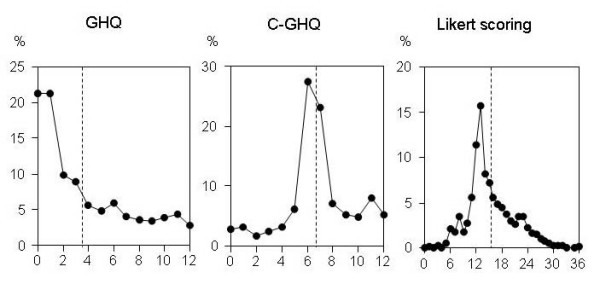
Psychological distress was measured at two years after the earthquake by using GHQ-12 in 2,107 subjects (99.0% response rate) who suffered the earthquake. GHQ-12 was scored by binary, chronic and Likert scoring method. Confirmatory factor analysis was used to reveal the factor structure of GHQ-12. Categorical regression analysis was performed to evaluate the relationships between various background factors and GHQ-12 scores.
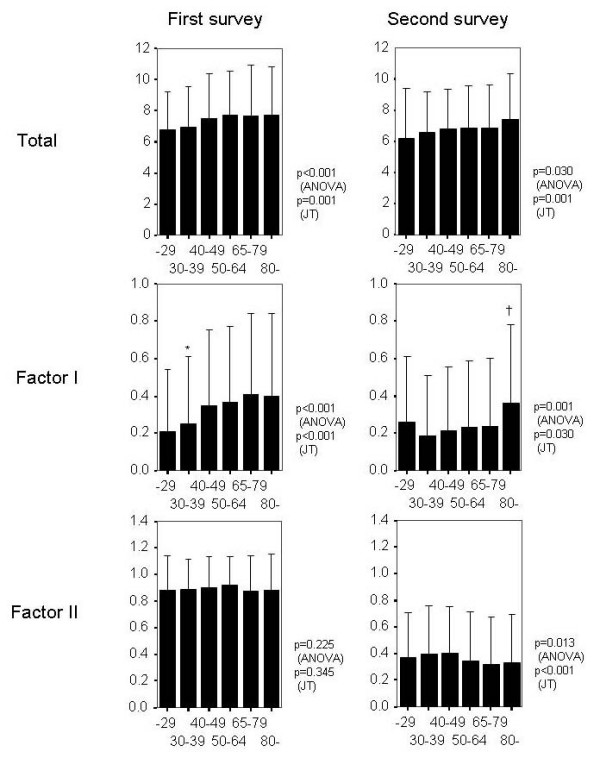
Confirmatory factor analysis revealed that the model consisting of the two factors and using chronic method gave the best goodness-of-fit among the various models for factor structure. Recovery in the scale for the factor 'social dysfunction' was remarkably impaired compared with that of the factor 'dysphoria'. Categorical regression analysis revealed that various factors, including advanced age, were associated with psychological distress. Advanced age affected the impaired recovery of factor 'social dysfunction' score as well as total GHQ score.
The two-factor structure of GHQ-12 was conserved between the survey at five month and that at two years after the earthquake. Impaired recovery in the ability to cope with daily problems in the subjects who had experienced the earthquake was remarkable even at two years after the earthquake.
通过对经历了2004年日本新潟中越地震(里氏6.8级)的受试者进行调查,研究了12项一般健康问卷(GHQ - 12)的因子结构。
在地震发生两年后,使用GHQ - 12对2107名遭受地震的受试者(应答率99.0%)进行心理困扰测量。GHQ - 12采用二分法、慢性病法和李克特计分法进行计分。采用验证性因子分析来揭示GHQ - 12的因子结构。进行分类回归分析以评估各种背景因素与GHQ - 12得分之间的关系。
验证性因子分析表明,由两个因子组成并采用慢性病法的模型在各种因子结构模型中拟合优度最佳。与“烦躁不安”因子相比,“社会功能障碍”因子量表的恢复明显受损。分类回归分析表明,包括高龄在内的各种因素与心理困扰有关。高龄影响了“社会功能障碍”因子得分以及GHQ总分的受损恢复。
GHQ - 12的两因子结构在地震后五个月和两年的调查之间保持不变。即使在地震两年后,经历地震的受试者应对日常问题能力的恢复受损仍很明显。