Toyabe Shin-ichi, Shioiri Toshiki, Kuwabara Hideki, Endoh Taroh, Tanabe Naohito, Someya Toshiyuki, Akazawa Kouhei
Department of Medical Informatics, Niigata University Medical and Dental Hospital, Asahimachi-Dori 1, Niigata 951-8520, Japan.
BMC Public Health. 2006 Sep 14;6:230. doi: 10.1186/1471-2458-6-230.
An earthquake measuring 6.8 on the Richter scale struck the Niigata-Chuetsu region of Japan at 5.56 P.M. on the 23rd of October, 2004. The earthquake was followed by sustained occurrence of numerous aftershocks, which delayed reconstruction of community lifelines. Even one year after the earthquake, 9,160 people were living in temporary housing. Such a devastating earthquake and life after the earthquake in an unfamiliar environment should cause psychological distress, especially among the elderly.
Psychological distress was measured using the 12-item General Health Questionnaire (GHQ-12) in 2,083 subjects (69% response rate) who were living in transient housing five months after the earthquake. GHQ-12 was scored using the original method, Likert scoring and corrected method. The subjects were asked to assess their psychological status before the earthquake, their psychological status at the most stressful time after the earthquake and their psychological status at five months after the earthquake. Exploratory and confirmatory factor analysis was used to reveal the factor structure of GHQ12. Multiple regression analysis was performed to analyze the relationship between various background factors and GHQ-12 score and its subscale.
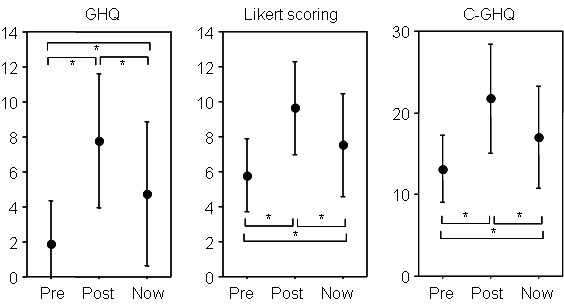
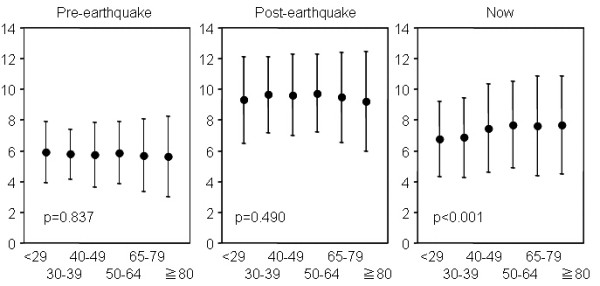
GHQ-12 scores were significantly elevated at the most stressful time and they were significantly high even at five months after the earthquake. Factor analysis revealed that a model consisting of two factors (social dysfunction and dysphoria) using corrected GHQ scoring showed a high level of goodness-of-fit. Multiple regression analysis revealed that age of subjects affected GHQ-12 scores. GHQ-12 score as well as its factor 'social dysfunction' scale were increased with increasing age of subjects at five months after the earthquake.
Impaired psychological recovery was observed even at five months after the Niigata-Chuetsu Earthquake in the elderly. The elderly were more affected by matters relating to coping with daily problems.
2004年10月23日下午5点56分,日本新潟中越地区发生了里氏6.8级地震。地震后余震持续不断,这延误了社区生命线的重建。即使在地震发生一年后,仍有9160人居住在临时住房中。如此具有毁灭性的地震以及在陌生环境中的震后生活,应该会导致心理困扰,尤其是在老年人当中。
采用12项一般健康问卷(GHQ - 12)对地震五个月后居住在临时住房中的2083名受试者(应答率69%)进行心理困扰测量。GHQ - 12采用原始方法、李克特计分法和校正法进行计分。受试者被要求评估他们在地震前的心理状态、地震后压力最大时的心理状态以及地震五个月后的心理状态。采用探索性和验证性因素分析来揭示GHQ12的因素结构。进行多元回归分析以分析各种背景因素与GHQ - 12得分及其子量表之间的关系。
在压力最大时,GHQ - 12得分显著升高,即使在地震五个月后也显著偏高。因素分析显示,使用校正后的GHQ计分法,由两个因素(社会功能障碍和烦躁不安)组成的模型具有较高的拟合优度。多元回归分析显示,受试者的年龄会影响GHQ - 12得分。在地震五个月后,随着受试者年龄的增加,GHQ - 12得分及其“社会功能障碍”因子量表均升高。
新潟中越地震五个月后,老年人的心理恢复仍受到损害。老年人更容易受到与应对日常问题相关事宜的影响。