Intelligent Data Analysis Laboratory, Fraunhofer Institute FIRST, Berlin, Germany.
PLoS One. 2007 Jul 25;2(7):e637. doi: 10.1371/journal.pone.0000637.
Brain computer interfaces (BCI) based on electro-encephalography (EEG) have been shown to detect mental states accurately and non-invasively, but the equipment required so far is cumbersome and the resulting signal is difficult to analyze. BCI requires accurate classification of small amplitude brain signal components in single trials from recordings which can be compromised by currents induced by muscle activity.
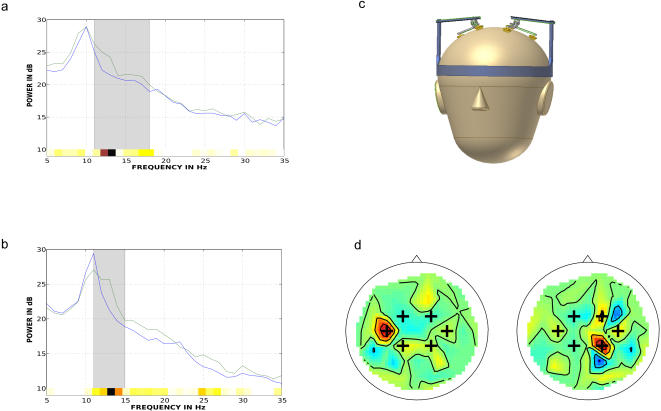
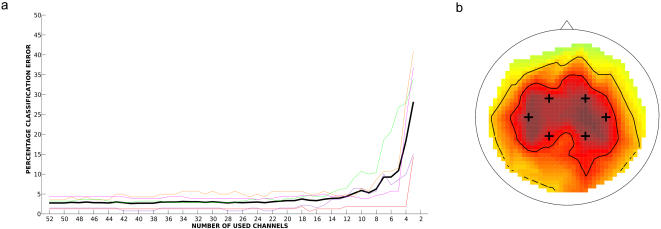
METHODOLOGY/PRINCIPAL FINDINGS: A novel EEG cap based on dry electrodes was developed which does not need time-consuming gel application and uses far fewer electrodes than on a standard EEG cap set-up. After optimizing the placement of the 6 dry electrodes through off-line analysis of standard cap experiments, dry cap performance was tested in the context of a well established BCI cursor control paradigm in 5 healthy subjects using analysis methods which do not necessitate user training. The resulting information transfer rate was on average about 30% slower than the standard cap. The potential contribution of involuntary muscle activity artifact to the BCI control signal was found to be inconsequential, while the detected signal was consistent with brain activity originating near the motor cortex.
CONCLUSIONS/SIGNIFICANCE: Our study shows that a surprisingly simple and convenient method of brain activity imaging is possible, and that simple and robust analysis techniques exist which discriminate among mental states in single trials. Within 15 minutes the dry BCI device is set-up, calibrated and ready to use. Peak performance matched reported EEG BCI state of the art in one subject. The results promise a practical non-invasive BCI solution for severely paralyzed patients, without the bottleneck of setup effort and limited recording duration that hampers current EEG recording technique. The presented recording method itself, BCI not considered, could significantly widen the use of EEG for emerging applications requiring long-term brain activity and mental state monitoring.
基于脑电图(EEG)的脑机接口(BCI)已被证明能够准确、非侵入性地检测到精神状态,但迄今为止所需的设备繁琐,且得到的信号难以分析。BCI 需要对来自记录的单次试验中小幅度脑信号成分进行准确分类,而这可能会受到肌肉活动引起的电流的影响。
方法/主要发现:开发了一种基于干电极的新型 EEG 帽,它不需要耗时的凝胶应用,并且使用的电极比标准 EEG 帽设置少得多。通过对标准帽实验的离线分析优化了 6 个干电极的放置位置后,在 5 名健康受试者中使用不需要用户培训的分析方法,在已建立的 BCI 光标控制范式中测试了干帽的性能。得到的信息传输率比标准帽平均慢约 30%。发现无意识肌肉活动伪影对 BCI 控制信号的潜在贡献可以忽略不计,而检测到的信号与起源于运动皮层附近的脑活动一致。
结论/意义:我们的研究表明,一种非常简单和方便的大脑活动成像方法是可能的,并且存在简单而强大的分析技术,可以在单次试验中区分不同的精神状态。在 15 分钟内,干 BCI 设备即可完成设置、校准并准备使用。在一名受试者中,其峰值性能与报告的 EEG BCI 最先进水平相匹配。研究结果有望为严重瘫痪患者提供一种实用的非侵入性 BCI 解决方案,而无需当前 EEG 记录技术的设置工作瓶颈和有限的记录持续时间。如果不考虑 BCI,所提出的记录方法本身就可以极大地拓宽 EEG 在需要长期大脑活动和精神状态监测的新兴应用中的使用。