Peter Medawar Building for Pathogen Research, Nuffield Department of Clinical Medicine, University of Oxford, Oxford, United Kingdom; Centre for Clinical Immunology and Biomedical Statistics, Royal Perth Hospital and Murdoch University, Perth, Australia.
PLoS One. 2007 Jul 25;2(7):e649. doi: 10.1371/journal.pone.0000649.
CD4+ T cell help is critical in maintaining antiviral immune responses and such help has been shown to be sustained in acute resolving hepatitis C. In contrast, in evolving chronic hepatitis C CD4+ T cell helper responses appear to be absent or short-lived, using functional assays.
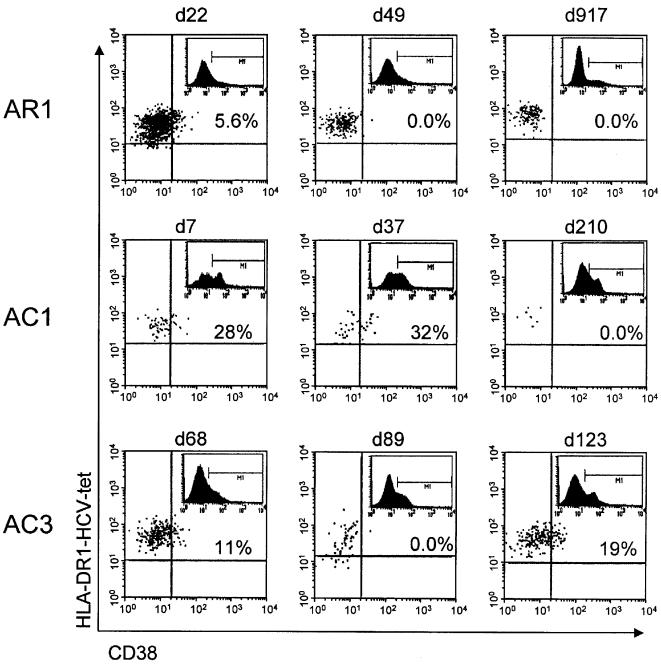
METHODOLOGY/PRINCIPAL FINDINGS: Here we used a novel HLA-DR1 tetramer containing a highly targeted CD4+ T cell epitope from the hepatitis C virus non-structural protein 4 to track number and phenotype of hepatitis C virus specific CD4+ T cells in a cohort of seven HLA-DR1 positive patients with acute hepatitis C in comparison to patients with chronic or resolved hepatitis C. We observed peptide-specific T cells in all seven patients with acute hepatitis C regardless of outcome at frequencies up to 0.65% of CD4+ T cells. Among patients who transiently controlled virus replication we observed loss of function, and/or physical deletion of tetramer+ CD4+ T cells before viral recrudescence. In some patients with chronic hepatitis C very low numbers of tetramer+ cells were detectable in peripheral blood, compared to robust responses detected in spontaneous resolvers. Importantly we did not observe escape mutations in this key CD4+ T cell epitope in patients with evolving chronic hepatitis C.
CONCLUSIONS/SIGNIFICANCE: During acute hepatitis C a CD4+ T cell response against this epitope is readily induced in most, if not all, HLA-DR1+ patients. This antiviral T cell population becomes functionally impaired or is deleted early in the course of disease in those where viremia persists.
CD4+ T 细胞的辅助作用对于维持抗病毒免疫反应至关重要,研究表明这种辅助作用在急性丙型肝炎的缓解期得以维持。相比之下,在进展性慢性丙型肝炎中,使用功能测定法发现 CD4+ T 细胞辅助反应似乎不存在或短暂存在。
方法/主要发现:在这里,我们使用一种新型 HLA-DR1 四聚体,其中包含丙型肝炎病毒非结构蛋白 4 中的一个高度靶向的 CD4+ T 细胞表位,以追踪七位 HLA-DR1 阳性急性丙型肝炎患者中丙型肝炎病毒特异性 CD4+ T 细胞的数量和表型,与慢性或缓解性丙型肝炎患者进行比较。我们观察到,无论最终结果如何,所有 7 例急性丙型肝炎患者均存在针对该肽段的特异性 T 细胞,其频率高达 CD4+ T 细胞的 0.65%。在那些暂时控制病毒复制的患者中,我们观察到功能丧失和/或四聚体+ CD4+ T 细胞的物理缺失,然后病毒再次出现。在一些慢性丙型肝炎患者中,与自发缓解者检测到的强烈反应相比,在外周血中可检测到的四聚体+细胞数量非常少。重要的是,我们在进展性慢性丙型肝炎患者中没有观察到该关键 CD4+ T 细胞表位的逃逸突变。
结论/意义:在急性丙型肝炎中,大多数(如果不是全部)HLA-DR1+患者都会轻易地诱导针对该表位的 CD4+ T 细胞反应。在那些持续性病毒血症的患者中,这种抗病毒 T 细胞群体在疾病早期会出现功能障碍或被删除。