Solzin Johannes, Iorga Bogdan, Sierakowski Eva, Gomez Alcazar Diana P, Ruess Daniel F, Kubacki Torsten, Zittrich Stefan, Blaudeck Natascha, Pfitzer Gabriele, Stehle Robert
Institut fuer Vegetative Physiologie, University Cologne, Köln, Germany.
Biophys J. 2007 Dec 1;93(11):3917-31. doi: 10.1529/biophysj.107.111146. Epub 2007 Aug 17.
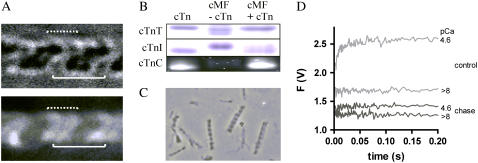
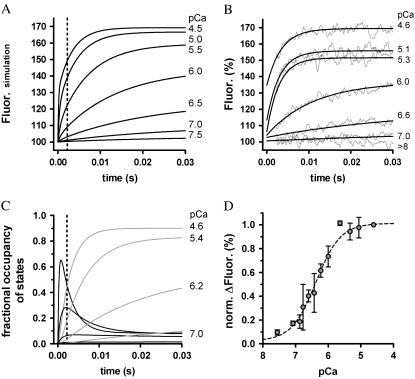
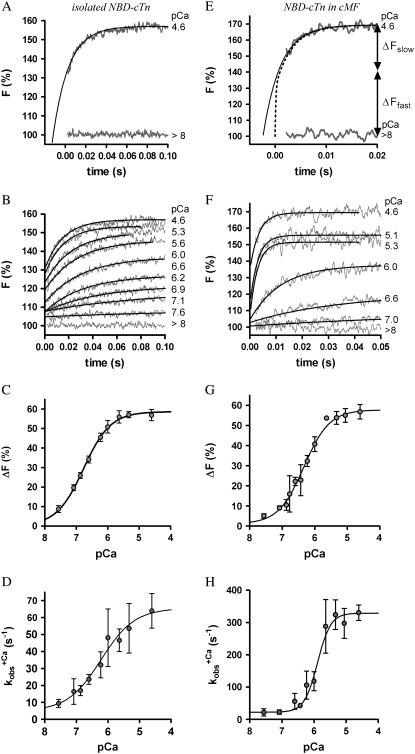
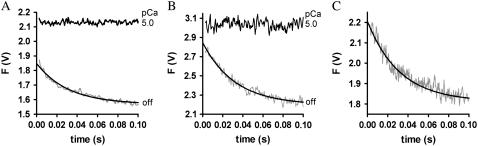
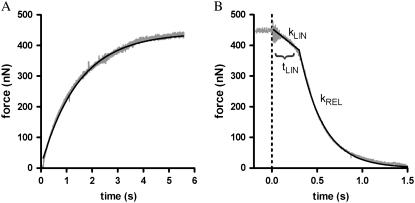
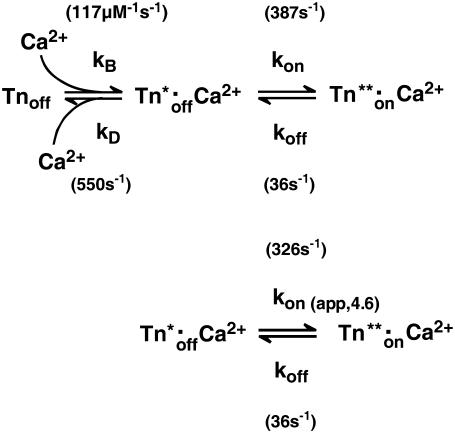
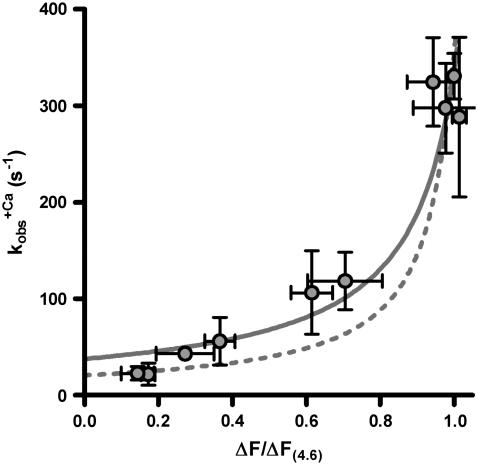
The kinetics of Ca(2+)-dependent conformational changes of human cardiac troponin (cTn) were studied on isolated cTn and within the sarcomeric environment of myofibrils. Human cTnC was selectively labeled on cysteine 84 with N-((2-(iodoacetoxy)ethyl)-N-methyl)amino-7-nitrobenz-2-oxa-1,3-diazole and reconstituted with cTnI and cTnT to the cTn complex, which was incorporated into guinea pig cardiac myofibrils. These exchanged myofibrils, or the isolated cTn, were rapidly mixed in a stopped-flow apparatus with different [Ca(2+)] or the Ca(2+)-buffer 1,2-Bis(2-aminophenoxy)ethane-N,N,N',N'-tetraacetic acid to determine the kinetics of the switch-on or switch-off, respectively, of cTn. Activation of myofibrils with high [Ca(2+)] (pCa 4.6) induced a biphasic fluorescence increase with rate constants of >2000 s(-1) and approximately 330 s(-1), respectively. At low [Ca(2+)] (pCa 6.6), the slower rate was reduced to approximately 25 s(-1), but was still approximately 50-fold higher than the rate constant of Ca(2+)-induced myofibrillar force development measured in a mechanical setup. Decreasing [Ca(2+)] from pCa 5.0-7.9 induced a fluorescence decay with a rate constant of 39 s(-1), which was approximately fivefold faster than force relaxation. Modeling the data indicates two sequentially coupled conformational changes of cTnC in myofibrils: 1), rapid Ca(2+)-binding (k(B) approximately 120 microM(-1) s(-1)) and dissociation (k(D) approximately 550 s(-1)); and 2), slower switch-on (k(on) = 390s(-1)) and switch-off (k(off) = 36s(-1)) kinetics. At high [Ca(2+)], approximately 90% of cTnC is switched on. Both switch-on and switch-off kinetics of incorporated cTn were around fourfold faster than those of isolated cTn. In conclusion, the switch kinetics of cTn are sensitively changed by its structural integration in the sarcomere and directly rate-limit neither cardiac myofibrillar contraction nor relaxation.
在分离的心肌肌钙蛋白(cTn)以及肌原纤维的肌节环境中研究了人心脏肌钙蛋白Ca(2+)依赖性构象变化的动力学。用人N-((2-(碘乙酰氧基)乙基)-N-甲基)氨基-7-硝基苯并-2-恶唑-1,3-二唑对人cTnC的半胱氨酸84进行选择性标记,并与cTnI和cTnT重组形成cTn复合物,该复合物被整合到豚鼠心脏肌原纤维中。将这些交换后的肌原纤维或分离的cTn在停流装置中与不同的[Ca(2+)]或Ca(2+)缓冲剂1,2-双(2-氨基苯氧基)乙烷-N,N,N',N'-四乙酸快速混合,分别测定cTn开启或关闭的动力学。用高[Ca(2+)](pCa 4.6)激活肌原纤维会诱导荧光双相增加,速率常数分别>2000 s(-1)和约330 s(-1)。在低[Ca(2+)](pCa 6.6)时,较慢的速率降至约25 s(-1),但仍比在机械装置中测量的Ca(2+)诱导的肌原纤维力发展的速率常数高约50倍。将[Ca(2+)]从pCa 5.0降至7.9会诱导荧光衰减,速率常数为39 s(-1),这比力松弛快约五倍。对数据进行建模表明肌原纤维中cTnC存在两个顺序耦合的构象变化:1)快速Ca(2+)结合(k(B)约为120 microM(-1) s(-1))和解离(k(D)约为550 s(-1));2)较慢的开启(k(on)=390s(-1))和关闭(k(off)=36s(-1))动力学。在高[Ca(2+)]时,约90%的cTnC处于开启状态。整合后的cTn的开启和关闭动力学比分离的cTn快约四倍。总之,cTn的开关动力学因其在肌节中的结构整合而敏感变化,并且既不直接限制心肌肌原纤维的收缩也不限制其松弛。