Bennell Kim, Coburn Sally, Wee Elin, Green Sally, Harris Anthony, Forbes Andrew, Buchbinder Rachelle
Centre for Health, Exercise & Sports Medicine, School of Physiotherapy, University of Melbourne, Australia.
BMC Musculoskelet Disord. 2007 Aug 31;8:86. doi: 10.1186/1471-2474-8-86.
Chronic rotator cuff pathology (CRCP) is a common shoulder condition causing pain and disability. Physiotherapy is often the first line of management for CRCP yet there is little conclusive evidence to support or refute its effectiveness and no formal evaluation of its cost-effectiveness.
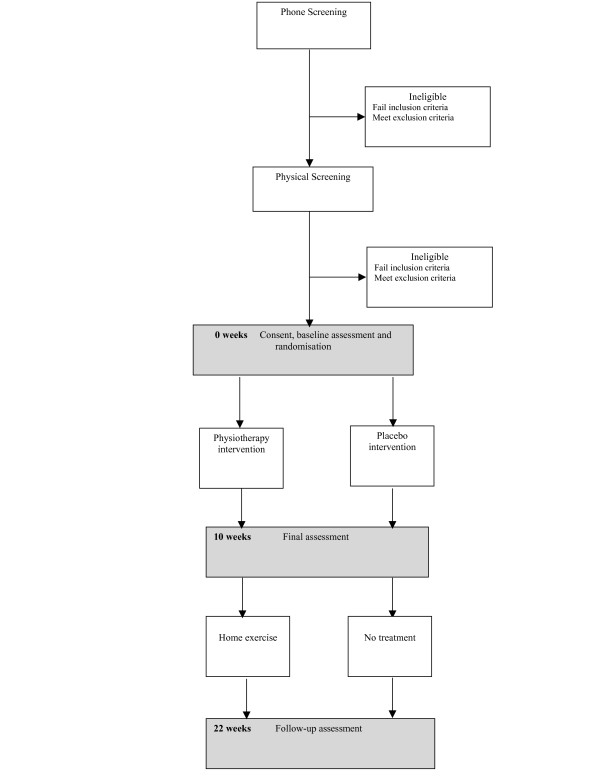
METHODS/DESIGN: This randomised, double-blind, placebo-controlled trial will involve 200 participants with CRCP recruited from medical practices, outpatient departments and the community via print and radio media. Participants will be randomly allocated to a physiotherapy or placebo group using concealed allocation stratified by treating physiotherapist. Both groups will receive 10 sessions of individual standardised treatment over 10 weeks from one of 10 project physiotherapists. For the following 12 weeks, the physiotherapy group will continue a home exercise program and the placebo group will receive no treatment. The physiotherapy program will comprise shoulder joint and spinal mobilisation, soft tissue massage, postural taping, and home exercises for scapular control, posture and rotator cuff strengthening. The placebo group will receive inactive ultrasound and gentle application of an inert gel over the shoulder region. Blinded assessment will be conducted at baseline and at 10 weeks and 22 weeks after randomisation. The primary outcome measures are self reported questionnaires including the shoulder pain and disability index (SPADI), average pain on an 11-point numeric rating scale and participant perceived global rating of change. Secondary measures include Medical Outcomes Study 36-item short form (SF-36), Assessment of Quality of Life index, numeric rating scales for shoulder pain and stiffness, participant perceived rating of change for pain, strength and stiffness, and manual muscle testing for shoulder strength using a handheld dynamometer. To evaluate cost-effectiveness, participants will record the use of all health-related treatments in a log-book returned to the assessor monthly. To test the effect of the intervention using an intention-to-treat analysis, linear regression modelling will be applied adjusting for baseline outcome values and other demographic characteristics. Participant measures of perceived change will be compared between groups by calculating the relative risks and their 95% confidence intervals at each time point using log binomial regression.
Results from this trial will contribute to the evidence regarding the effectiveness of a physiotherapy program for the management of CRCP.
慢性肩袖病理改变(CRCP)是一种常见的肩部疾病,会导致疼痛和功能障碍。物理治疗通常是CRCP的一线治疗方法,但几乎没有确凿证据支持或反驳其有效性,也没有对其成本效益进行正式评估。
方法/设计:这项随机、双盲、安慰剂对照试验将纳入200名通过印刷品和广播媒体从医疗诊所、门诊部和社区招募的CRCP患者。参与者将使用由治疗物理治疗师分层的隐藏分配方法随机分配到物理治疗组或安慰剂组。两组都将在10周内从10名项目物理治疗师中的一名接受10次个体化标准化治疗。在接下来的12周里,物理治疗组将继续进行家庭锻炼计划,而安慰剂组将不接受治疗。物理治疗计划将包括肩关节和脊柱松动、软组织按摩、姿势贴扎以及用于肩胛控制、姿势和肩袖强化的家庭锻炼。安慰剂组将接受无效超声治疗,并在肩部区域轻柔涂抹惰性凝胶。在基线以及随机分组后10周和22周进行盲法评估。主要结局指标是自我报告问卷,包括肩痛和功能障碍指数(SPADI)、11点数字评分量表上的平均疼痛程度以及参与者感知的总体变化评分。次要指标包括医学结局研究36项简短量表(SF-36)、生活质量指数评估、肩痛和僵硬的数字评分量表、参与者对疼痛、力量和僵硬的感知变化评分,以及使用手持测力计进行的肩部力量手动肌力测试。为了评估成本效益,参与者将在每月返还给评估者的日志中记录所有与健康相关治疗的使用情况。为了使用意向性分析测试干预效果,将应用线性回归模型,并对基线结局值和其他人口统计学特征进行调整。通过使用对数二项回归计算每个时间点的相对风险及其95%置信区间,比较两组参与者的感知变化测量值。
该试验的结果将有助于提供关于物理治疗计划对CRCP管理有效性的证据。