Science of Rehabilitation programme at Universidade Federal de Ciências da Saúde de Porto Alegre, Rua Sarmento Leite, 245, Porto Alegre, Rio Grande do Sul, CEP 90050-170, Brazil.
, São Leopoldo, Brazil.
BMC Musculoskelet Disord. 2020 Nov 12;21(1):744. doi: 10.1186/s12891-020-03765-6.
Rotator cuff related pain (RCRP) is one of the most common sources of musculoskeletal shoulder pain affecting the general population. Conservative treatment, in the form of exercise, is considered the first line approach, nonetheless, improvements seem to be modest. One therapeutic modality that might be an adjunct to the treatment of this condition is mobilisation with movement (MWM). MWM is a pain-free manual procedure that targets restricted and painful movements, commonly seen in patients with RCRP. The purpose of clinical trial is to determine whether MWM with exercise has benefits over sham MWM with exercise in RCRP.
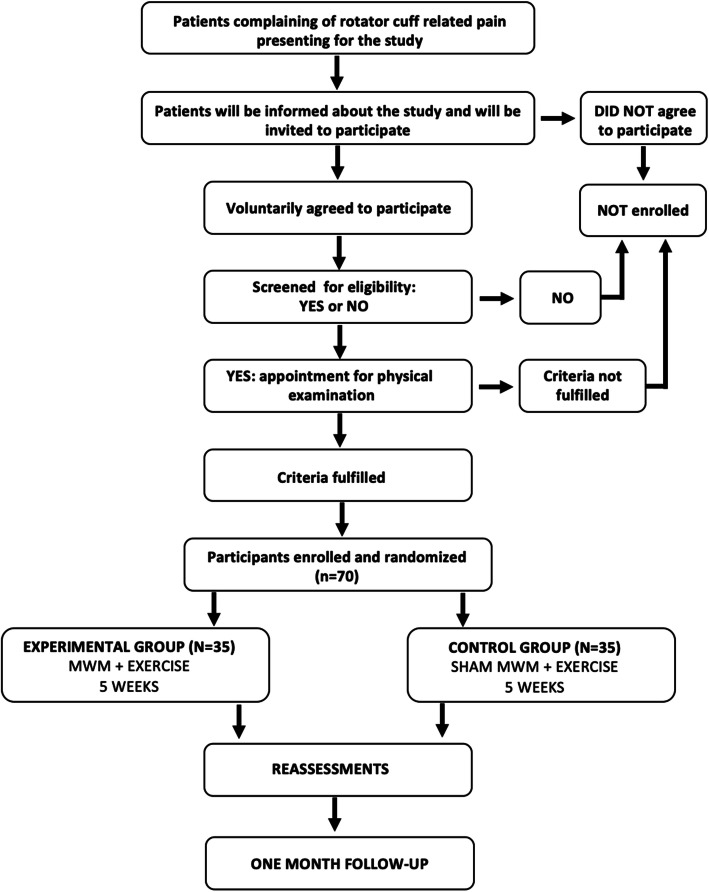
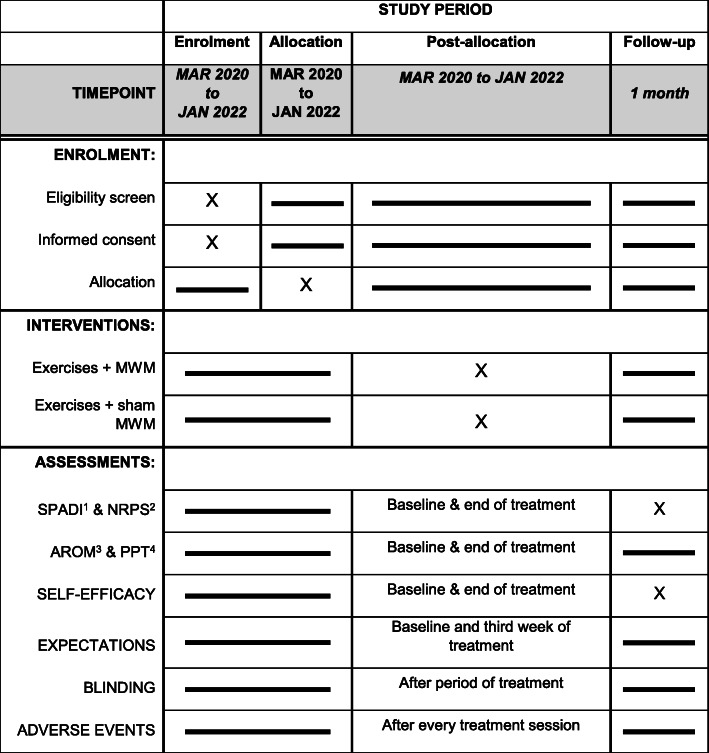
A randomised, sham-controlled trial of 70 adults complaining of RCRP will compare the effects of MWM combined with exercise over sham MWM with exercise. Participants will be allocated to one of two groups: exercise and MWM (EG) or exercise and sham MWM (CG). Two weekly individual treatment sessions will be conducted over five weeks. All assessments will be performed by a blinded assessor. Primary outcome measures will be the shoulder pain and disability index (SPADI) and the numeric pain rating scale (NPRS), assessed at baseline, discharge and one-month follow-up. Secondary outcome measures will be active range of motion, self-efficacy and the global rating of change scale. The analyses will be conducted considering a statistically significant p-value ≤0.05. Normality will be assessed with the Kolmogorov-Smirnov test and homogeneity with the Levene's test. For the primary outcome measures (SPADI and NPRS) and self-efficacy, a 2 × 3 ANOVA with treatment group (EG versus CG) and time (baseline, end of the treatment and follow-up) factors will be performed. Separate 2 × 2 ANOVA will be used for range of motion (baseline and end of the treatment). Global rating scale of change analysis will be conducted using descriptive statistics. Intention-to-treat analysis will be adopted.
As there is a paucity of longitudinal studies investigating the use of MWM in patients with RCRP, this study will help to better understand its role together with a structured exercise programme.
Clinical Trials Registry number NCT04175184 . November, 2019.
肩袖相关疼痛(RCRP)是影响普通人群的最常见肌肉骨骼肩部疼痛源之一。以运动为形式的保守治疗被认为是首选方法,然而,改善效果似乎有限。一种可能是这种疾病治疗辅助手段的治疗方法是松动运动(MWM)。MWM 是一种无疼痛的手动程序,针对 RCRP 患者常见的受限和疼痛运动。临床试验的目的是确定 RCRP 中 MWM 结合运动是否比假 MWM 结合运动更有优势。
一项针对 70 名患有 RCRP 的成年人的随机、假对照试验将比较 MWM 结合运动与假 MWM 结合运动的效果。参与者将被分配到以下两个组之一:运动和 MWM(EG)或运动和假 MWM(CG)。在五周内每周进行两次个体治疗。所有评估都将由一名盲法评估者进行。主要结局指标是肩部疼痛和残疾指数(SPADI)和数字疼痛评分量表(NPRS),在基线、出院和一个月随访时进行评估。次要结局指标是主动活动范围、自我效能和整体变化量表评分。分析将考虑到具有统计学意义的 p 值≤0.05。正态性将通过 Kolmogorov-Smirnov 检验进行评估,同质性将通过 Levene 检验进行评估。对于主要结局指标(SPADI 和 NPRS)和自我效能,将进行 2×3 ANOVA 处理组(EG 与 CG)和时间(基线、治疗结束和随访)因素。单独的 2×2 ANOVA 将用于运动范围(基线和治疗结束时)。整体变化量表分析将采用描述性统计。将采用意向治疗分析。
由于缺乏对 RCRP 患者使用 MWM 的纵向研究,因此本研究将有助于更好地了解其与结构化运动方案一起的作用。
临床试验注册号 NCT04175184。2019 年 11 月。