Laboratory of Malaria and Vector Research, National Institute of Allergy and Infectious Diseases, National Institutes of Health, Rockville, Maryland, United States of America.
PLoS One. 2007 Sep 5;2(9):e850. doi: 10.1371/journal.pone.0000850.
Inclusion of multiple immunogens to target a single organism is a strategy being pursued for many experimental vaccines, especially where it is difficult to generate a strongly protective response from a single immunogen. Although there are many human vaccines that contain multiple defined immunogens, in almost every case each component targets a different pathogen. As a consequence, there is little practical experience for deciding where the increased complexity of vaccines with multiple defined immunogens vaccines targeting single pathogens will be justifiable.
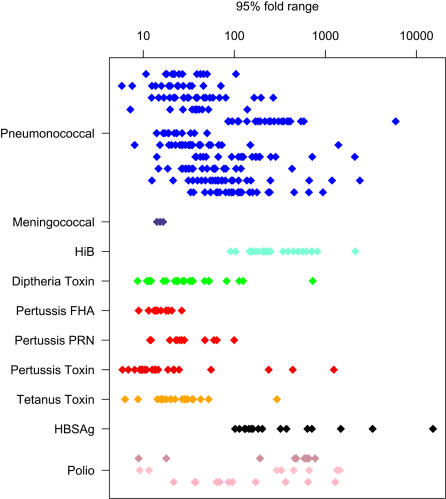
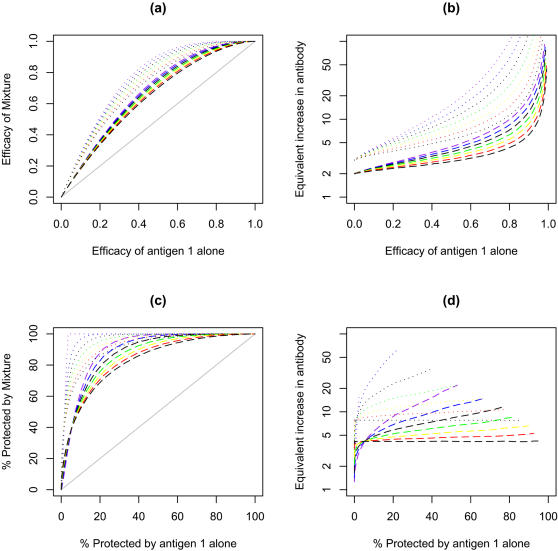
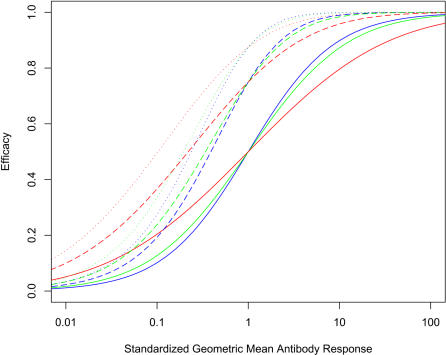
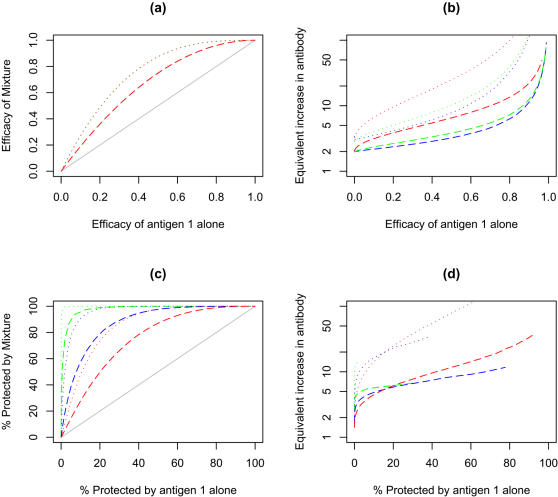
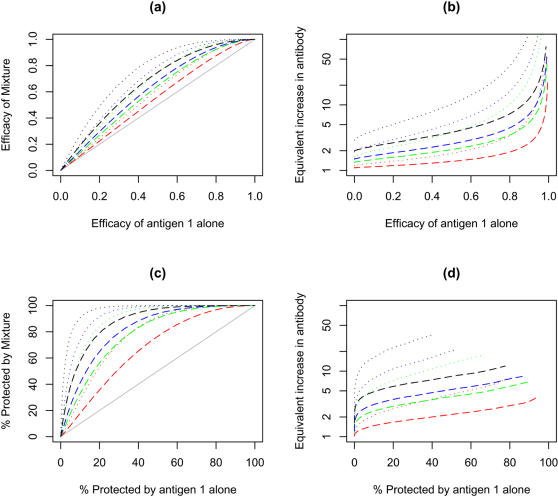
METHODOLOGY/PRINCIPAL FINDINGS: A mathematical model, with immunogenicity parameters derived from a database of human responses to established vaccines, was used to predict the increase in the efficacy and the proportion of the population protected resulting from addition of further immunogens. The gains depended on the relative protection and the range of responses in the population to each immunogen and also to the correlation of the responses between immunogens. In most scenarios modeled, the gain in overall efficacy obtained by adding more immunogens was comparable to gains obtained from a single immunogen through the use of better formulations or adjuvants. Multi-component single target vaccines were more effective at decreasing the proportion of poor responders than increasing the overall efficacy of the vaccine in a population.
CONCLUSIONS/SIGNIFICANCE: Inclusion of limited number of antigens in a vaccine aimed at targeting a single organism will increase efficacy, but the gains are relatively modest and for a practical vaccine there are constraints that are likely to limit multi-component single target vaccines to a small number of key antigens. The model predicts that this type of vaccine will be most useful where the critical issue is the reduction in proportion of poor responders.
将多种免疫原纳入针对单一生物体的疫苗中是许多实验疫苗所采用的策略,尤其是在难以从单一免疫原中产生强烈保护反应的情况下。尽管有许多含有多种明确免疫原的人类疫苗,但在几乎所有情况下,每个成分都针对不同的病原体。因此,在决定针对单一病原体的具有多种明确免疫原的疫苗的增加复杂性是否合理方面,几乎没有实际经验。
方法/主要发现:使用一种数学模型,该模型的免疫原性参数源自对已建立的疫苗的人类反应数据库,用于预测增加额外免疫原的疫苗功效和受保护人群比例的增加。收益取决于相对保护以及人群对每种免疫原的反应范围,以及免疫原之间反应的相关性。在大多数模拟的情况下,通过使用更好的配方或佐剂从单个免疫原添加更多免疫原获得的整体功效提高可与获得的提高相媲美。与增加人群中疫苗的总体功效相比,多成分单靶疫苗更有效地降低了不良反应者的比例。
结论/意义:在针对单一生物体的疫苗中纳入有限数量的抗原将提高功效,但收益相对较小,对于实用疫苗而言,存在限制因素可能会将多成分单靶疫苗限制为少数关键抗原。该模型预测,这种类型的疫苗在减少不良反应者比例的关键问题上最有用。