Gass Jennifer N, Jiang Hao-Yuan, Wek Ronald C, Brewer Joseph W
Department of Microbiology and Immunology, Stritch School of Medicine, Loyola University, Chicago, United States.
Mol Immunol. 2008 Feb;45(4):1035-43. doi: 10.1016/j.molimm.2007.07.029. Epub 2007 Sep 5.
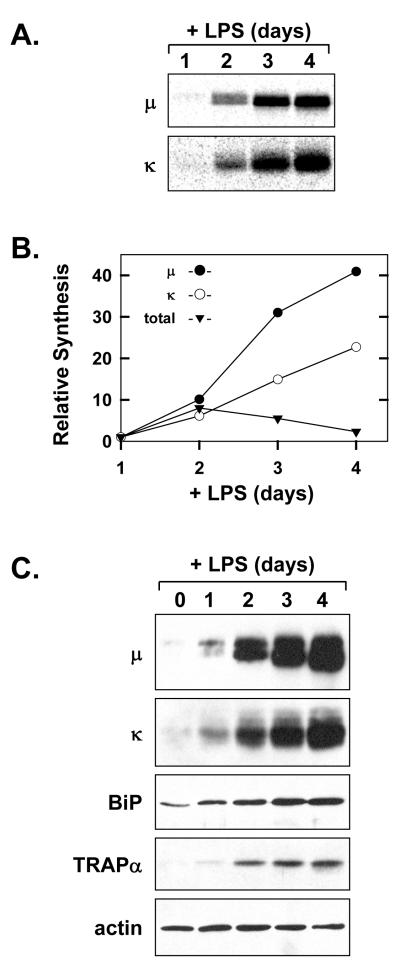
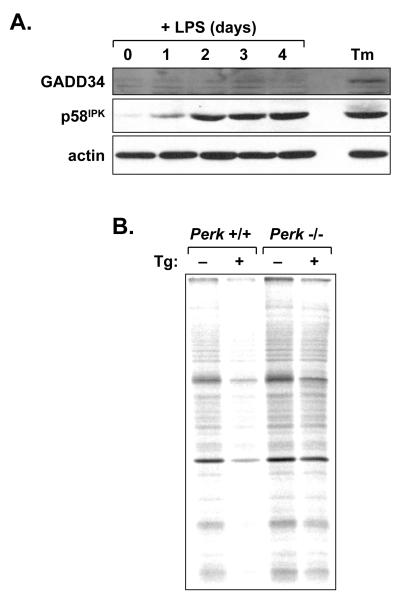
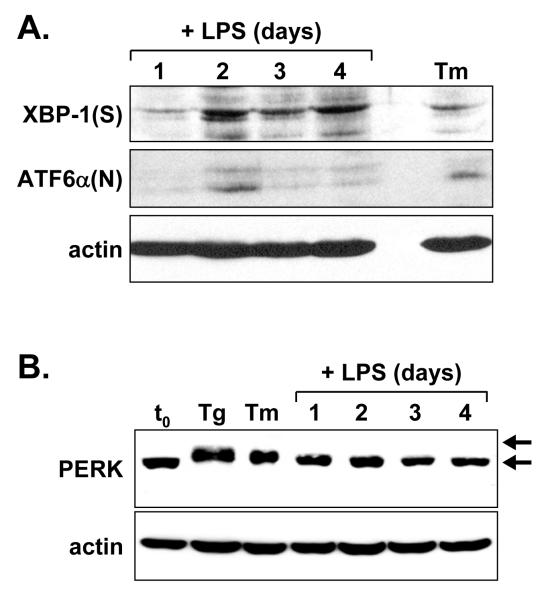
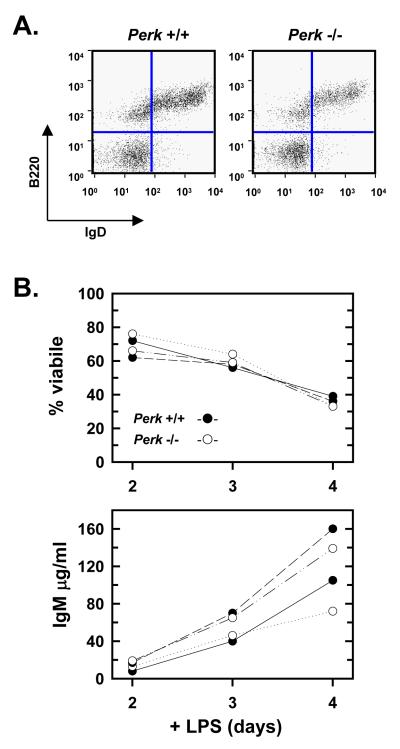
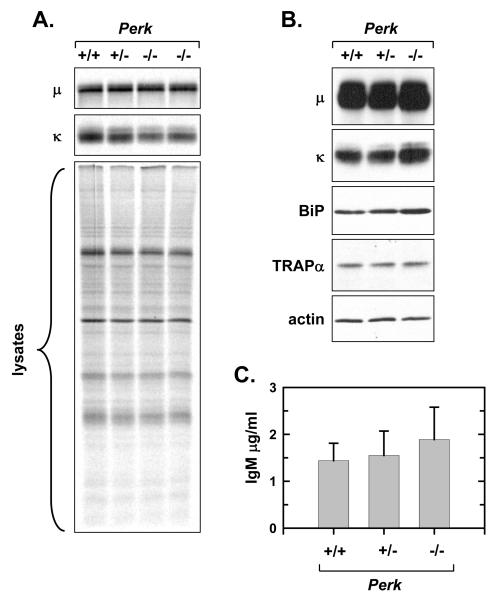
When B-lymphocytes differentiate into plasma cells, immunoglobulin (Ig) heavy and light chain synthesis escalates and the entire secretory apparatus expands to support high-rate antibody secretion. These same events occur when murine B-cells are stimulated with lipopolysaccharide (LPS), providing an in vitro model in which to investigate the differentiation process. The unfolded protein response (UPR), a multi-pathway signaling response emanating from the endoplasmic reticulum (ER) membrane, allows cells to adapt to increasing demands on the protein folding capacity of the ER. As such, the UPR plays a pivotal role in the differentiation of antibody-secreting cells. Three specific stress sensors, IRE1, PERK/PEK and ATF6, are central to the recognition of ER stress and induction of the UPR. IRE1 triggers splicing of Xbp-1 mRNA, yielding a transcriptional activator of the UPR termed XBP-1(S), and activation of the IRE1/XBP-1 pathway has been reported to be required for expansion of the ER and antibody secretion. Here, we provide evidence that PERK is not activated in LPS-stimulated splenic B-cells, whereas XBP-1(S) and the UPR transcriptional activator ATF6 are both induced. We further demonstrate that Perk-/- B-cells develop and are fully competent for induction of Ig synthesis and antibody secretion when stimulated with LPS. These data provide clear evidence for differential activation and utilization of distinct UPR components as activated B-lymphocytes increase Ig synthesis and differentiate into specialized secretory cells.
当B淋巴细胞分化为浆细胞时,免疫球蛋白(Ig)重链和轻链的合成增加,整个分泌装置扩大以支持高速率的抗体分泌。当用脂多糖(LPS)刺激小鼠B细胞时,也会发生同样的事件,这提供了一个用于研究分化过程的体外模型。未折叠蛋白反应(UPR)是一种从内质网(ER)膜发出的多途径信号反应,使细胞能够适应对内质网蛋白质折叠能力不断增加的需求。因此,UPR在抗体分泌细胞的分化中起关键作用。三种特定的应激传感器,即肌醇需求酶1(IRE1)、蛋白激酶R样内质网激酶(PERK/PEK)和活化转录因子6(ATF6),对于内质网应激的识别和UPR的诱导至关重要。IRE1触发X盒结合蛋白1(Xbp-1)mRNA的剪接,产生一种称为XBP-1(S)的UPR转录激活因子,据报道,IRE1/XBP-1途径的激活是内质网扩张和抗体分泌所必需的。在这里,我们提供证据表明,在LPS刺激的脾B细胞中,PERK未被激活,而XBP-1(S)和UPR转录激活因子ATF6均被诱导。我们进一步证明,在用LPS刺激时,Perk基因敲除的B细胞能够发育并且完全有能力诱导Ig合成和抗体分泌。这些数据为不同UPR组分的差异激活和利用提供了明确证据,因为活化的B淋巴细胞增加Ig合成并分化为特化的分泌细胞。