Gu Qingyang, Bowden G Tim, Normolle Daniel, Sun Yi
Department of Radiation Oncology, University of Michigan Comprehensive Cancer Center, Ann Arbor, MI 48109, USA.
J Cell Biol. 2007 Sep 10;178(6):1009-23. doi: 10.1083/jcb.200612067.
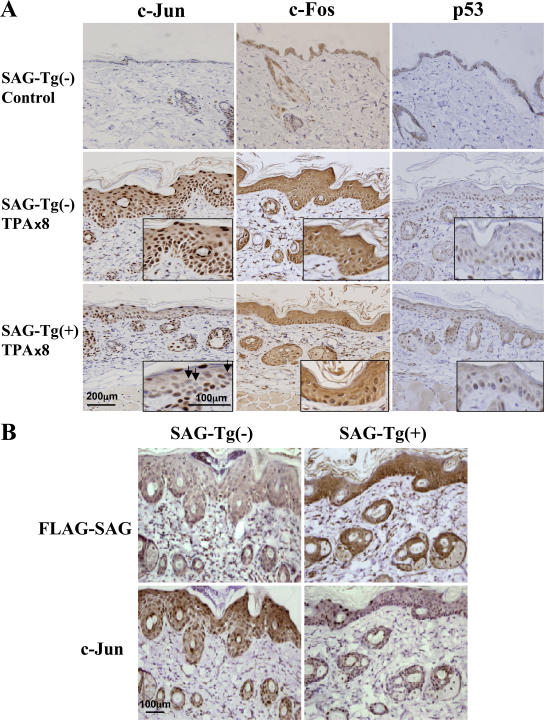
Sensitive to apoptosis gene (SAG)/regulator of cullins-2-Skp1-cullin-F-box protein (SCF) E3 ubiquitin ligase regulates cellular functions through ubiquitination and degradation of protein substrates. We report that, when expressed in mouse epidermis driven by the K14 promoter, SAG inhibited TPA-induced c-Jun levels and activator protein-1 (AP-1) activity in both in vitro primary culture, in vivo transgenic mice, and an AP-1- luciferase reporter mouse model. After AP-1 inactivation, epidermal proliferation induced by 7,12-dimethylbenz(a)-anthracene/12-O-tetradecanoylphorbol-13-acetate at the early stage of carcinogenesis was substantially inhibited. Later stage tumor formation was also substantially inhibited with prolonged latency and reduced frequency of tumor formation. Interestingly, SAG expression increased tumor size, not because of accelerated proliferation, but caused by reduced apoptosis resulting, at least in part, from nuclear factor kappaB (NF-kappaB) activation. Thus, SAG, in a manner depending on the availability of F-box proteins, demonstrated early-stage suppression of tumor formation by promoting c-Jun degradation, thereby inhibiting AP-1, and later-stage enhancement of tumor growth, by promoting inhibitor of kappaBalpha degradation to activate NF-kappaB and inhibit apoptosis.
凋亡敏感基因(SAG)/Cullin-2调节因子-Skp1-Cullin-F盒蛋白(SCF)E3泛素连接酶通过蛋白质底物的泛素化和降解来调节细胞功能。我们报道,当由K14启动子驱动在小鼠表皮中表达时,SAG在体外原代培养、体内转基因小鼠以及AP-1荧光素酶报告基因小鼠模型中均抑制了佛波酯(TPA)诱导的c-Jun水平和活化蛋白-1(AP-1)活性。AP-1失活后,在致癌作用早期由7,12-二甲基苯并[a]蒽/12-O-十四烷酰佛波醇-13-乙酸酯诱导的表皮增殖受到显著抑制。后期肿瘤形成也受到显著抑制,潜伏期延长且肿瘤形成频率降低。有趣的是,SAG表达增加了肿瘤大小,这并非由于增殖加速,而是至少部分由核因子κB(NF-κB)激活导致的细胞凋亡减少所致。因此,SAG以一种依赖于F盒蛋白可用性的方式,通过促进c-Jun降解从而抑制AP-1,表现出对肿瘤形成的早期抑制作用;又通过促进κBα抑制蛋白降解以激活NF-κB并抑制细胞凋亡,表现出对肿瘤生长的后期增强作用。