Van Laere S, Van der Auwera I, Van den Eynden G, Van Hummelen P, van Dam P, Van Marck E, Vermeulen P B, Dirix L
Translational Cancer Research Group (Lab Pathology), University of Antwerp, Universiteitsplein 1, Wilrijk B2610, Belgium.
Br J Cancer. 2007 Oct 22;97(8):1165-74. doi: 10.1038/sj.bjc.6603967. Epub 2007 Sep 11.
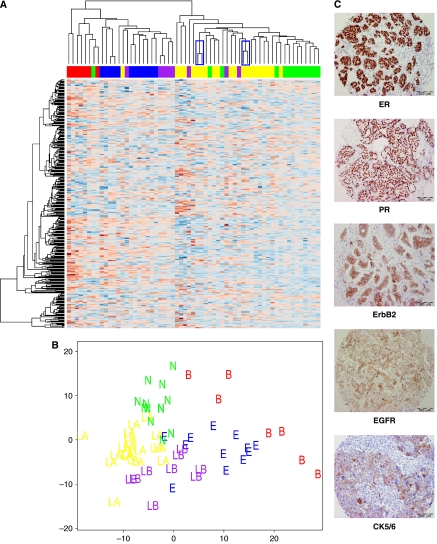
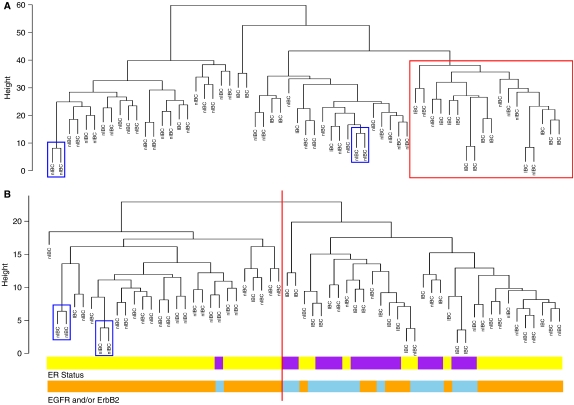
The present study aims at a platform-independent confirmation of previously obtained cDNA microarray results on inflammatory breast cancer (IBC) using Affymetrix chips. Gene-expression data of 19 IBC and 40 non-IBC specimens were subjected to clustering and principal component analysis. The performance of a previously identified IBC signature was tested using clustering and gene set enrichment analysis. The presence of different cell-of-origin subtypes in IBC was investigated and confirmed using immunohistochemistry on a TMA. Differential gene expression was analysed using SAM and topGO was used to identify the fingerprints of a pro-metastatic-signalling pathway. IBC and non-IBC have distinct gene-expression profiles. The differences in gene expression between IBC and non-IBC are captured within an IBC signature, identified in a platform-independent manner. Part of the gene-expression differences between IBC and non-IBC are attributable to the differential presence of the cell-of-origin subtypes, since IBC primarily segregated into the basal-like or ErbB2-overexpressing group. Strikingly, IBC tumour samples more closely resemble the gene-expression profile of T1/T2 tumours than the gene-expression profile or T3/T4 tumours. We identified the insulin-like growth factor-signalling pathway, potentially contributing to the biology of IBC. Our previous results have been validated in a platform-independent manner. The distinct biological behaviour of IBC is reflected in a distinct gene-expression profile. The fact that IBC tumours are quickly arising tumours might explain the close resemblance of the IBC gene-expression profile to the expression profile of T1/T2 tumours.
本研究旨在使用Affymetrix芯片对先前获得的炎性乳腺癌(IBC)的cDNA微阵列结果进行与平台无关的验证。对19个IBC样本和40个非IBC样本的基因表达数据进行聚类分析和主成分分析。使用聚类分析和基因集富集分析对先前确定的IBC特征的性能进行测试。通过对组织微阵列(TMA)进行免疫组织化学研究并确认IBC中不同起源细胞亚型的存在。使用SAM分析差异基因表达,并使用topGO识别促转移信号通路的特征。IBC和非IBC具有不同的基因表达谱。IBC和非IBC之间的基因表达差异被包含在一个以与平台无关的方式确定的IBC特征中。IBC和非IBC之间部分基因表达差异可归因于起源细胞亚型的差异存在,因为IBC主要分为基底样或ErbB2过表达组。令人惊讶的是,IBC肿瘤样本与T1/T2肿瘤的基因表达谱比与T3/T4肿瘤的基因表达谱更相似。我们确定了胰岛素样生长因子信号通路,其可能对IBC的生物学特性有影响。我们先前的结果已以与平台无关的方式得到验证。IBC独特的生物学行为反映在独特的基因表达谱中。IBC肿瘤是快速发生的肿瘤这一事实可能解释了IBC基因表达谱与T1/T2肿瘤表达谱的相似性。