Jonides John, Lewis Richard L, Nee Derek Evan, Lustig Cindy A, Berman Marc G, Moore Katherine Sledge
Department of Psychology, University of Michigan, Ann Arbor, Michigan 48109, USA.
Annu Rev Psychol. 2008;59:193-224. doi: 10.1146/annurev.psych.59.103006.093615.
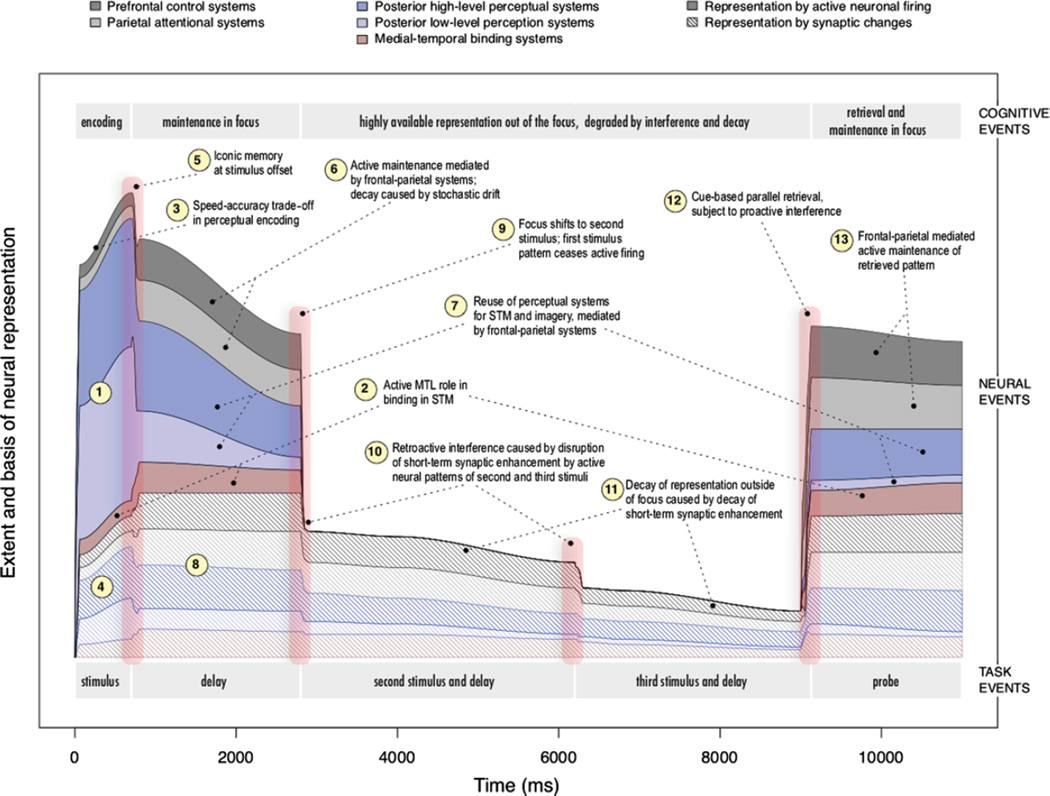
The past 10 years have brought near-revolutionary changes in psychological theories about short-term memory, with similarly great advances in the neurosciences. Here, we critically examine the major psychological theories (the "mind") of short-term memory and how they relate to evidence about underlying brain mechanisms. We focus on three features that must be addressed by any satisfactory theory of short-term memory. First, we examine the evidence for the architecture of short-term memory, with special attention to questions of capacity and how--or whether--short-term memory can be separated from long-term memory. Second, we ask how the components of that architecture enact processes of encoding, maintenance, and retrieval. Third, we describe the debate over the reason about forgetting from short-term memory, whether interference or decay is the cause. We close with a conceptual model tracing the representation of a single item through a short-term memory task, describing the biological mechanisms that might support psychological processes on a moment-by-moment basis as an item is encoded, maintained over a delay with some forgetting, and ultimately retrieved.
在过去十年里,心理学界关于短期记忆的理论发生了近乎革命性的变化,神经科学领域也取得了同样巨大的进展。在此,我们批判性地审视了短期记忆的主要心理学理论(“心智”),以及它们与潜在大脑机制证据之间的关系。我们聚焦于任何令人满意的短期记忆理论都必须解决的三个特征。首先,我们考察短期记忆结构的证据,特别关注容量问题以及短期记忆能否——或者是否——与长期记忆区分开来。其次,我们探讨该结构的组成部分如何执行编码、维持和检索过程。第三,我们描述关于短期记忆遗忘原因的争论,即干扰还是衰退是其成因。我们以一个概念模型作为结尾,该模型追踪单个项目在短期记忆任务中的表征,描述在项目被编码、在有一定遗忘的延迟期间被维持并最终被检索时,可能在瞬间支持心理过程的生物学机制。