Mozrzymas Jerzy W, Wójtowicz Tomasz, Piast Michal, Lebida Katarzyna, Wyrembek Paulina, Mercik Katarzyna
Laboratory of Neuroscience, Department of Biophysics, Wrocław Medical University, Chałubiñskiego 3, 50-368 Wroclaw, Poland.
J Physiol. 2007 Nov 15;585(Pt 1):29-46. doi: 10.1113/jphysiol.2007.143602. Epub 2007 Sep 13.
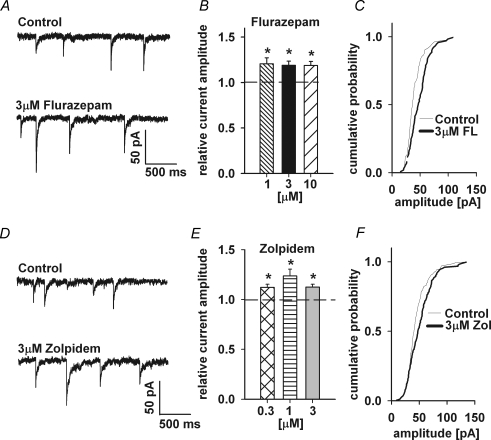
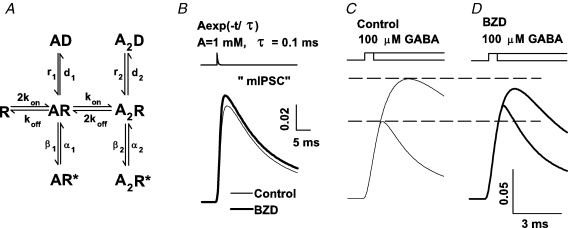
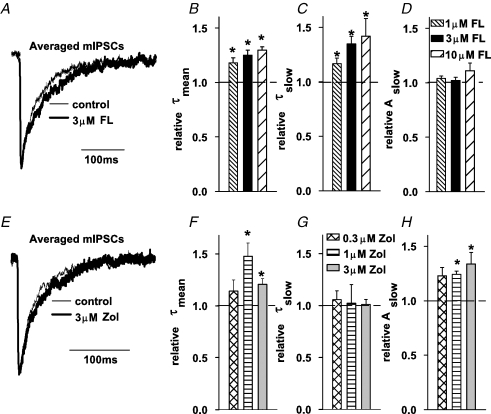
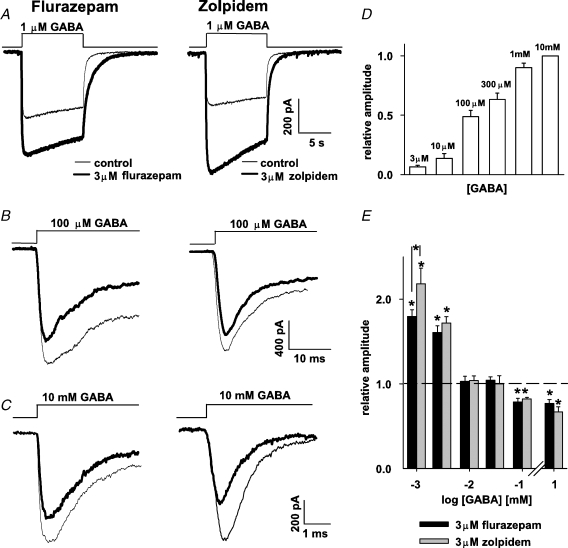
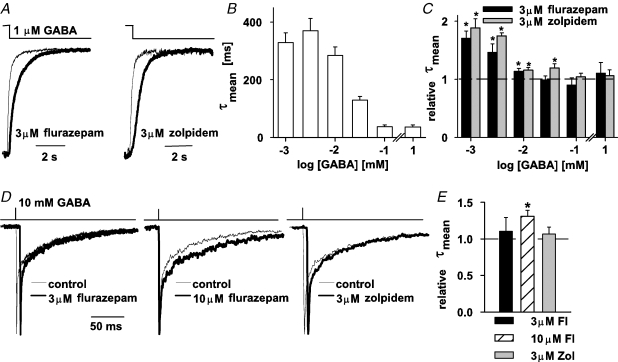
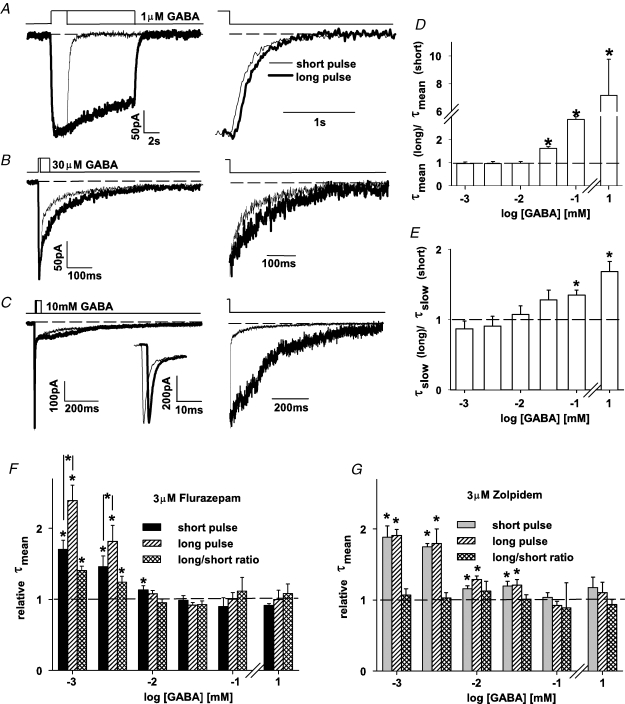
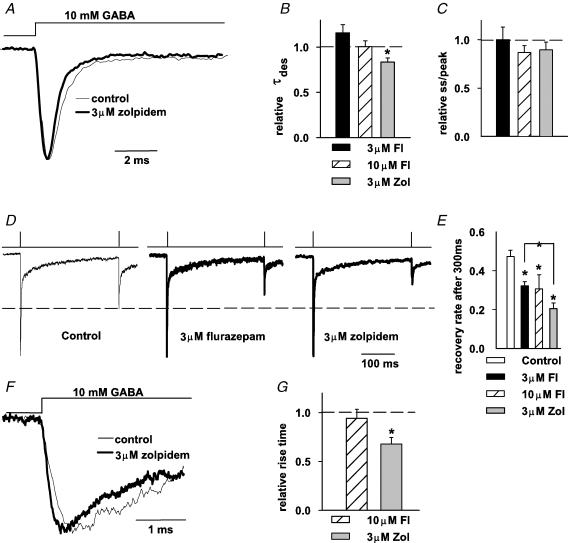
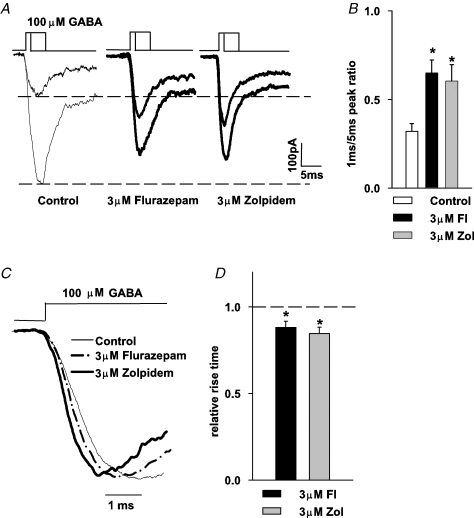
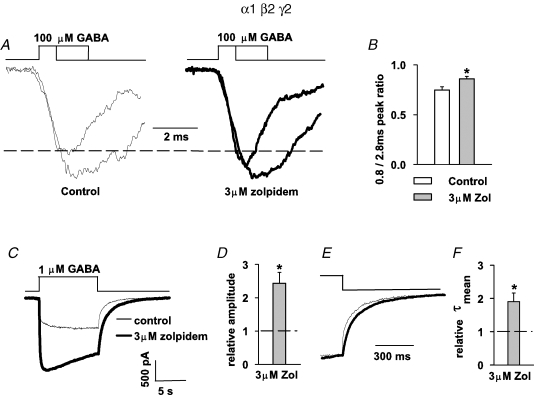
Benzodiazepines (BDZs) are known to increase the amplitude and duration of IPSCs. Moreover, at low [GABA], BDZs strongly enhance GABAergic currents suggesting the up-regulation of agonist binding while their action on gating remains a matter of debate. In the present study we have examined the impact of flurazepam and zolpidem on mIPSCs by investigating their effects on GABA(A)R binding and gating and by considering dynamic conditions of synaptic receptor activation. Flurazepam and zolpidem enhanced the amplitude and prolonged decay of mIPSCs. Both compounds strongly enhanced responses to low [GABA] but, surprisingly, decreased the currents evoked by saturating or half-saturating [GABA]. Analysis of current responses to ultrafast GABA applications indicated that these compounds enhanced binding and desensitization of GABA(A) receptors. Flurazepam and zolpidem markedly prolonged deactivation of responses to low [GABA] but had almost no effect on deactivation at saturating or half-saturating [GABA]. Moreover, at low [GABA], flurazepam enhanced desensitization-deactivation coupling but zolpidem did not. Recordings of responses to half-saturating [GABA] applications revealed that appropriate timing of agonist exposure was sufficient to reproduce either a decrease or enhancement of currents by flurazepam or zolpidem. Recordings of currents mediated by recombinant ('synaptic') alpha1beta2gamma2 receptors reproduced all major findings observed for neuronal GABA(A)Rs. We conclude that an extremely brief agonist transient renders IPSCs particularly sensitive to the up-regulation of agonist binding by BDZs.
苯二氮䓬类药物(BDZs)已知会增加抑制性突触后电流(IPSCs)的幅度和持续时间。此外,在低浓度[GABA]时,BDZs会强烈增强GABA能电流,这表明激动剂结合上调,而它们对门控的作用仍存在争议。在本研究中,我们通过研究氟西泮和唑吡坦对GABA(A)受体结合和门控的影响,并考虑突触受体激活的动态条件,来考察它们对微小抑制性突触后电流(mIPSCs)的影响。氟西泮和唑吡坦增强了mIPSCs的幅度并延长了其衰减时间。两种化合物都强烈增强了对低浓度[GABA]的反应,但令人惊讶的是,它们降低了由饱和或半饱和浓度[GABA]诱发的电流。对超快GABA应用的电流反应分析表明,这些化合物增强了GABA(A)受体的结合和脱敏。氟西泮和唑吡坦显著延长了对低浓度[GABA]反应的失活时间,但对饱和或半饱和浓度[GABA]下的失活几乎没有影响。此外,在低浓度[GABA]时,氟西泮增强了脱敏 - 失活偶联,而唑吡坦则没有。对半饱和浓度[GABA]应用的反应记录显示,适当的激动剂暴露时机足以重现氟西泮或唑吡坦对电流的降低或增强作用。由重组(“突触性”)α1β2γ2受体介导的电流记录重现了在神经元GABA(A)受体上观察到的所有主要发现。我们得出结论,极短暂的激动剂瞬变使IPSCs对BDZs引起的激动剂结合上调特别敏感。