Nikolic Dejan M, Gong Ming C, Turk John, Post Steven R
Departments of Molecular and Biomedical Pharmacology, University of Kentucky, Lexington, Kentucky, 40536.
Department of Physiology, University of Kentucky, Lexington, Kentucky 40536.
J Biol Chem. 2007 Nov 16;282(46):33405-33411. doi: 10.1074/jbc.M704133200. Epub 2007 Sep 15.
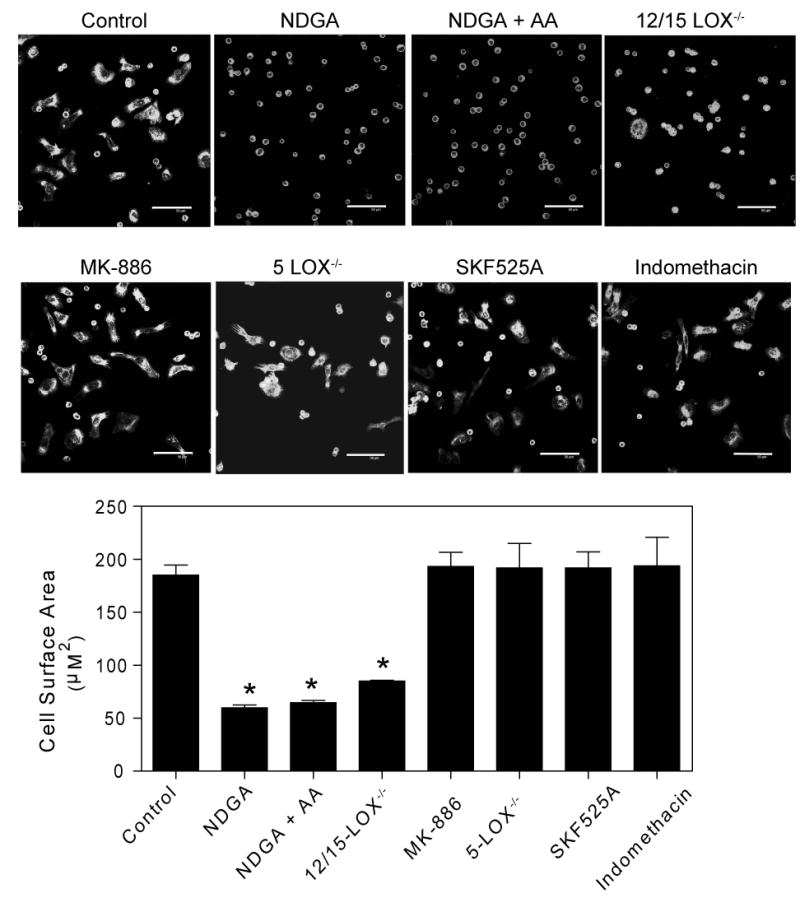
Class A scavenger receptors (SR-A) participate in multiple macrophage functions including adhesion to modified extracellular matrix proteins present in various inflammatory disorders such as atherosclerosis and diabetes. By mediating macrophage adhesion to modified proteins and increasing macrophage retention, SR-A may contribute to the inflammatory process. Eicosanoids produced after phospholipase A(2) (PLA(2))-catalyzed release of arachidonic acid (AA) are important regulators of macrophage function and inflammatory responses. The potential roles of AA release and metabolism in SR-A-mediated macrophage adhesion were determined using macrophages adherent to modified protein. SR-A-dependent macrophage adhesion was abolished by selectively inhibiting calcium-independent PLA(2) (iPLA(2)) activity and absent in macrophages isolated from iPLA(2) beta(-/-) mice. Our results further demonstrate that 12/15-lipoxygenase (12/15-LOX)-derived, but not cyclooxygenase- or cytochrome P450-dependent epoxygenase-derived AA metabolites, are specifically required for SR-A-dependent adhesion. Because of their role in regulating actin polymerization and cell adhesion, Rac and Cdc42 activation were also examined and shown to be increased via an iPLA(2)- and LOX-dependent pathway. Together, our results identify a novel role for iPLA(2)-catalyzed AA release and its metabolism by 12/15-LOX in coupling SR-A-mediated macrophage adhesion to Rac and Cdc42 activation.
A类清道夫受体(SR-A)参与多种巨噬细胞功能,包括黏附于存在于各种炎症性疾病(如动脉粥样硬化和糖尿病)中的修饰细胞外基质蛋白。通过介导巨噬细胞与修饰蛋白的黏附并增加巨噬细胞的滞留,SR-A可能促进炎症过程。磷脂酶A2(PLA(2))催化花生四烯酸(AA)释放后产生的类花生酸是巨噬细胞功能和炎症反应的重要调节因子。使用黏附于修饰蛋白的巨噬细胞确定了AA释放和代谢在SR-A介导的巨噬细胞黏附中的潜在作用。通过选择性抑制钙非依赖性PLA(2)(iPLA(2))活性,消除了SR-A依赖性巨噬细胞黏附,并且在从iPLA(2)β(-/-)小鼠分离的巨噬细胞中不存在这种黏附。我们的结果进一步证明,SR-A依赖性黏附特别需要12/15-脂氧合酶(12/15-LOX)衍生的而非环氧化酶或细胞色素P450依赖性环氧化酶衍生的AA代谢产物。由于Rac和Cdc42在调节肌动蛋白聚合和细胞黏附中的作用,我们还检测了它们的激活情况,结果显示它们通过iPLA(2)和LOX依赖性途径增加。总之,我们的结果确定了iPLA(2)催化的AA释放及其通过12/15-LOX的代谢在将SR-A介导的巨噬细胞黏附与Rac和Cdc42激活偶联中的新作用。