LaRowe Tara L, Wubben Deborah P, Cronin Kate A, Vannatter SuAnne M, Adams Alexandra K
Department of Family Medicine, University of Wisconsin-Madison, 777 South Mills Street, Madison, WI 53714, USA.
Prev Chronic Dis. 2007 Oct;4(4):A109. Epub 2007 Sep 15.
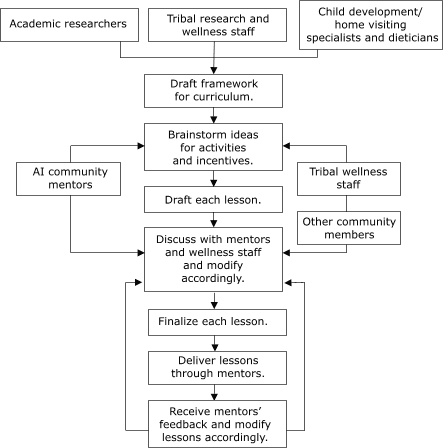
We designed an obesity prevention intervention for American Indian families called Healthy Children, Strong Families using a participatory approach involving three Wisconsin tribes. Healthy Children, Strong Families promotes healthy eating and physical activity for preschool children and their caregivers while respecting each community's cultural and structural framework. Academic researchers, tribal wellness staff, and American Indian community mentors participated in development of the Healthy Children, Strong Families educational curriculum. The curriculum is based on social cognitive and family systems theories as well as on community eating and activity patterns with adaptation to American Indian cultural values. The curricular materials, which were delivered through a home-based mentoring model, have been successfully received and are being modified so that they can be tailored to individual family needs. The curriculum can serve as a nutrition and physical activity model for health educators that can be adapted for other American Indian preschool children and their families or as a model for development of a culturally specific curriculum.
我们为美国印第安家庭设计了一项名为“健康儿童,强壮家庭”的肥胖预防干预措施,采用了一种参与式方法,涉及威斯康星州的三个部落。“健康儿童,强壮家庭”项目在尊重每个社区文化和结构框架的同时,促进学龄前儿童及其照顾者的健康饮食和体育活动。学术研究人员、部落健康工作人员和美国印第安社区导师参与了“健康儿童,强壮家庭”教育课程的开发。该课程基于社会认知和家庭系统理论,以及社区饮食和活动模式,并融入了美国印第安文化价值观。通过家庭辅导模式提供的课程材料已成功获得认可,并正在进行修改,以便能够根据个别家庭的需求进行调整。该课程可以作为健康教育工作者的营养和体育活动模式,适用于其他美国印第安学龄前儿童及其家庭,或者作为开发特定文化课程的模式。