Duchene Johan, Lecomte Florence, Ahmed Saleh, Cayla Cecile, Pesquero Joao, Bader Michael, Perretti Mauro, Ahluwalia Amrita
William Harvey Research Institute, St. Barts and the London Medical School, Charterhouse Square, London, United Kingdom.
J Immunol. 2007 Oct 1;179(7):4849-56. doi: 10.4049/jimmunol.179.7.4849.
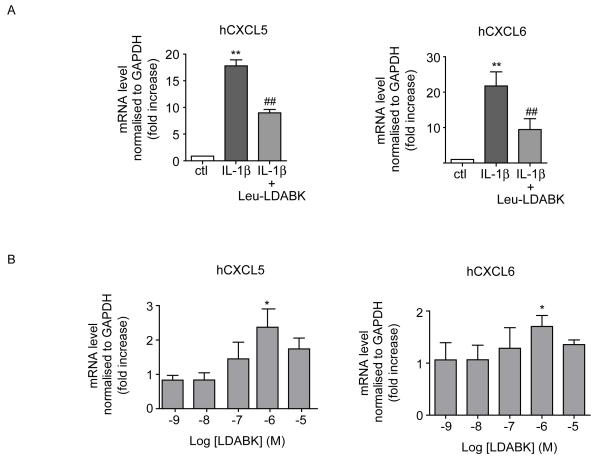
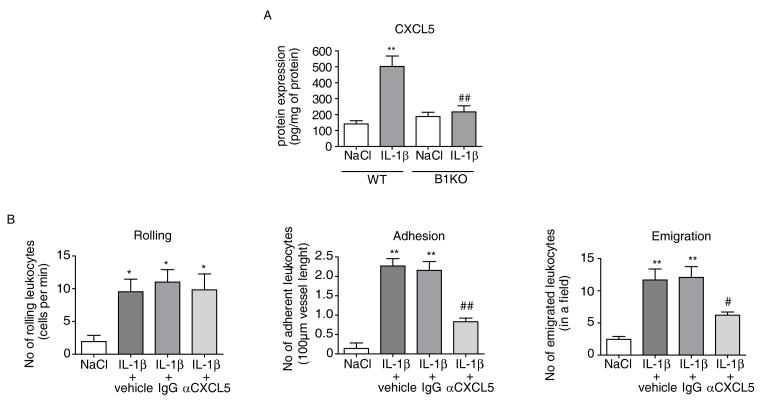
The kinin B1 receptor is an inducible receptor not normally expressed but induced by inflammatory stimuli and plays a major role in neutrophil recruitment, particularly in response to the cytokine IL-1beta. However, the exact mechanism involved in this response is unclear. The aim of this study was to dissect the molecular mechanism involved, in particular to determine whether specific ELR-CXCL chemokines (specific neutrophil chemoattractants) played a role. Using intravital microscopy, we demonstrated that IL-1beta-induced leukocyte rolling, adherence, and emigration in mesenteric venules of wild-type (WT) mice, associated with an increase in B1 receptor mRNA expression, were substantially attenuated (>80%) in B1 receptor knockout mice (B1KO). This effect in B1KO mice was correlated with a selective down-regulation of IL-1beta-induced CXCL5 mRNA and protein expression compared with WT mice. Furthermore a selective neutralizing CXCL5 Ab caused profound suppression of leukocyte emigration in IL-1beta-treated WT mice. Finally, treatment of human endothelial cells with IL-1beta enhanced mRNA expression of the B1 receptor and the human (h) CXCL5 homologues (hCXCL5 and hCXCL6). This response was suppressed by approximately 50% when cells were pretreated with the B1 receptor antagonist des-Arg9-[Leu8]-bradykinin while treatment with des-Arg9-bradykinin, the B1 receptor agonist, caused a concentration-dependent increase in hCXCL5 and hCXCL6 mRNA expression. This study unveils a proinflammatory pathway centered on kinin B1 receptor activation of CXCL5 leading to leukocyte trafficking and highlights the B1 receptor as a potential target in the therapeutics of inflammatory disease.
激肽B1受体是一种诱导型受体,通常不表达,但可由炎症刺激诱导产生,在中性粒细胞募集过程中起主要作用,尤其是对细胞因子IL-1β的反应。然而,这种反应所涉及的确切机制尚不清楚。本研究的目的是剖析其中涉及的分子机制,特别是确定特定的ELR-CXCL趋化因子(特定的中性粒细胞趋化剂)是否发挥作用。利用活体显微镜技术,我们证明,在野生型(WT)小鼠的肠系膜小静脉中,IL-1β诱导的白细胞滚动、黏附和移出与B1受体mRNA表达增加相关,而在B1受体基因敲除小鼠(B1KO)中,这种现象显著减弱(>80%)。与WT小鼠相比,B1KO小鼠中的这种效应与IL-1β诱导的CXCL5 mRNA和蛋白表达的选择性下调相关。此外,选择性中和CXCL5抗体可显著抑制IL-1β处理的WT小鼠中的白细胞移出。最后,用IL-1β处理人内皮细胞可增强B1受体和人(h)CXCL5同源物(hCXCL5和hCXCL6)的mRNA表达。当细胞用B1受体拮抗剂去-Arg9-[Leu8]-缓激肽预处理时,这种反应被抑制了约50%,而用B1受体激动剂去-Arg9-缓激肽处理则导致hCXCL5和hCXCL6 mRNA表达呈浓度依赖性增加。本研究揭示了一条以激肽B1受体激活CXCL5导致白细胞迁移为中心的促炎途径,并突出了B1受体作为炎症性疾病治疗潜在靶点的作用。