Shimamoto Yuta, Kono Fumiaki, Suzuki Madoka, Ishiwata Shin'ichi
Department of Physics, Faculty of Science and Engineering, Waseda University, Tokyo, Japan.
Biophys J. 2007 Dec 15;93(12):4330-41. doi: 10.1529/biophysj.107.110650. Epub 2007 Sep 21.
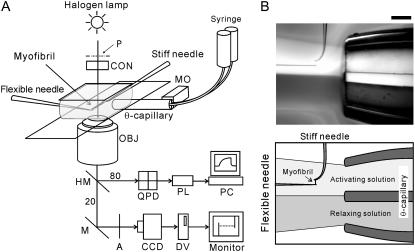
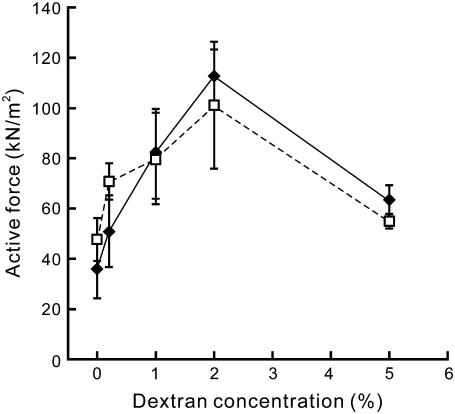
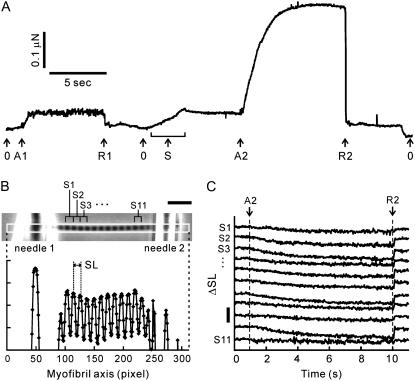
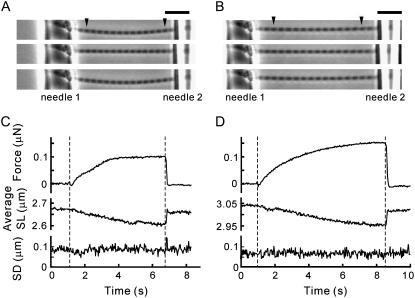
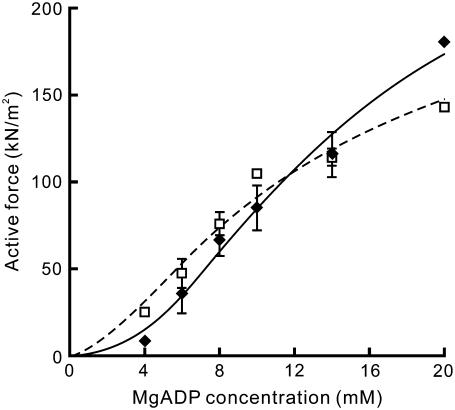
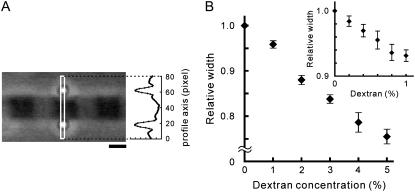
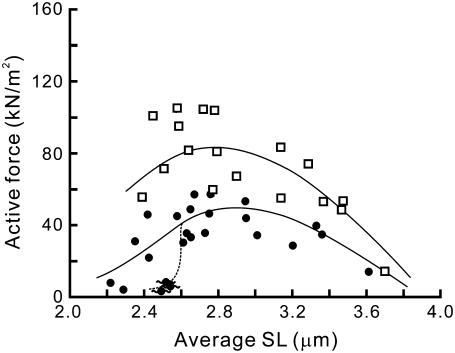
The regulatory mechanism of sarcomeric activity has not been fully clarified yet because of its complex and cooperative nature, which involves both Ca(2+) and cross-bridge binding to the thin filament. To reveal the mechanism of regulation mediated by the cross-bridges, separately from the effect of Ca(2+), we investigated the force-sarcomere length (SL) relationship in rabbit skeletal myofibrils (a single myofibril or a thin bundle) at SL > 2.2 microm in the absence of Ca(2+) at various levels of activation by exogenous MgADP (4-20 mM) in the presence of 1 mM MgATP. The individual SLs were measured by phase-contrast microscopy to confirm the homogeneity of the striation pattern of sarcomeres during activation. We found that at partial activation with 4-8 mM MgADP, the developed force nonlinearly depended on the length of overlap between the thick and the thin filaments; that is, contrary to the maximal activation, the maximal active force was generated at shorter overlap. Besides, the active force became larger, whereas this nonlinearity tended to weaken, with either an increase in [MgADP] or the lateral osmotic compression of the myofilament lattice induced by the addition of a macromolecular compound, dextran T-500. The model analysis, which takes into account the [MgADP]- and the lattice-spacing-dependent probability of cross-bridge formation, was successfully applied to account for the force-SL relationship observed at partial activation. These results strongly suggest that the cross-bridge works as a cooperative activator, the function of which is highly sensitive to as little as <or=1 nm changes in the lattice spacing.
由于肌节活动的调节机制具有复杂且协同的性质,涉及钙离子(Ca(2+))和横桥与细肌丝的结合,其尚未完全阐明。为了揭示由横桥介导的调节机制,独立于Ca(2+)的作用,我们在1 mM MgATP存在的情况下,通过外源MgADP(4 - 20 mM)在不同激活水平下,研究了兔骨骼肌肌原纤维(单个肌原纤维或细束)在肌节长度(SL)> 2.2微米且无Ca(2+)时的力 - 肌节长度关系。通过相差显微镜测量各个SL,以确认激活过程中肌节条纹模式的均匀性。我们发现,在4 - 8 mM MgADP的部分激活下,产生的力非线性地依赖于粗肌丝和细肌丝之间的重叠长度;也就是说,与最大激活相反,最大主动力在较短的重叠长度时产生。此外,随着[MgADP]的增加或添加大分子化合物葡聚糖T - 500引起的肌丝晶格横向渗透压缩,主动力变大,而这种非线性趋于减弱。考虑到[MgADP]和晶格间距依赖性横桥形成概率的模型分析,成功地用于解释在部分激活时观察到的力 - SL关系。这些结果强烈表明,横桥作为一种协同激活剂起作用,其功能对晶格间距低至≤1 nm的变化高度敏感。