Mierke Claudia Tanja, Kollmannsberger Philip, Zitterbart Daniel Paranhos, Smith James, Fabry Ben, Goldmann Wolfgang Heinrich
Center for Medical Physics and Technology, Department of Physics, Biophysics, University of Erlangen-Nuremberg, Erlangen, Germany.
Biophys J. 2008 Jan 15;94(2):661-70. doi: 10.1529/biophysj.107.108472. Epub 2007 Sep 21.
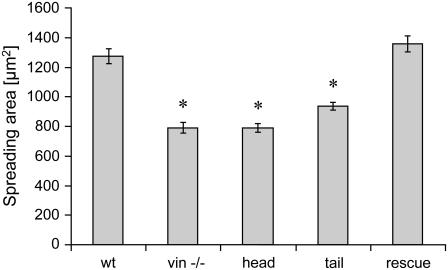
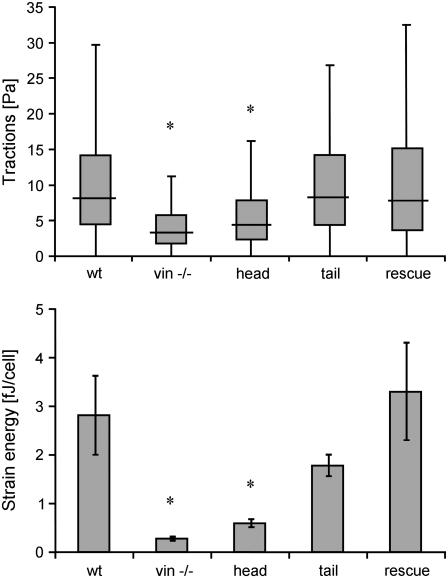
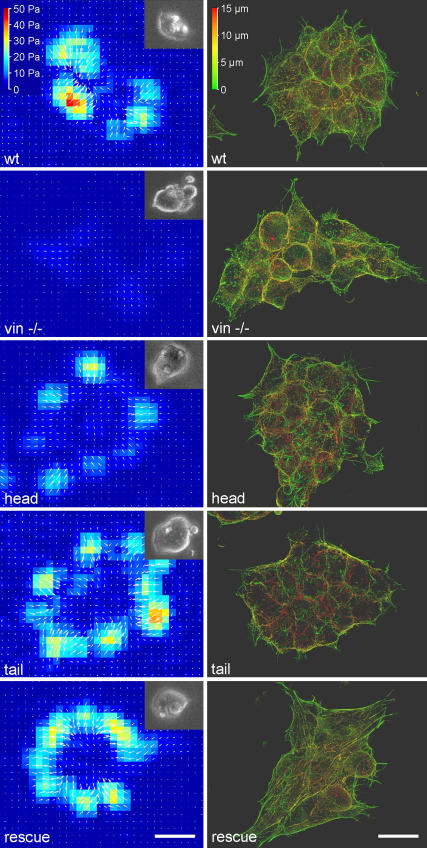
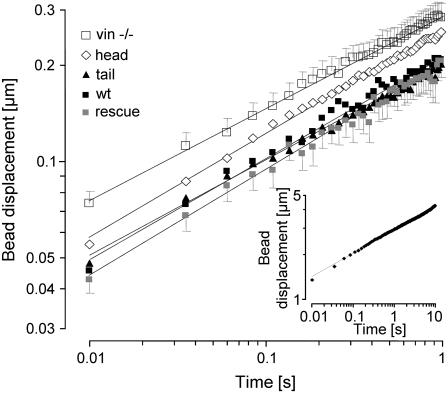
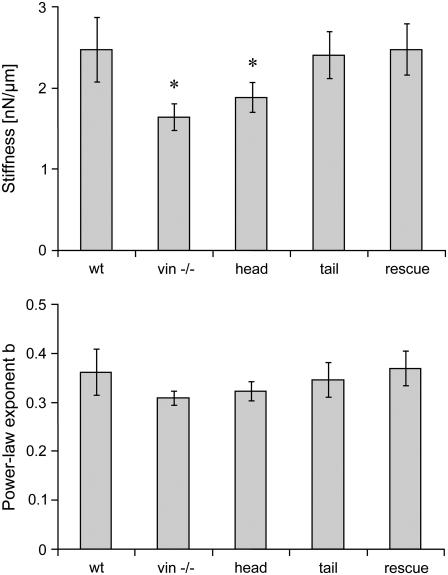
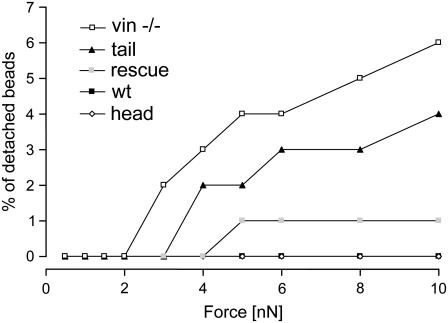
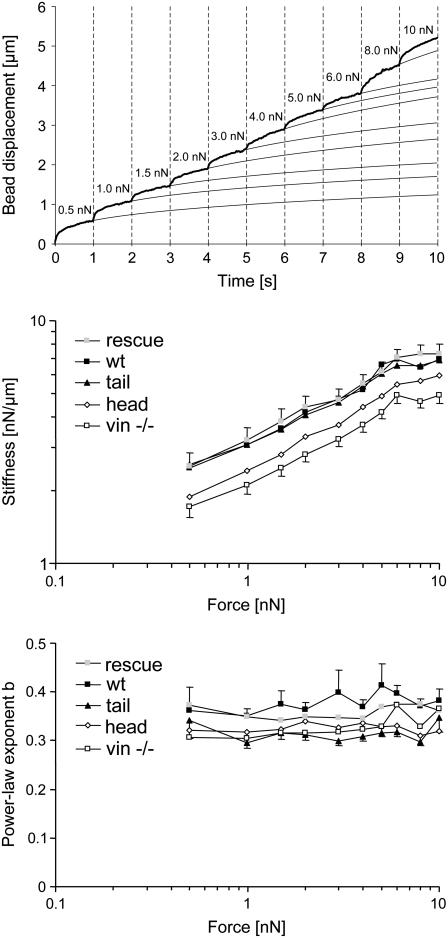
Vinculin binds to multiple focal adhesion and cytoskeletal proteins and has been implicated in transmitting mechanical forces between the actin cytoskeleton and integrins or cadherins. It remains unclear to what extent the mechano-coupling function of vinculin also involves signaling mechanisms. We report the effect of vinculin and its head and tail domains on force transfer across cell adhesions and the generation of contractile forces. The creep modulus and the adhesion forces of F9 mouse embryonic carcinoma cells (wild-type), vinculin knock-out cells (vinculin -/-), and vinculin -/- cells expressing either the vinculin head domain, tail domain, or full-length vinculin (rescue) were measured using magnetic tweezers on fibronectin-coated super-paramagnetic beads. Forces of up to 10 nN were applied to the beads. Vinculin -/- cells and tail cells showed a slightly higher incidence of bead detachment at large forces. Compared to wild-type, cell stiffness was reduced in vinculin -/- and head cells and was restored in tail and rescue cells. In all cell lines, the cell stiffness increased by a factor of 1.3 for each doubling in force. The power-law exponent of the creep modulus was force-independent and did not differ between cell lines. Importantly, cell tractions due to contractile forces were suppressed markedly in vinculin -/- and head cells, whereas tail cells generated tractions similar to the wild-type and rescue cells. These data demonstrate that vinculin contributes to the mechanical stability under large external forces by regulating contractile stress generation. Furthermore, the regulatory function resides in the tail domain of vinculin containing the paxillin-binding site.
纽蛋白可与多种粘着斑和细胞骨架蛋白结合,并参与在肌动蛋白细胞骨架与整合素或钙黏着蛋白之间传递机械力。纽蛋白的机械偶联功能在多大程度上还涉及信号机制仍不清楚。我们报告了纽蛋白及其头部和尾部结构域对跨细胞黏附的力传递和收缩力产生的影响。使用磁镊在纤连蛋白包被的超顺磁珠上测量了F9小鼠胚胎癌细胞(野生型)、纽蛋白敲除细胞(纽蛋白-/-)以及表达纽蛋白头部结构域、尾部结构域或全长纽蛋白(拯救型)的纽蛋白-/-细胞的蠕变模量和黏附力。向磁珠施加高达10 nN的力。在较大力作用下,纽蛋白-/-细胞和尾部结构域细胞的磁珠脱离发生率略高。与野生型相比,纽蛋白-/-细胞和头部结构域细胞的细胞硬度降低,而尾部结构域细胞和拯救型细胞的细胞硬度恢复。在所有细胞系中,力每增加一倍,细胞硬度增加1.3倍。蠕变模量的幂律指数与力无关,且在各细胞系之间无差异。重要的是,纽蛋白-/-细胞和头部结构域细胞中由收缩力引起的细胞牵引力明显受到抑制,而尾部结构域细胞产生的牵引力与野生型和拯救型细胞相似。这些数据表明,纽蛋白通过调节收缩应力的产生,有助于在大外力作用下维持机械稳定性。此外,调节功能存在于纽蛋白含有桩蛋白结合位点的尾部结构域中。