Ferraroni Marta, Myasoedova Nina M, Schmatchenko Vadim, Leontievsky Alexey A, Golovleva Ludmila A, Scozzafava Andrea, Briganti Fabrizio
Department of Chemistry University of Florence, Via della Lastruccia 3, Sesto Fiorentino, 50019 Florence, Italy.
BMC Struct Biol. 2007 Sep 26;7:60. doi: 10.1186/1472-6807-7-60.
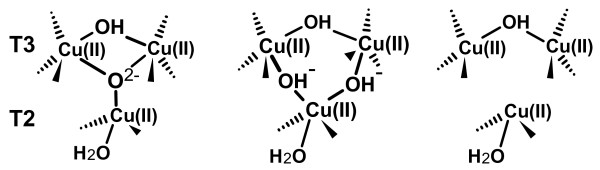
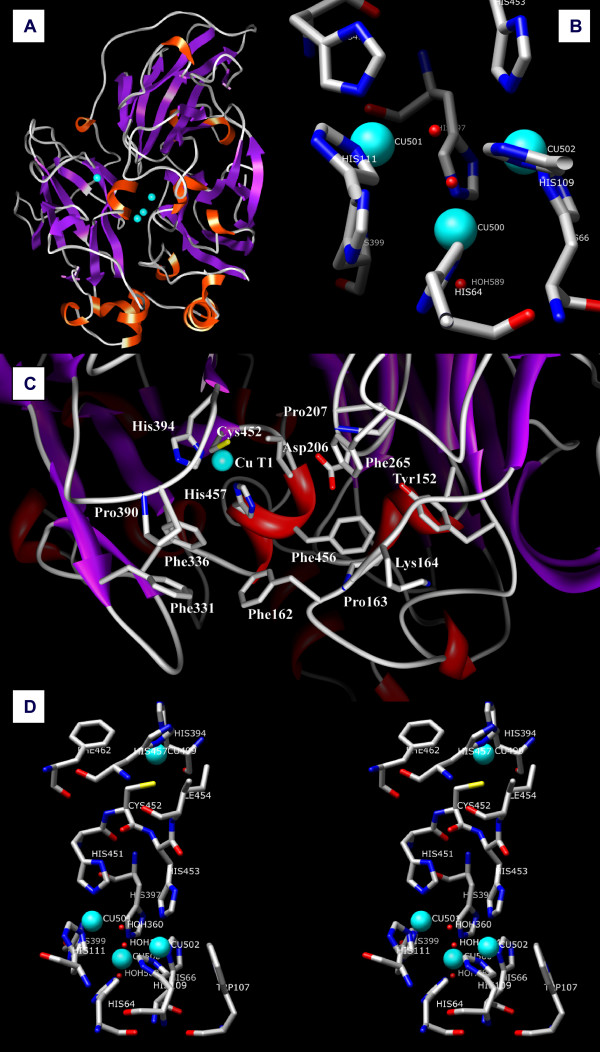
Laccases belong to multicopper oxidases, a widespread class of enzymes implicated in many oxidative functions in pathogenesis, immunogenesis and morphogenesis of organisms and in the metabolic turnover of complex organic substances. They catalyze the coupling between the four one-electron oxidations of a broad range of substrates with the four-electron reduction of dioxygen to water. These catalytic processes are made possible by the contemporaneous presence of at least four copper ion sites, classified according to their spectroscopic properties: one type 1 (T1) site where the electrons from the reducing substrates are accepted, one type 2 (T2), and a coupled binuclear type 3 pair (T3) which are assembled in a T2/T3 trinuclear cluster where the electrons are transferred to perform the O2 reduction to H2O.
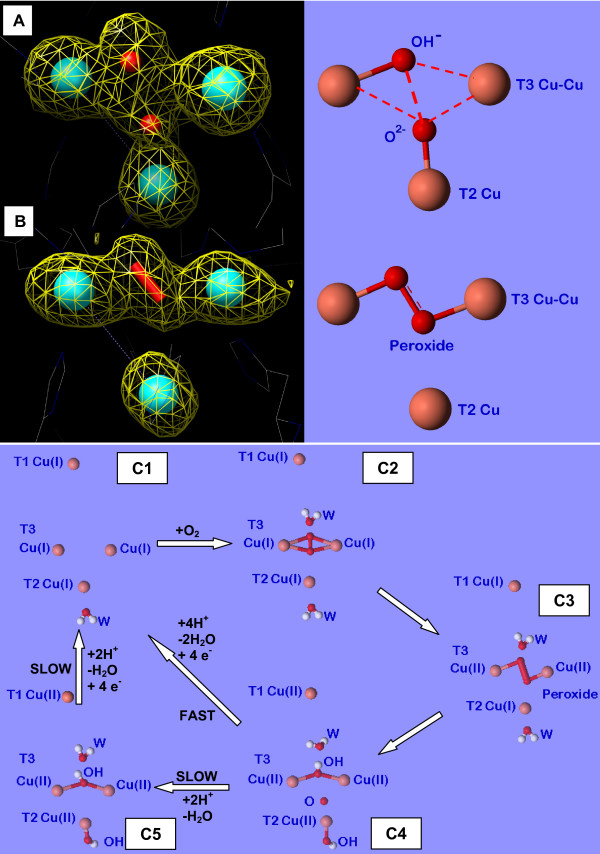
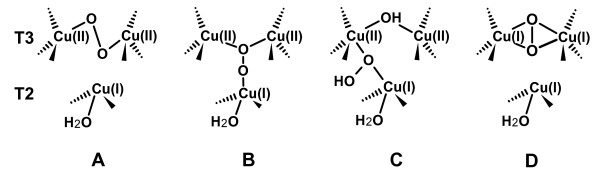
The structure of a laccase from the white-rot fungus Lentinus (Panus) tigrinus, a glycoenzyme involved in lignin biodegradation, was solved at 1.5 A. It reveals a asymmetric unit containing two laccase molecules (A and B). The progressive reduction of the copper ions centers obtained by the long-term exposure of the crystals to the high-intensity X-ray synchrotron beam radiation under aerobic conditions and high pH allowed us to detect two sequential intermediates in the molecular oxygen reduction pathway: the "peroxide" and the "native" intermediates, previously hypothesized through spectroscopic, kinetic and molecular mechanics studies. Specifically the electron-density maps revealed the presence of an end-on bridging, micro-eta 1:eta 1 peroxide ion between the two T3 coppers in molecule B, result of a two-electrons reduction, whereas in molecule A an oxo ion bridging the three coppers of the T2/T3 cluster (micro3-oxo bridge) together with an hydroxide ion externally bridging the two T3 copper ions, products of the four-electrons reduction of molecular oxygen, were best modelled.
This is the first structure of a multicopper oxidase which allowed the detection of two intermediates in the molecular oxygen reduction and splitting. The observed features allow to positively substantiate an accurate mechanism of dioxygen reduction catalyzed by multicopper oxidases providing general insights into the reductive cleavage of the O-O bonds, a leading problem in many areas of biology.
漆酶属于多铜氧化酶,是一类广泛存在的酶,参与生物体发病机制、免疫发生和形态发生中的许多氧化功能以及复杂有机物质的代谢周转。它们催化多种底物的四次单电子氧化与氧气还原为水的四电子还原之间的偶联反应。这些催化过程通过至少四个铜离子位点的同时存在得以实现,这些位点根据其光谱性质分类:一个1型(T1)位点,用于接受来自还原底物的电子;一个2型(T2)位点;以及一个耦合的双核3型对(T3),它们组装成一个T2/T3三核簇,在其中电子被转移以将氧气还原为水。
来自白腐真菌虎皮香菇(Lentinus (Panus) tigrinus)的一种参与木质素生物降解的糖基化漆酶的结构在1.5埃分辨率下得到解析。它揭示了一个不对称单元,包含两个漆酶分子(A和B)。通过在有氧条件和高pH值下将晶体长期暴露于高强度X射线同步加速器光束辐射而获得的铜离子中心的逐步还原,使我们能够在分子氧还原途径中检测到两个连续的中间体:“过氧化物”和“天然”中间体,这两个中间体此前通过光谱、动力学和分子力学研究被推测存在。具体而言,电子密度图显示在分子B的两个T3铜之间存在一个端对端桥连的微η1:η1过氧化物离子,这是双电子还原的结果,而在分子A中,一个氧离子桥连T2/T3簇的三个铜(微3 - 氧桥)以及一个外部桥连两个T3铜离子的氢氧根离子,这是分子氧四电子还原的产物,得到了最佳建模。
这是首个多铜氧化酶的结构,它使得在分子氧还原和裂解过程中检测到两个中间体成为可能。观察到的特征能够确凿地证实多铜氧化酶催化的双原子氧还原的精确机制,为许多生物学领域中的一个主要问题——O - O键的还原裂解提供了一般性见解。