Skånér Ylva, Nilsson Gunnar H, Sundquist Kristina, Hassler Ejda, Krakau Ingvar
CeFAM (Centre for Family and Community Medicine), Karolinska Institute, Alfred Nobels väg 12, SE-141 83 Huddinge, Sweden.
BMC Fam Pract. 2007 Oct 17;8:61. doi: 10.1186/1471-2296-8-61.
Self-rated health is an important indicator of quality of life as well as a good predictor of future health. The purpose of the study was to follow up the self-rated health and the prevalence of symptoms of depression and general symptoms in a population of first-ever stroke patients 3 and 12 months after stroke.
All patients surviving their first-ever stroke and residing in Nacka municipality in Stockholm County Council were included using a multiple overlapping search strategy during an 18-month period (n = 187). Our study group comprised the 145 patients who survived the first 3 months after stroke. Three and 12 months after their stroke, the patients were assessed regarding self-rated health and general symptoms using parts of the Göteborg Quality of Life Instrument (GQLI), and regarding symptoms of depression using the Montgomery Asberg Depression Scale (MADRS-S).
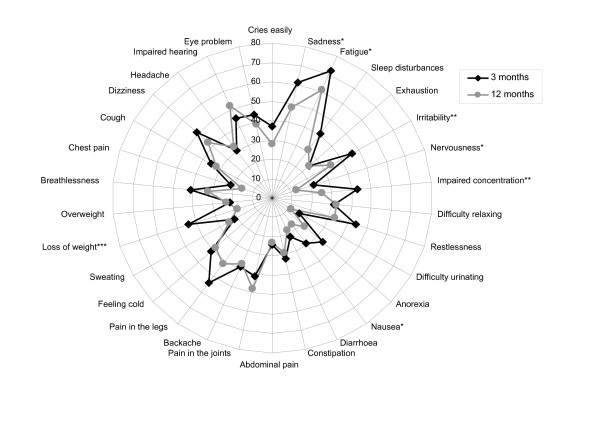
Self-rated health was rated as very good or rather good by 62% at 3 months after stroke and by 78% at 12 months after stroke. More than half of the patients suffered from symptoms of depression, with no significant improvement at 12 months. The most common general symptoms at 3 months after stroke were fatigue, sadness, pain in the legs, dizziness and irritability. Fatigue and sadness were still common at 12 months. Twelve months after stroke the prevalences of crying easily, irritability, impaired concentration, nausea and loss of weight were significantly lower.
The majority of patients rated their health as rather good or very good at 3 and 12 months after stroke. However, the majority suffered from fatigue and from symptoms of depression after both 3 and 12 months. In continued care of stroke survivors, it is important to consider the fact that many patients who rate their health as good may nevertheless have symptoms of depression, and some of them may benefit from anti-depressive treatment.
自我评定健康状况是生活质量的重要指标,也是未来健康状况的良好预测指标。本研究的目的是对首次发生中风的患者群体在中风后3个月和12个月时的自我评定健康状况以及抑郁症状和一般症状的患病率进行随访。
在18个月期间,采用多重重叠搜索策略纳入了所有首次中风后存活且居住在斯德哥尔摩郡议会纳卡市的患者(n = 187)。我们的研究组包括中风后前3个月存活的145名患者。在中风后3个月和12个月时,使用哥德堡生活质量量表(GQLI)的部分内容对患者的自我评定健康状况和一般症状进行评估,并使用蒙哥马利-阿斯伯格抑郁量表(MADRS-S)对抑郁症状进行评估。
中风后3个月时,62%的患者将自我评定健康状况评为非常好或相当好,中风后12个月时这一比例为78%。超过一半的患者有抑郁症状,在12个月时无显著改善。中风后3个月最常见的一般症状是疲劳、悲伤、腿部疼痛、头晕和易怒。疲劳和悲伤在12个月时仍然常见。中风后12个月时,容易哭泣、易怒、注意力不集中、恶心和体重减轻的患病率显著降低。
大多数患者在中风后3个月和12个月时将自己的健康状况评为相当好或非常好。然而,大多数患者在3个月和12个月后都有疲劳和抑郁症状。在对中风幸存者的持续护理中,重要的是要考虑到许多自我评定健康状况良好的患者可能仍有抑郁症状,其中一些患者可能受益于抗抑郁治疗。