Parker Jeremy D K, Bradley Brian A, Mooers Arne O, Quarmby Lynne M
Department of Molecular Biology and Biochemistry, Simon Fraser University, Burnaby, British Columbia, Canada.
PLoS One. 2007 Oct 24;2(10):e1076. doi: 10.1371/journal.pone.0001076.
NIMA-related kinases (Neks) have been studied in diverse eukaryotes, including the fungus Aspergillus and the ciliate Tetrahymena. In the former, a single Nek plays an essential role in cell cycle regulation; in the latter, which has more than 30 Neks in its genome, multiple Neks regulate ciliary length. Mammalian genomes encode an intermediate number of Neks, several of which are reported to play roles in cell cycle regulation and/or localize to centrosomes. Previously, we reported that organisms with cilia typically have more Neks than organisms without cilia, but were unable to establish the evolutionary history of the gene family.
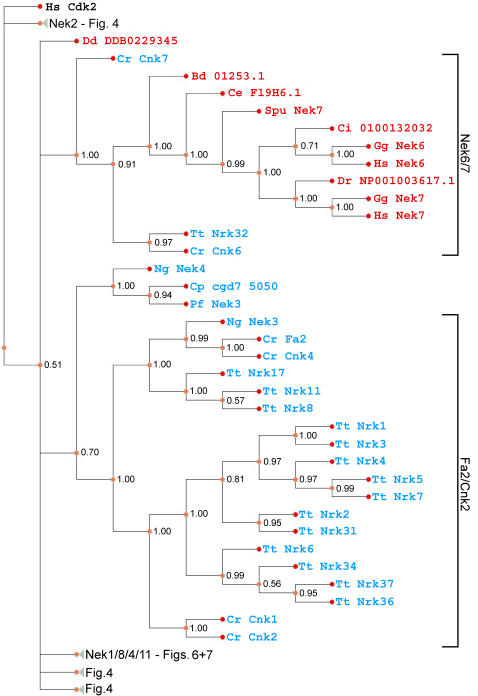
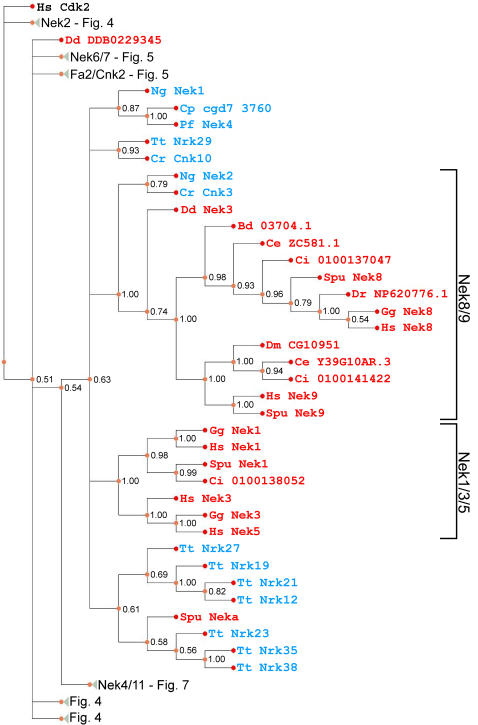
METHODOLOGY/PRINCIPLE FINDINGS: We have performed a large-scale analysis of the Nek family using Bayesian techniques, including tests of alternate topologies. We find that the Nek family had already expanded in the last common ancestor of eukaryotes, a ciliated cell which likely expressed at least five Neks. We suggest that Neks played an important role in the common ancestor in regulating cilia, centrioles, and centrosomes with respect to mitotic entry, and that this role continues today in organisms with cilia. Organisms that lack cilia generally show a reduction in the number of Nek clades represented, sometimes associated with lineage specific expansion of a single clade, as has occurred in the plants.
CONCLUSION/SIGNIFICANCE: This is the first rigorous phylogenetic analysis of a kinase family across a broad array of phyla. Our findings provide a coherent framework for the study of Neks and their roles in coordinating cilia and cell cycle progression.
NIMA相关激酶(Neks)已在多种真核生物中得到研究,包括真菌曲霉和纤毛虫四膜虫。在前者中,单个Nek在细胞周期调控中起关键作用;在后者中,其基因组中有30多个Neks,多个Neks调控纤毛长度。哺乳动物基因组编码的Neks数量处于中间水平,其中一些据报道在细胞周期调控中发挥作用和/或定位于中心体。此前,我们报道有纤毛的生物通常比没有纤毛的生物拥有更多的Neks,但无法确定该基因家族的进化史。
方法/主要发现:我们使用贝叶斯技术对Nek家族进行了大规模分析,包括对替代拓扑结构的测试。我们发现Nek家族在真核生物的最后一个共同祖先中就已经扩张,这个有纤毛的细胞可能至少表达了五种Neks。我们认为,Neks在共同祖先中在有丝分裂进入时对纤毛、中心粒和中心体的调控中发挥了重要作用, 并且这种作用在今天有纤毛的生物中仍然存在。缺乏纤毛的生物通常显示所代表的Nek进化枝数量减少,有时与单个进化枝的谱系特异性扩张有关,就像在植物中发生的那样。
结论/意义:这是首次对广泛门类的激酶家族进行严格的系统发育分析。我们的发现为研究Neks及其在协调纤毛和细胞周期进程中的作用提供了一个连贯的框架。