Zmasek Christian M, Zhang Qing, Ye Yuzhen, Godzik Adam
Burnham Institute for Medical Research, North Torrey Pines Road, La Jolla, CA 92037, USA.
Genome Biol. 2007;8(10):R226. doi: 10.1186/gb-2007-8-10-r226.
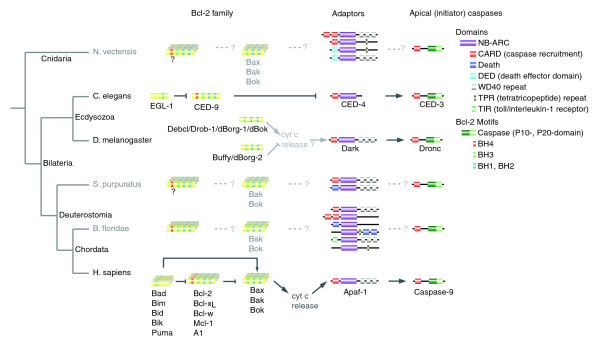
Apoptosis, one of the main types of programmed cell death, is regulated and performed by a complex protein network. Studies in model organisms, mostly in the nematode Caenorhabditis elegans, identified a relatively simple apoptotic network consisting of only a few proteins. However, analysis of several recently sequenced invertebrate genomes, ranging from the cnidarian sea anemone Nematostella vectensis, representing one of the morphologically simplest metazoans, to the deuterostomes sea urchin and amphioxus, contradicts the current paradigm of a simple ancestral network that expanded in vertebrates.
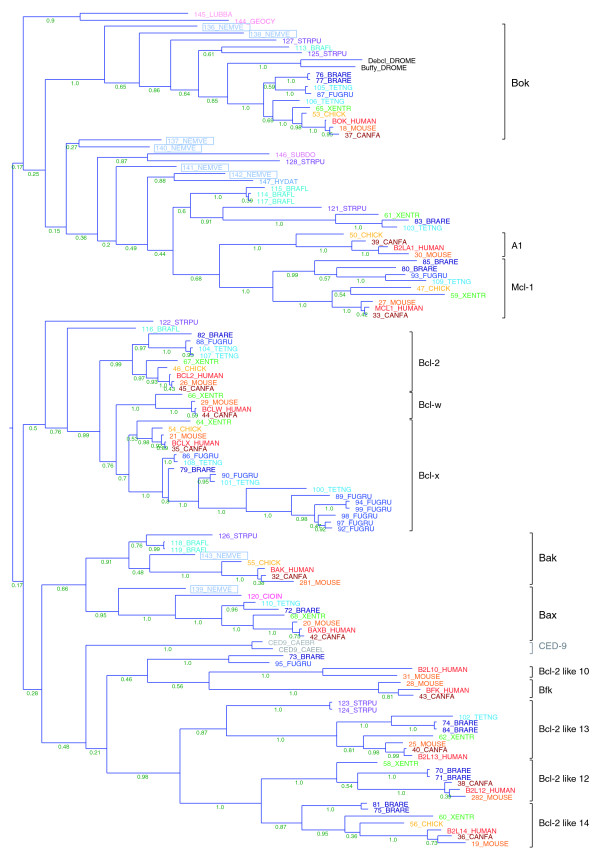
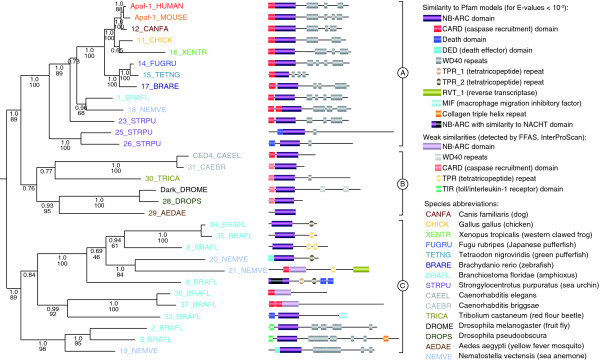
Here we show that the apoptosome-forming CED-4/Apaf-1 protein, present in single copy in vertebrate, nematode, and insect genomes, had multiple paralogs in the cnidarian-bilaterian ancestor. Different members of this ancestral Apaf-1 family led to the extant proteins in nematodes/insects and in deuterostomes, explaining significant functional differences between proteins that until now were believed to be orthologous. Similarly, the evolution of the Bcl-2 and caspase protein families appears surprisingly complex and apparently included significant gene loss in nematodes and insects and expansions in deuterostomes.
The emerging picture of the evolution of the apoptosis network is one of a succession of lineage-specific expansions and losses, which combined with the limited number of 'apoptotic' protein families, resulted in apparent similarities between networks in different organisms that mask an underlying complex evolutionary history. Similar results are beginning to surface for other regulatory networks, contradicting the intuitive notion that regulatory networks evolved in a linear way, from simple to complex.
细胞凋亡是程序性细胞死亡的主要类型之一,由一个复杂的蛋白质网络调控并执行。对模式生物的研究,主要是在线虫秀丽隐杆线虫中,确定了一个相对简单的凋亡网络,仅由少数几种蛋白质组成。然而,对最近测序的几种无脊椎动物基因组的分析,从代表形态上最简单的后生动物之一的刺胞动物海葵星状海葵,到后口动物海胆和文昌鱼,都与当前认为在脊椎动物中扩展的简单祖先网络的范式相矛盾。
我们在此表明,在脊椎动物、线虫和昆虫基因组中以单拷贝形式存在的形成凋亡小体的CED-4/Apaf-1蛋白,在刺胞动物-两侧对称动物的祖先中有多个旁系同源物。这个祖先Apaf-1家族的不同成员导致了线虫/昆虫和后口动物中现存的蛋白质,解释了迄今为止被认为是直系同源的蛋白质之间的显著功能差异。同样,Bcl-2和半胱天冬酶蛋白家族的进化似乎也令人惊讶地复杂,显然包括线虫和昆虫中的显著基因丢失以及后口动物中的基因扩展。
凋亡网络进化的新图景是一系列特定谱系的扩展和丢失,这与有限数量的“凋亡”蛋白家族相结合,导致不同生物体中的网络之间存在明显的相似性,掩盖了潜在的复杂进化历史。其他调控网络也开始出现类似的结果,这与调控网络从简单到复杂以线性方式进化的直观概念相矛盾。