Liedvogel Miriam, Maeda Kiminori, Henbest Kevin, Schleicher Erik, Simon Thomas, Timmel Christiane R, Hore P J, Mouritsen Henrik
VW Nachswuchgruppe Animal Navigation, IBU, University of Oldenburg, Oldenburg, Germany.
PLoS One. 2007 Oct 31;2(10):e1106. doi: 10.1371/journal.pone.0001106.
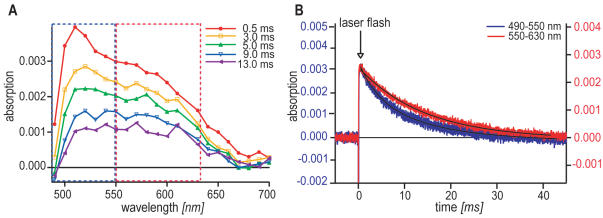
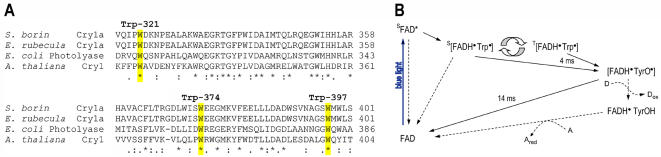
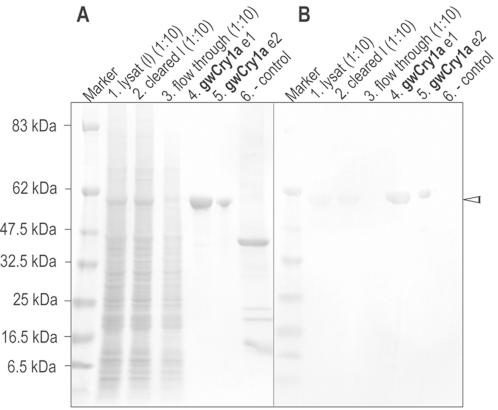
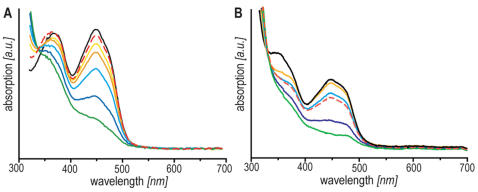
Cryptochromes (Cry) have been suggested to form the basis of light-dependent magnetic compass orientation in birds. However, to function as magnetic compass sensors, the cryptochromes of migratory birds must possess a number of key biophysical characteristics. Most importantly, absorption of blue light must produce radical pairs with lifetimes longer than about a microsecond. Cryptochrome 1a (gwCry1a) and the photolyase-homology-region of Cry1 (gwCry1-PHR) from the migratory garden warbler were recombinantly expressed and purified from a baculovirus/Sf9 cell expression system. Transient absorption measurements show that these flavoproteins are indeed excited by light in the blue spectral range leading to the formation of radicals with millisecond lifetimes. These biophysical characteristics suggest that gwCry1a is ideally suited as a primary light-mediated, radical-pair-based magnetic compass receptor.
隐花色素(Cry)被认为是鸟类光依赖型磁罗盘定向的基础。然而,要作为磁罗盘传感器发挥作用,候鸟的隐花色素必须具备一些关键的生物物理特性。最重要的是,蓝光吸收必须产生寿命长于约一微秒的自由基对。从杆状病毒/Sf9细胞表达系统中重组表达并纯化了来自迁徙花园莺的隐花色素1a(gwCry1a)和Cry1的光解酶同源区域(gwCry1-PHR)。瞬态吸收测量表明,这些黄素蛋白确实在蓝光光谱范围内被光激发,导致形成具有毫秒寿命的自由基。这些生物物理特性表明,gwCry1a非常适合作为基于自由基对的主要光介导磁罗盘受体。