Wiltschko Roswitha, Gehring Dennis, Denzau Susanne, Nießner Christine, Wiltschko Wolfgang
Goethe-Universität Frankfurt, FB Biowissenschaften, Max-von-Laue-Straße 13, D-60438 Frankfurt am Main, Germany
Goethe-Universität Frankfurt, FB Biowissenschaften, Max-von-Laue-Straße 13, D-60438 Frankfurt am Main, Germany.
J Exp Biol. 2014 Dec 1;217(Pt 23):4225-8. doi: 10.1242/jeb.110981.
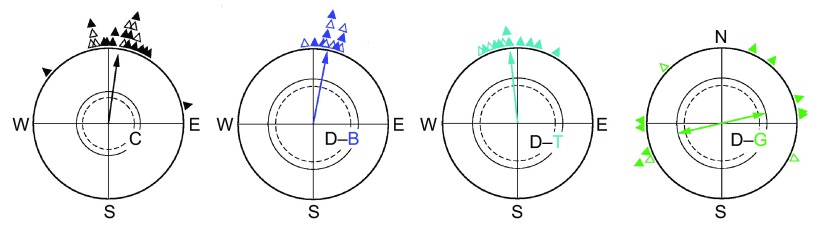
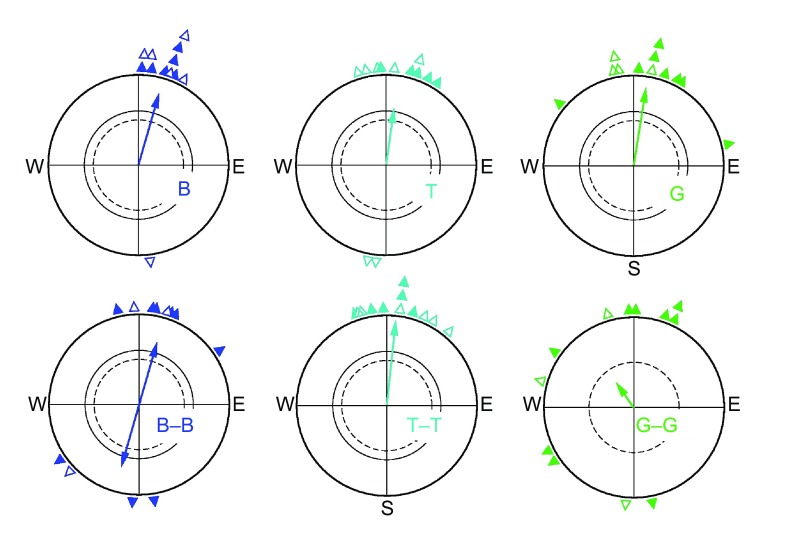
Behavioural tests of the magnetic compass of birds and corresponding immunohistological studies on the activation of retinal cryptochrome 1a, the putative receptor molecule, showed oriented behaviour and activated Cry1a under 373 nm UV, 424 nm blue, 502 nm turquoise and 565 nm green light, although the last wavelength does not allow the first step of photoreduction of cryptochrome to the semiquinone form. The tested birds had been kept under 'white' light before, hence we suggested that there was a supply of semiquinone present at the beginning of the exposure to green light that could be further reduced and then re-oxidized. To test the hypothesis in behavioural experiments, we tested robins, Erithacus rubecula, under various wavelengths (1) after 1 h pre-exposure to total darkness and (2) after 1 h pre-exposure to the same light as used in the test. The birds were oriented under blue and turquoise light, where the full cryptochrome cycle can run, but not under green light. This finding is in agreement with the hypothesis. Orientation under green light appears to be a transient phenomenon until the supply of semiquinone is depleted.
对鸟类磁罗盘的行为测试以及对假定的受体分子视网膜隐花色素1a激活情况的相应免疫组织学研究表明,在373纳米紫外线、424纳米蓝光、502纳米蓝绿色光和565纳米绿光下,鸟类表现出定向行为且隐花色素1a被激活,尽管最后一个波长不允许隐花色素光还原为半醌形式的第一步反应。受试鸟类此前一直饲养在“白色”光下,因此我们推测在开始暴露于绿光时存在半醌供应,其可进一步被还原然后再氧化。为在行为实验中验证该假设,我们对知更鸟(欧亚鸲)在以下两种情况下进行了不同波长(1)预先暴露于完全黑暗1小时后以及(2)预先暴露于与测试所用相同的光1小时后测试。鸟类在蓝光和蓝绿色光下能够定向,此时隐花色素的完整循环可以进行,但在绿光下则不能。这一发现与该假设相符。在半醌供应耗尽之前,绿光下的定向似乎是一种短暂现象。