Tawari Blessing, Ali Ibne Karim M, Scott Claire, Quail Michael A, Berriman Matthew, Hall Neil, Clark C Graham
Department of Infectious and Tropical Diseases, London School of Hygiene and Tropical Medicine, London, United Kingdom.
Mol Biol Evol. 2008 Jan;25(1):187-98. doi: 10.1093/molbev/msm238. Epub 2007 Nov 1.
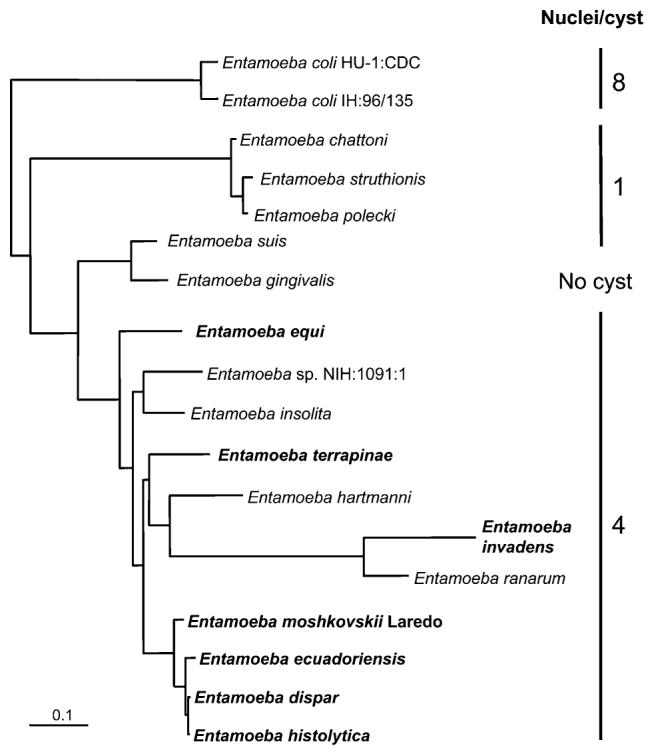
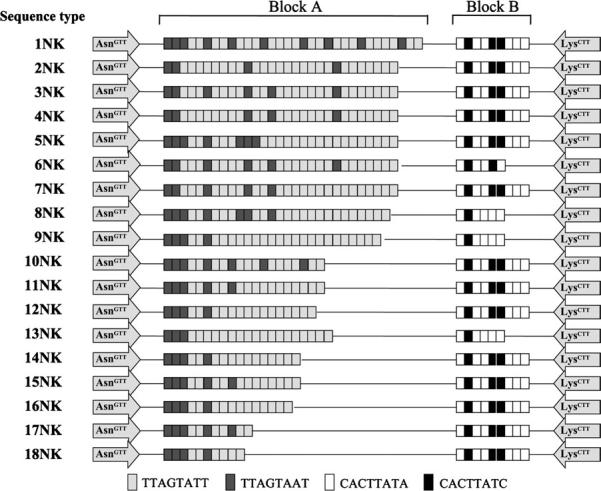
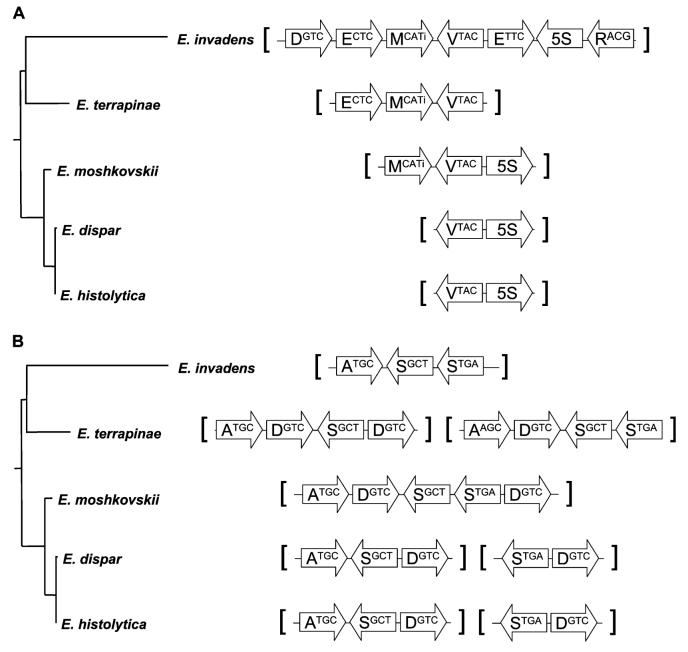
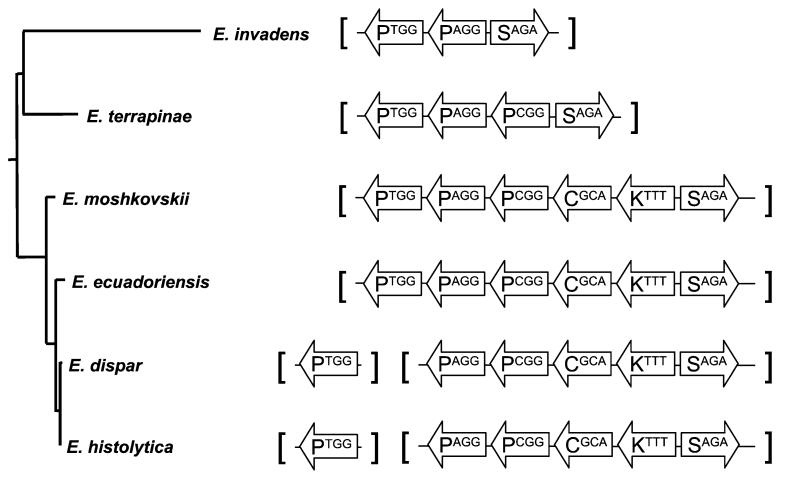
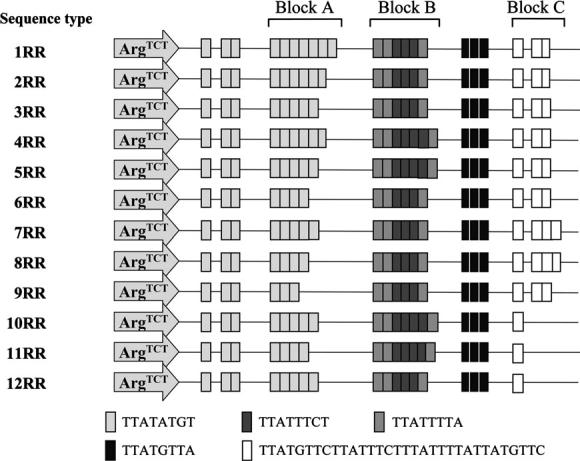
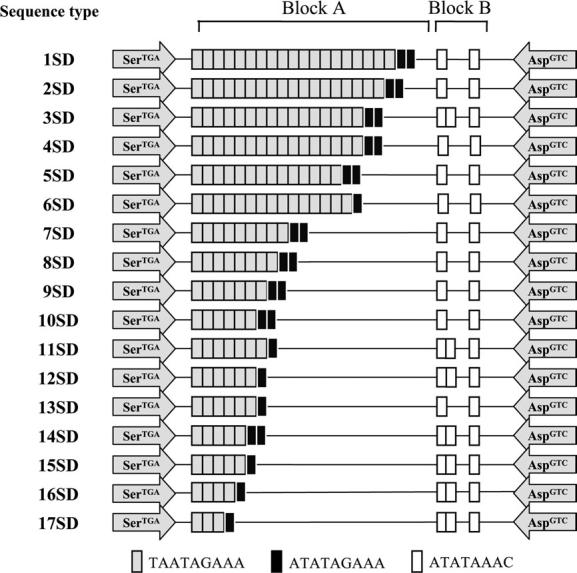
Genome sequencing of the protistan parasite Entamoeba histolytica HM-1:IMSS revealed that almost all the tRNA genes are organized into tandem arrays that make up over 10% of the genome. The 25 distinct array units contain up to 5 tRNA genes each and some also encode the 5S RNA. Between adjacent genes in array units are complex short tandem repeats (STRs) resembling microsatellites. To investigate the origins and evolution of this unique gene organization, we have undertaken a genome survey to determine the array unit organization in 4 other species of Entamoeba-Entamoeba dispar, Entamoeba moshkovskii, Entamoeba terrapinae, and Entamoeba invadens-and have explored the STR structure in other isolates of E. histolytica. The genome surveys revealed that E. dispar has the same array unit organization as E. histolytica, including the presence and numerical variation of STRs between adjacent genes. However, the individual repeat sequences are completely different to those in E. histolytica. All other species of Entamoeba studied also have tandem arrays of clustered tRNA genes, but the gene composition of the array units often differs from that in E. histolytica/E. dispar. None of the other species' arrays exhibit the complex STRs between adjacent genes although simple tandem duplications are occasionally seen. The degree of similarity in organization reflects the phylogenetic relationships among the species studied. Within individual isolates of E. histolytica most copies of the array unit are uniform in sequence with only minor variation in the number and organization of the STRs. Between isolates, however, substantial differences in STR number and organization can exist although the individual repeat sequences tend to be conserved. The origin of this unique gene organization in the genus Entamoeba clearly predates the common ancestor of the species investigated to date and their function remains unclear.
对原生生物寄生虫溶组织内阿米巴HM-1:IMSS进行的基因组测序显示,几乎所有的tRNA基因都排列成串联阵列,这些阵列占基因组的比例超过10%。25个不同的阵列单元每个包含多达5个tRNA基因,有些还编码5S RNA。在阵列单元中的相邻基因之间是类似于微卫星的复杂短串联重复序列(STRs)。为了研究这种独特基因组织的起源和进化,我们进行了一项基因组调查,以确定其他4种阿米巴属物种——迪氏内阿米巴、莫斯科维茨内阿米巴、龟内阿米巴和侵袭内阿米巴——的阵列单元组织,并探索了溶组织内阿米巴其他分离株中的STR结构。基因组调查显示,迪氏内阿米巴与溶组织内阿米巴具有相同的阵列单元组织,包括相邻基因之间STRs的存在和数量变化。然而,单个重复序列与溶组织内阿米巴中的完全不同。所研究的所有其他阿米巴属物种也有tRNA基因成簇的串联阵列,但阵列单元的基因组成通常与溶组织内阿米巴/迪氏内阿米巴不同。尽管偶尔会出现简单的串联重复,但其他物种的阵列在相邻基因之间均未表现出复杂的STRs。组织上的相似程度反映了所研究物种之间的系统发育关系。在溶组织内阿米巴的单个分离株中,阵列单元的大多数拷贝在序列上是一致的,只是STRs的数量和组织存在微小差异。然而,在不同分离株之间,尽管单个重复序列往往是保守的,但STR数量和组织可能存在很大差异。阿米巴属中这种独特基因组织的起源显然早于迄今所研究物种的共同祖先,其功能仍不清楚。