Kuwabara Yu, Alexeeff George V, Broadwin Rachel, Salmon Andrew G
Office of Environmental Health Hazard Assessment, California Environmental Protection Agency, Oakland, California 94612, USA.
Environ Health Perspect. 2007 Nov;115(11):1609-16. doi: 10.1289/ehp.9848.
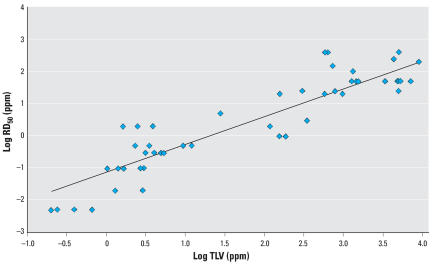
The RD(50) (exposure concentration producing a 50% respiratory rate decrease) test evaluates airborne chemicals for sensory irritation and has become an American Society for Testing and Materials (ASTM) standard method. Past studies reported good correlations (R(2)) between RD(50)s and the occupational exposure limits, particularly threshold limit values (TLVs).
The main purpose of this study was to examine the relationship between RD(50)s and human sensory irritation responses in a quantitative manner, particularly for chemicals that produce burning sensation of the eyes, nose, or throat, based on lowest observed adverse effect levels (LOAELs) reported for human subjects.
We compared RD(50)s with LOAELs and acute reference exposure levels (RELs). RELs, developed by the California Environmental Protection Agency's Office of Environmental Health Hazard Assessment, represent a level at which no adverse effects are anticipated after exposure. We collected RD(50)s from the published literature and evaluated them for consistency with ASTM procedures. We identified LOAELs for human irritation and found 25 chemicals with a corresponding RD(50) in mice.
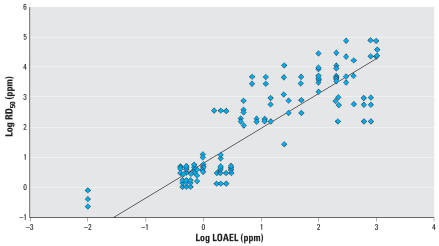
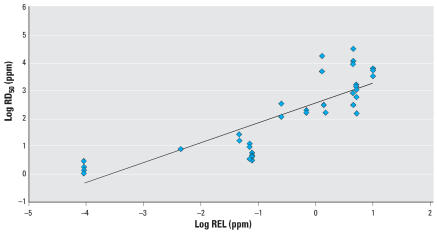
We found the relationship between RD(50)s and LOAELs as log RD(50) = 1.16 (log LOAEL) + 0.77 with an R(2) value of 0.80. This strong correlation supports the use of the RD(50) in establishing exposure limits for the public. We further identified 16 chemical irritants with both RD(50)s and corresponding acute RELs, and calculated the relationship as log RD(50) = 0.71 (log REL) + 2.55 with an R(2) value of 0.71. This relationship could be used to identify health protective values for the public to prevent respiratory or sensory irritation.
Consequently, we believe that the RD(50) has benefits for use in setting protective levels for the health of both workers and the general population.
RD(50)(导致呼吸频率降低50%的暴露浓度)测试用于评估空气中化学物质的感官刺激性,已成为美国材料与试验协会(ASTM)的标准方法。过去的研究报告称,RD(50)与职业接触限值,尤其是阈限值(TLV)之间存在良好的相关性(R(2))。
本研究的主要目的是以定量方式研究RD(50)与人类感官刺激反应之间的关系,特别是对于那些根据人类受试者报告的最低观察到的有害作用水平(LOAEL)会引起眼睛、鼻子或喉咙灼痛感觉的化学物质。
我们将RD(50)与LOAEL和急性参考暴露水平(REL)进行了比较。REL由加利福尼亚州环境保护局环境卫生危害评估办公室制定,代表暴露后预计不会产生不良影响的水平。我们从已发表的文献中收集了RD(50),并根据ASTM程序对其进行了一致性评估。我们确定了人类刺激的LOAEL,并找到了25种在小鼠中有相应RD(50)的化学物质。
我们发现RD(50)与LOAEL之间的关系为log RD(50)=1.16(log LOAEL)+0.77,R(2)值为0.80。这种强相关性支持使用RD(50)来确定公众的暴露限值。我们进一步确定了16种同时具有RD(50)和相应急性REL的化学刺激物,并计算出它们之间的关系为log RD(50)=0.71(log REL)+2.55,R(2)值为0.71。这种关系可用于确定保护公众健康以防止呼吸或感官刺激的数值。
因此,我们认为RD(50)在为工人和普通人群的健康设定保护水平方面具有益处。