Schmalz Dorothy L, Deane Glenn D, Birch Leann L, Davison Kirsten Krahnstoever
Department of Parks, Recreation, & Tourism Management, Clemson University, Clemson, South Carolina 29634, USA.
J Adolesc Health. 2007 Dec;41(6):559-65. doi: 10.1016/j.jadohealth.2007.07.001. Epub 2007 Sep 29.
For decades, researchers have proclaimed the positive psychosocial benefits of participation in physical activity. However, recent meta-analyses of the literature have found infrequent and inconclusive empirical support for the link between physical activity and psychosocial well-being. In this study, we use data from a longitudinal study to explore the links between participation in physical activity and global self-esteem among girls from childhood into early adolescence and the direction of this relationship.
Participants included 197 non-Hispanic white girls. Girls' participation in physical activity and their global self-esteem were assessed when they were 9, 11, and 13 years old. Panel regression was used to assess the lagged effect of physical activity on self-esteem and the lagged effect of self-esteem on physical activity, controlling for family socioeconomic status (SES) and girls' body mass index (BMI).
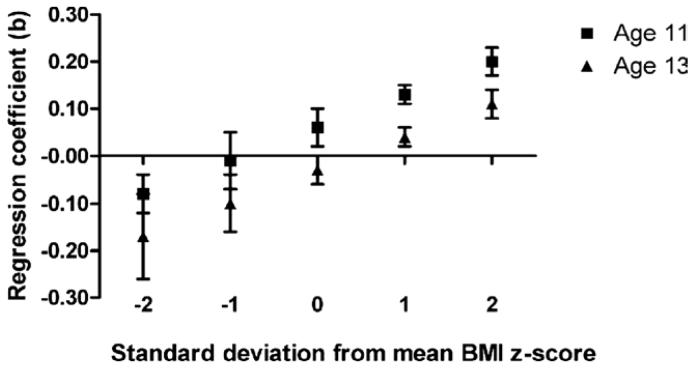
A significant lagged effect of physical activity on self-esteem was identified. Specifically, higher physical activity at ages 9 and 11 years predicted higher self-esteem at ages 11 and 13 years respectively, controlling for covariates. Positive effects of physical activity on self-esteem were most apparent at age 11 and for girls with higher BMI. No support was gained for the lagged effect of self-esteem on physical activity.
Results suggest that participating in physical activity can lead to positive self-esteem among adolescent girls, particularly for younger girls and those at greatest risk of overweight. These findings highlight the necessity of promoting physical activity among adolescent girls as a method of fostering positive self-worth.
数十年来,研究人员一直宣称参与体育活动对心理社会有益。然而,最近对文献的荟萃分析发现,体育活动与心理社会幸福感之间的联系缺乏实证支持且结论不一。在本研究中,我们使用一项纵向研究的数据,探讨从童年到青春期早期女孩参与体育活动与总体自尊之间的联系以及这种关系的方向。
参与者包括197名非西班牙裔白人女孩。在她们9岁、11岁和13岁时评估女孩参与体育活动的情况及其总体自尊。使用面板回归评估体育活动对自尊的滞后效应以及自尊对体育活动的滞后效应,并控制家庭社会经济地位(SES)和女孩的体重指数(BMI)。
确定了体育活动对自尊有显著的滞后效应。具体而言,在控制协变量的情况下,9岁和11岁时较高的体育活动水平分别预测了11岁和13岁时较高的自尊。体育活动对自尊的积极影响在11岁时最为明显,且对BMI较高的女孩也是如此。未发现自尊对体育活动有滞后效应的证据。
结果表明,参与体育活动可使青春期女孩产生积极的自尊,特别是对年龄较小的女孩和超重风险最大的女孩。这些发现凸显了促进青春期女孩参与体育活动作为培养积极自我价值感方法的必要性。