Studholme Colin, Cardenas Valerie
Department of Radiology, University of California San Francisco, USA.
Med Image Comput Comput Assist Interv. 2007;10(Pt 2):311-8. doi: 10.1007/978-3-540-75759-7_38.
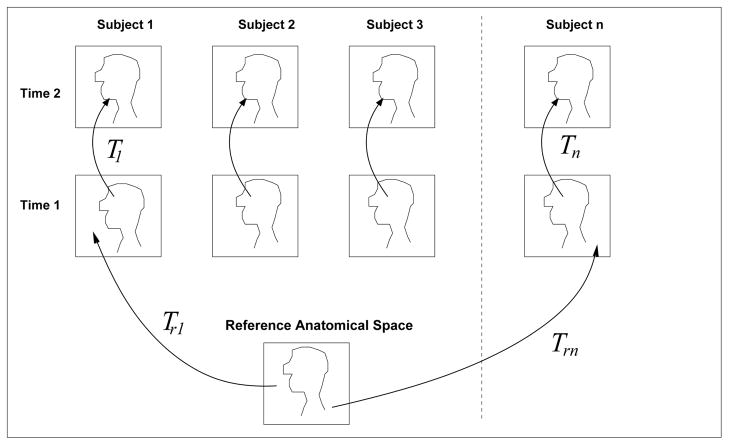
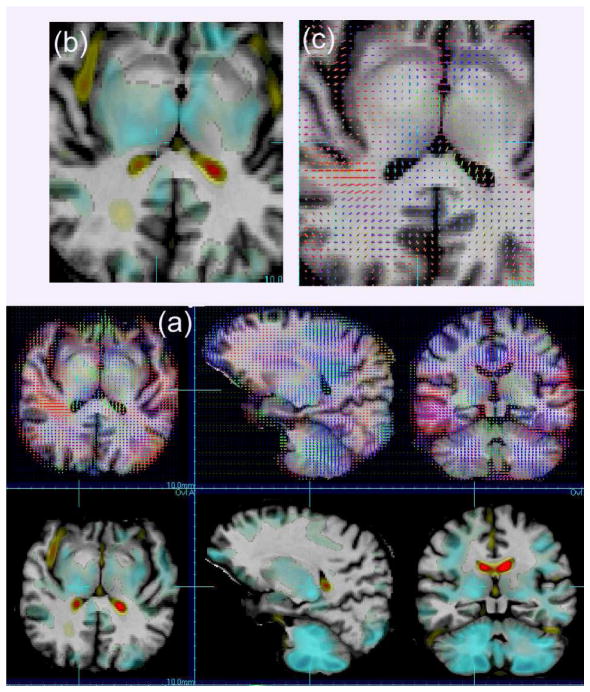
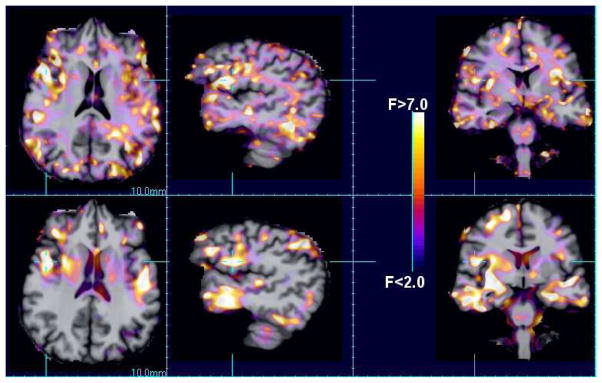
Deformation morphometry provides a sensitive approach to detecting and mapping subtle volume changes in the brain. Population based analyses of this data have been used successfully to detect characteristic changes in different neurodegenerative conditions. However, most studies have been limited to statistical mapping of the scalar volume change at each point in the brain, by evaluating the determinant of the Jacobian of the deformation field. In this paper we describe an approach to spatial normalisation and analysis of the full deformation tensor. The approach employs a spatial relocation and reorientation of tensors of each subject. Using the assumption of small changes, we use a linear modeling of effects of clinical variables on each deformation tensor component across a population. We illustrate the use of this approach by examining the pattern of significance and orientation of the volume change effects in recovery from alcohol abuse. Results show new local structure which was not apparent in the analysis of scalar volume changes.
变形形态测量学提供了一种灵敏的方法来检测和描绘大脑中细微的体积变化。基于人群对这些数据的分析已成功用于检测不同神经退行性疾病中的特征性变化。然而,大多数研究仅限于通过评估变形场雅可比行列式来对大脑中每个点的标量体积变化进行统计映射。在本文中,我们描述了一种对全变形张量进行空间归一化和分析的方法。该方法采用对每个受试者的张量进行空间重新定位和重新定向。利用小变化的假设,我们对临床变量对整个人群中每个变形张量分量的影响进行线性建模。我们通过检查酒精滥用恢复过程中体积变化效应的显著性模式和方向来说明该方法的应用。结果显示出在标量体积变化分析中不明显的新局部结构。